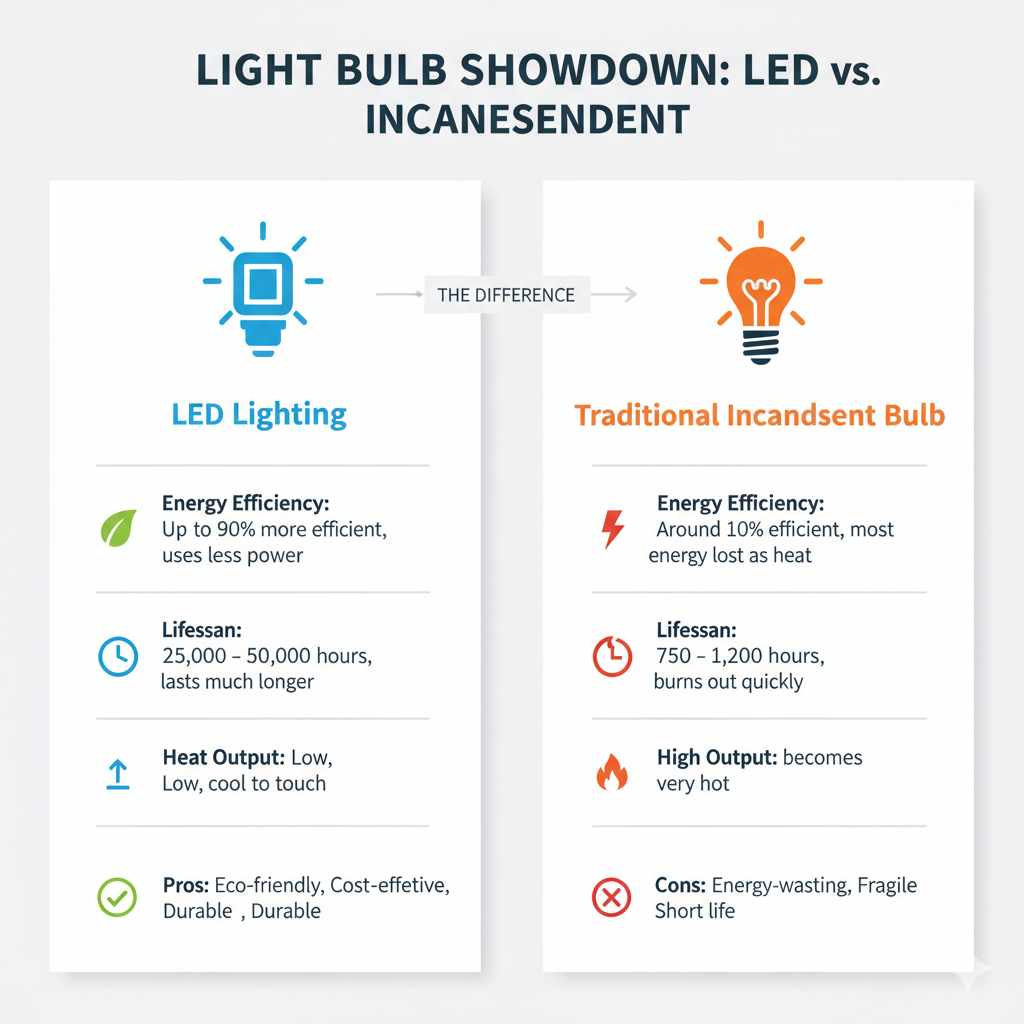
The main difference is technology: an LED (Light Emitting Diode) is a modern lighting technology using semiconductors to create light, while “light bulb” usually refers to older technologies like incandescent bulbs that create light by heating a filament. LEDs use far less energy and last much longer.
Got a burned-out bulb in your car, your garage, or even your home? You might notice options like “LED” and “traditional bulb” being thrown around. It can feel confusing trying to figure out which one to buy, especially when they look similar but cost different amounts. Worry not! We are going to break down exactly what is the difference between LED and light bulb using simple terms that anyone can understand. By the end of this guide, you’ll be choosing the right light source for your needs with total confidence. Let’s clear up the confusion and get you shining brightly!
Understanding the Basics: What Are We Even Comparing?
When people ask about the difference between LEDs and standard light bulbs, they are usually comparing new technology against old technology. Think of it like comparing a modern smartphone to an old rotary phone—they both make calls, but the internal workings and efficiency are worlds apart.
The Traditional Incandescent Bulb: The Old Faithful
For nearly a century, the standard light bulb in most homes and older cars was the incandescent bulb. These are the ones that get surprisingly hot to the touch when they’ve been on for a while.
How Incandescent Bulbs Work (Keep It Simple!)
The design is actually quite basic. Inside the glass shell, there is a thin wire, usually made of tungsten, called a filament.
- Electricity flows into the filament.
- The tungsten filament heats up intensely because it resists the flow of electricity.
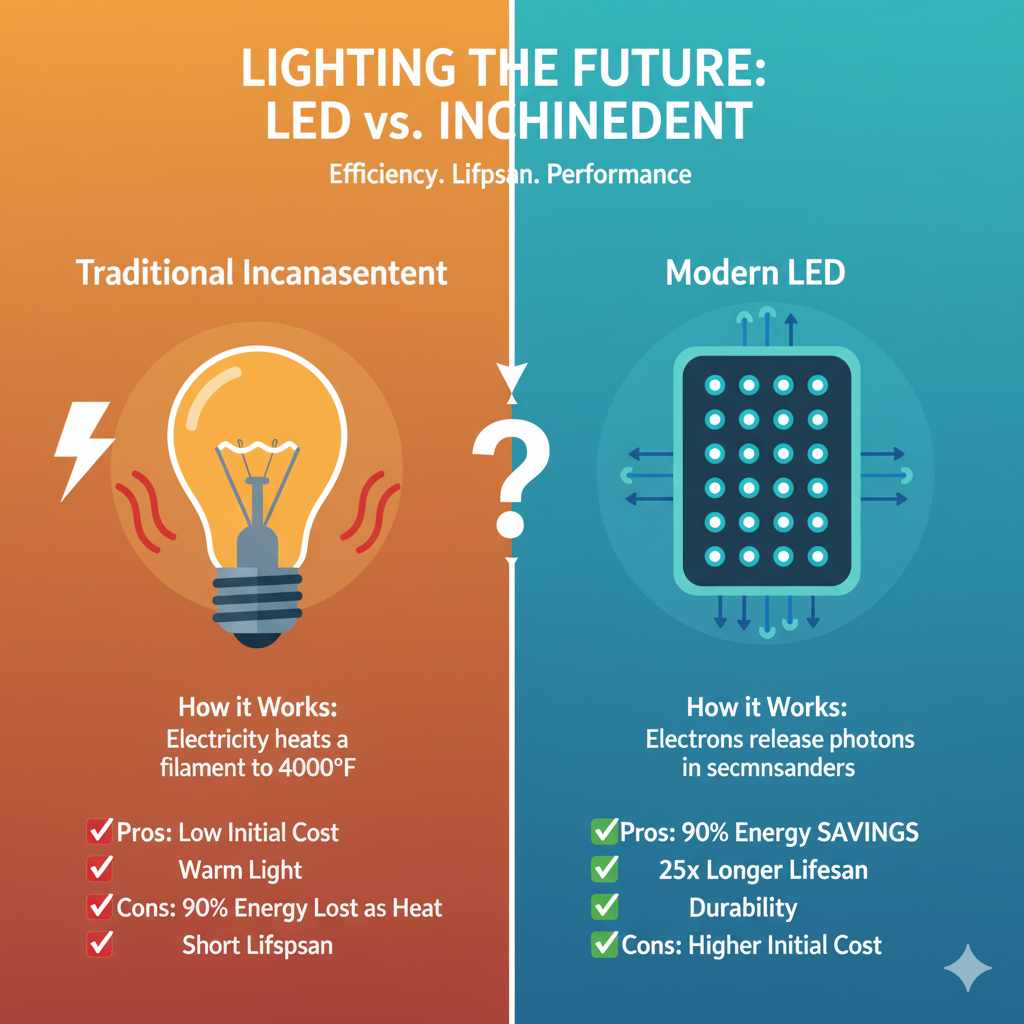
- When the filament gets super hot (around 4,000 degrees Fahrenheit!), it glows brightly, producing visible light.
The Downside to Heating Things Up
While these bulbs are cheap to buy initially, they waste a huge amount of energy. About 90% of the electricity they use turns into heat, not light! This is why they burn out relatively quickly and make your energy bills higher.
The LED: The Modern Marvel
LED stands for Light Emitting Diode. These are not just improved old bulbs; they use a completely different, solid-state method to create light.
How LEDs Produce Light
Instead of heating a wire, LEDs use tiny semiconductor chips.
- When electricity passes through the semiconductor material (the diode), it excites electrons.
- As these electrons settle back down to a lower energy level, they release energy in the form of photons—which is light!
Because the process involves moving electrons rather than boiling metal, LEDs produce very little heat, making them incredibly efficient and durable.
The Core Showdown: What Is The Difference Between LED And Light Bulb?
Now that we know how each one works, let’s put them side-by-side. This is often the most important part for making a smart purchase, whether for your car’s interior map light or your home living room.
1. Energy Efficiency and Cost Savings
This is usually the biggest selling point for switching to LEDs.
Incandescent Efficiency
They are energy hogs. If you compare a 60-watt incandescent bulb to an LED that produces the same amount of brightness (lumens), the LED might only use 8 or 9 watts. That is a massive saving!
LED Efficiency
LEDs are champions of efficiency. They convert electricity into light far more effectively. Over the lifespan of one LED bulb, you can save significant money just on your utility bills. This initial higher cost for an LED quickly pays for itself.
2. Lifespan: How Long Will They Last?
If you hate constantly climbing ladders or fiddling behind your dashboard to change a light, lifespan matters!
Incandescent Lifespan
These bulbs typically last for about 750 to 2,000 hours of use. The constant heating and cooling cycles cause the thin tungsten filament to slowly break down until it snaps.
LED Lifespan
LEDs are built to last. Most quality LEDs are rated for 25,000 to 50,000 hours or more. That could mean years of use without ever touching it! This increased durability is why they are often the choice for hard-to-reach spots in vehicles.
3. Heat Output: Cool vs. Hot
This difference is key for safety and comfort.
Incandescent: Very hot. Can cause burns if touched and adds unnecessary heat to a room or vehicle cabin.
LED: Very cool. They put out almost no radiant heat, making them safer to handle immediately after being on.
4. Durability and Shock Resistance
Since we are talking about cars, durability is huge. Road bumps, vibrations, and minor impacts can quickly jar an old bulb loose.
Incandescent: Fragile. They rely on glass envelopes and delicate internal filaments that are easily broken by shock or vibration.
LED: Tough. Since they are solid-state technology (no delicate internal moving parts or filaments), they handle vibration, shocks, and minor drops much better. This makes them ideal for automotive lighting.
Quick Comparison Table: LED vs. Traditional Bulb
To make the differences crystal clear, here is a simple table summarizing the vital features.
| Feature | Traditional Incandescent Bulb | LED Bulb |
|---|---|---|
| Light Source Mechanism | Heating a tungsten filament | Flowing electricity through a semiconductor (diode) |
| Energy Use (for same brightness) | High (Lots of wasted heat) | Very Low (Highly efficient) |
| Average Lifespan | 750 – 2,000 hours | 25,000 – 50,000+ hours |
| Heat Produced | Very High | Very Low |
| Durability | Fragile; sensitive to vibration | Extremely durable; shock-resistant |
| Initial Cost | Very Low | Higher |
Why This Matters for Your Vehicle Maintenance
When you open your car’s owner’s manual or seek parts online, you will see terms like 9005, H11, or 3157. These refer to the bulb base type, but you must choose the technology: incandescent (older style) or LED (modern replacement).
Choosing Headlights and Brake Lights
While many vehicles come stock with halogen-incandescent bulbs in the headlights, upgrading to LED headlights is a popular and functional modification.
Key Automotive Advantage: Instant-On Brightness.
When you hit the brakes, you want your brake lights to activate instantly. Because LEDs use less power and switch on almost immediately (unlike an incandescent that needs a split second to heat its filament), they offer a slight but meaningful improvement in reaction time for drivers behind you. This is a safety feature supported by many modern vehicle manufacturers.
Interior and Accent Lights
For dome lights, map lights, or trunk lights, LEDs are a no-brainer replacement.
- Less Battery Drain: If you leave a courtesy light on accidentally, an LED draws so little power that it is far less likely to completely drain your car battery than an older bulb.
- Color Options: LEDs come in crisp white (often mimicking daylight), which looks cleaner than the yellowish glow of older bulbs. You can also find specialty colors for custom looks, though always check local laws regarding colors used for essential signaling lights (like brake or turn signals).
Diving Deeper: Color Temperature and Light Quality
Another important difference that affects how things look—whether you are illuminating your workshop or your vehicle’s dashboard—is the color of the light produced. This is measured in Kelvins (K).
Understanding Kelvin (K) Ratings
Think of Kelvin ratings like a spectrum from blue/cool to orange/warm.
Warm White (2700K – 3000K): This mimics the soft, yellowish glow you get from a traditional incandescent bulb. It feels cozy but might look slightly dim for detailed work.
Natural/Neutral White (3500K – 4500K): A balanced light, great for general-purpose use where you need good visibility without harshness.
Cool White/Daylight (5000K – 6500K): This is a bright, blue-white light that reveals maximum contrast. Many modern vehicle headlights and high-powered work lights use this spectrum because it helps drivers see details clearly.
LEDs offer precise control over these Kelvin ratings, whereas older bulbs naturally default to a lower, warmer rating because of how the filament glows.
Safety and Regulatory Checks (Especially for Cars)
When replacing bulbs in your car, always remember that lighting is critical for safety and is regulated by state and national bodies.
Legal Considerations
Before swapping out any exterior bulb for an LED replacement, it is smart to check local Department of Motor Vehicles (DMV) guidelines or talk to certified professionals. For example, in many jurisdictions, using LED bulbs in housings designed for halogen bulbs can cause issues if:
- The beam pattern is incorrectly focused, blinding oncoming drivers.
- The bulb flickers or flashes improperly, confusing the turn signal system.
For more official guidance on proper vehicle lighting standards, you can often reference standards provided by organizations like the National Highway Traffic Safety Administration (NHTSA) website, which outlines vital safety requirements for automotive components. The general rule is: if you upgrade, ensure the replacement bulb fits the housing correctly and maintains the proper light pattern.
The Longevity Factor: How Heat Kills Electronics
One common misconception is that just because LEDs are durable, they will last forever. They do degrade, but very slowly, and heat is their biggest enemy—even though they don’t produce much heat!
The Driver Component
LEDs require a small internal circuit board or “driver” to manage the incoming voltage from your car or home and convert it into the precise low voltage the diode needs.
If this driver overheats (because it’s crammed into a sealed headlight assembly that gets hot from the engine bay, for instance), the driver components will fail first, causing the light to stop working long before the actual diode wears out.
This is why buying high-quality, name-brand LED replacements with good heat sinks (the metal fins on the base that draw heat away) is worth the extra cost. They are designed to manage that small amount of heat effectively.
Practical Steps: Making the Switch From Old to New
If you’ve decided that the benefits of LED—efficiency, lifespan, and clarity—outweigh the higher initial price, here is a simple approach to switching:
Step 1: Identify the Bulb Type
You need to know the exact type your vehicle or fixture currently uses.
- In Your Car: Check your owner’s manual. It will list the bulb type (e.g., H7, 1157) for headlights, brake lights, and interior lights.
- In Your Home: Look at the base of the existing bulb for markings, or check the fixture itself for the maximum wattage rating (which often gives a clue as to the bulb type it accepts).
Step 2: Research Quality Replacements
When shopping for “what is the difference between led and light bulb,” you are inherently comparing quality levels. Don’t just buy the cheapest LED bulb.
Look for:
- High lumen rating (brightness) relative to low wattage draw, confirming efficiency.
- Good heat dissipation features (often visible heat sinks).
- Positive reviews regarding longevity and color accuracy.
Step 3: Safe Removal of the Old Bulb
SAFETY FIRST! Always ensure the power is OFF. If you are working on a hot bulb (like a headlight that was just running), let it cool down completely.
For exterior lights, you might need to unclip a retaining wire or twist the socket base counter-clockwise.
For interior lights, they usually just pull straight out or twist slightly.
Step 4: Installing the New LED
LEDs sometimes require a slightly different touch.
- Orientation Matters: Unlike an incandescent bulb that shines light in all directions, most LED replacements shine light primarily from one or two sides. Make sure the LED chips are positioned facing the direction your old bulb faced.
- Secure the Fit: Gently push or twist the LED base until it locks securely into the socket.
- Test Before Reassembling: Before putting a cover or housing back on, briefly turn on the light switch to ensure the LED works and is pointing correctly.
Summary of Advantages: Why Choose One Over the Other?
To help you make the final decision, consider these simple pros and cons. You are choosing between proven history and modern superior performance.
Reasons to Stick with Traditional Incandescent (The Pros)
Despite their flaws, incumbencies still have a place for some users or applications:
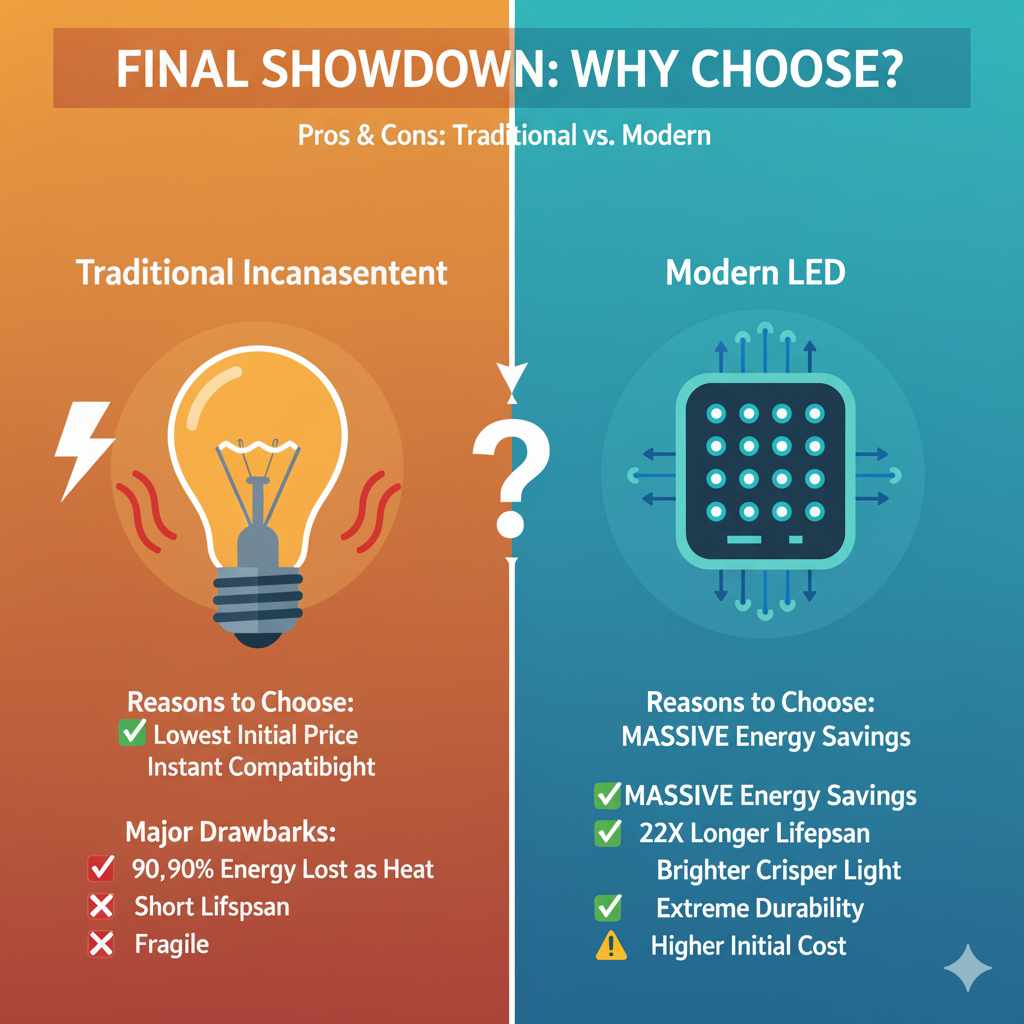
- Lowest Initial Purchase Price: They cost next to nothing at the store or auto parts counter.
- Instant Compatibility: They plug right into any socket designed for them without needing any extra drivers or resistors.
- Familiar Light Quality: Some people strongly prefer the warm, slightly dimmer quality of traditional light.
Reasons to Embrace LED (The Overwhelming Pros)
For reliability, efficiency, and longevity, LEDs win almost every time:
- Massive Energy Savings: Reduces load on your vehicle’s alternator or your home’s electrical system.
- Unmatched Lifespan: Fewer replacements mean less maintenance hassle and cost over time.
- Better Light Quality: Brighter, crisper light output, especially important for seeing the road clearly.
- Durability: Excellent resistance to vibration, perfect for cars, trucks, and rough environments.
Frequently Asked Questions (FAQ) for Beginners
Q1: Can I use an LED bulb in a fixture designed for an incandescent bulb?
A: In most cases, yes, as long as the base fits perfectly (e.g., an E26 screw base). However, for cars, you must ensure the LED replacement is designed to fit the specific socket and that it doesn’t cause errors like “bulb out” warnings on your dashboard.
Q2: Are LED bulbs really that much brighter than old bulbs?
A: LEDs are often brighter when comparing wattage, but what matters more is the lumen count. A 9-watt LED can easily produce the same amount of usable light (lumens) as a 60-watt incandescent bulb, perhaps even focusing that light better in the forward direction.
Q3: Why are LED bulbs more expensive upfront?
A: The higher cost comes from the advanced microchip technology, better internal wiring, and the necessary components (like heat sinks and drivers) needed to manage the electricity safely. You pay more for the superior engineering.
Q4: Do LED lights get hot at all?
A: Yes, they generate a small amount of heat, but crucially, they do not radiate it forward like an incandescent bulb does. All the heat generated is concentrated at the base and must be dissipated via a built-in heat sink. They only feel slightly warm to the touch, not burning hot.
Q5: If I replace my headlights with LEDs, will my car automatically adjust the beam?
A: No. If you buy “drop-in” LED conversion kits for halogen housings, the light might scatter poorly. For proper safety and focusing, it is always best to buy headlight assemblies that were designed from the factory specifically for LED use, if available for your vehicle.
Q6: Do LEDs wear out suddenly like traditional bulbs?
A: Incandescents usually fail suddenly when the filament breaks. LEDs typically experience “lumen depreciation”—they gradually get slightly dimmer over many years, rather than one day just failing completely.
Conclusion: Making a Confident Lighting Choice
We’ve covered the fundamentals: what is the difference between LED and light bulb comes down to the technology used to generate light—heating metal versus moving electrons. While the traditional incandescent bulb has served us well for decades, the modern LED offers undeniable advantages in efficiency, lifespan, durability, and light quality.
For the everyday driver or homeowner looking to save money on energy and spend less time on maintenance ladders or under the hood, making the switch to LED is a straightforward, wise upgrade. Start small—replace the interior dome lights first—and you will quickly see the difference in clarity and performance. You now have the knowledge to choose the right light source every time with total confidence. Happy driving and happy lighting!