
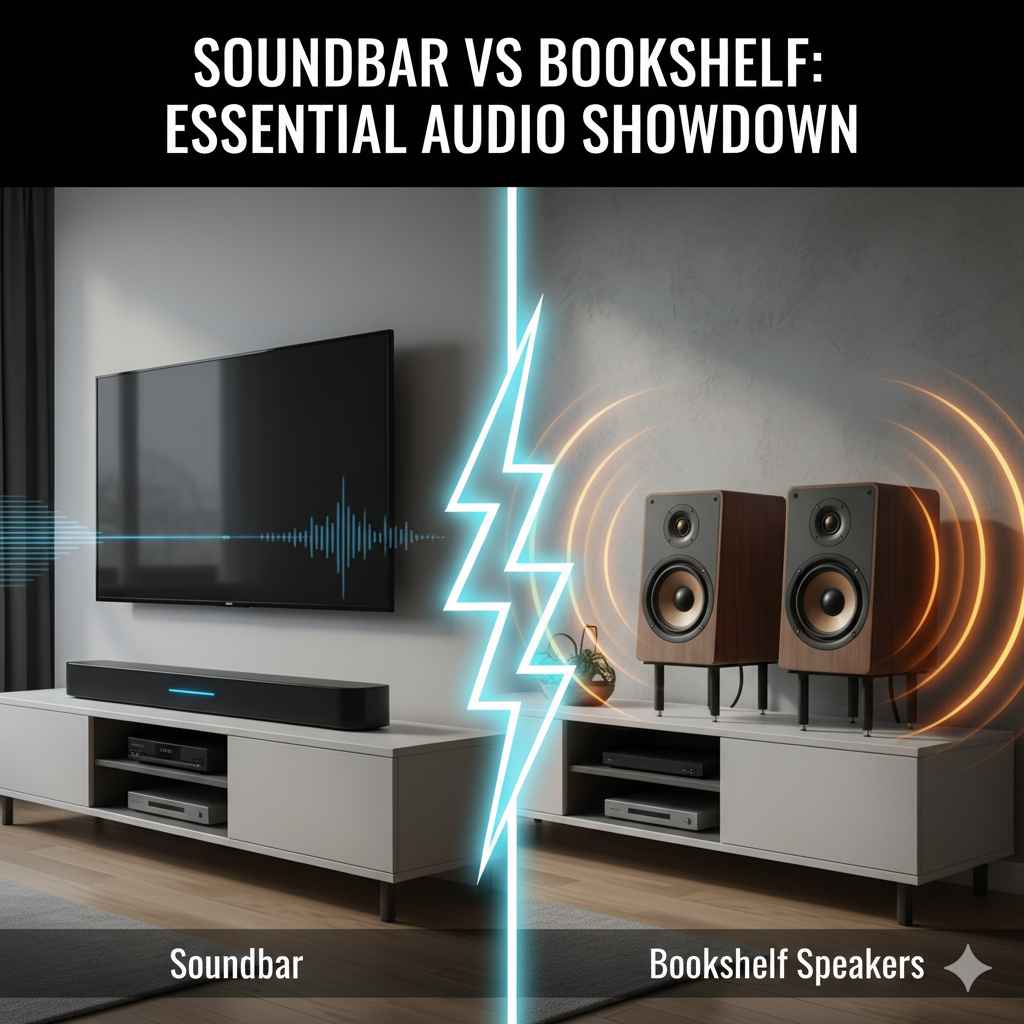
Soundbar vs Bookshelf: For clear, powerful home audio, the best choice depends on your space and budget. Soundbars offer simplicity and slim design, ideal for smaller rooms, while Bookshelf speakers deliver superior stereo separation and sound depth, earning them the win for true audiophiles willing to manage wires and space.

Polk Audio
Polk Audio T15 100 Watt Home Theater…
- EXPERIENCE AMAZING HOME THEATER SOUND WITH RICH, IMMERSIVE AUDIO – Featuring a 0.75" tweeter and a 5.25" Dynamic Balance driver, t…
- Use these wall-mountable bookshelf speakers as front, left-right, or rear for a surround sound system in your home theater setup a…
- Start your home theater journey with these Polk audio speakers then expand to a full 5.1 setup by adding T50 towers, T30 center ch…
As an Amazon Associate I earn from qualifying purchases.
For a closely related home or decor topic, How To Store Books Without A Bookshelf Creatively gives readers a useful next step.
Hey there! Dustin here. Upgrading the sound in your living room or office can feel like a confusing maze, especially when you see all those sleek boxes promising amazing audio. Two big names always pop up: the modern soundbar and the classic bookshelf speaker setup. Which one is right for your ride—I mean, your room? It’s easy to scratch your head wondering if you need complex setups or simple plugs. Don’t worry! We’re going to break this down simply, just like checking your tire pressure. By the end of this, you’ll confidently choose the perfect audio companion for your home theater or music setup.
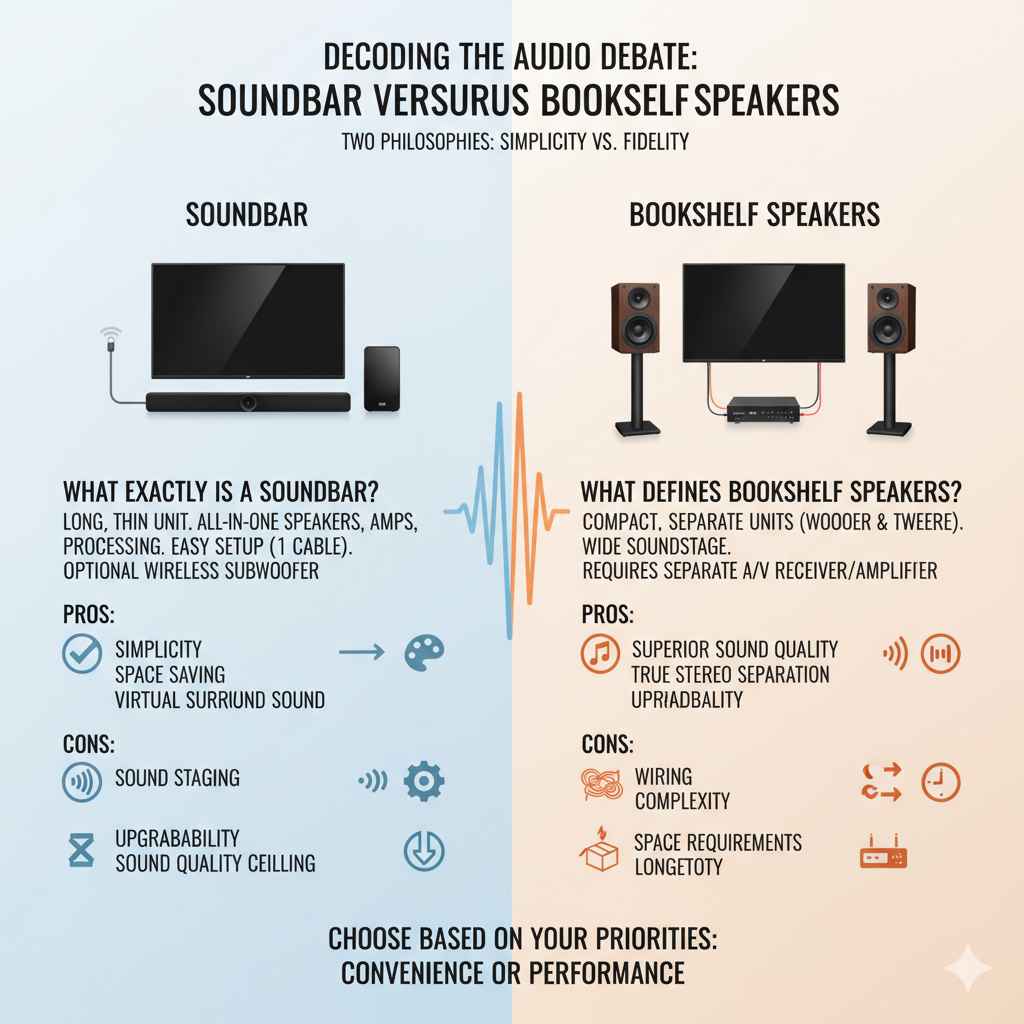
Decoding the Audio Debate: Soundbar Versus Bookshelf Speakers
When we talk about home audio, we are really comparing two different philosophies. One focuses on blending in seamlessly, while the other aims to deliver the best possible sound quality, even if it takes up a bit more real estate. Understanding the core design helps set the stage for our big showdown.
What Exactly is a Soundbar?
Think of a soundbar as a long, thin speaker unit you usually place right below your TV. These units are designed for convenience. Everything—the speakers, the amplifiers, and the processing tech—is packed into one slim enclosure.
They are the audio equivalent of an all-in-one tool kit. They need minimal space and usually connect to your TV with just one easy cable (like an HDMI cable). Many modern soundbars also come with a separate subwoofer delivered wirelessly, which handles those deep, rumbling bass notes.
Pros of Choosing a Soundbar:
- Simplicity: Very easy setup. Usually just plug and play.
- Space Saving: Slim profile fits perfectly under flat-screen TVs without blocking the screen.
- Aesthetics: They look clean and modern, blending into décor easily.
- Virtual Surround Sound: Many models use clever processing to mimic surround sound effects from a single bar.
Cons of Choosing a Soundbar:
- Sound Staging: Because the left and right channels are physically close, true stereo separation is limited.
- Upgradability: You generally can’t swap out individual components later (like upgrading just the tweeter).
- Sound Quality Ceiling: While great for the money, they rarely reach the peak sound quality of dedicated speaker systems.
What Defines Bookshelf Speakers?
Bookshelf speakers are compact, passive, or active speakers designed to sit on stands, shelves, or dedicated audio racks. They are called “bookshelf” speakers because they traditionally fit neatly on a standard shelf, though most audio enthusiasts prefer placing them on dedicated stands for optimal sound height.
These are designed as true separate units, often including a dedicated woofer for bass and a tweeter for high notes (a 2-way design). Since they are separate units, you get a wide “soundstage”—the ability to accurately place where sounds are coming from in your listening area. They almost always require a separate Audio/Video (A/V) receiver or integrated amplifier to power them.
Pros of Choosing Bookshelf Speakers:
- Superior Sound Quality: Better clarity, deeper bass response, and wider dynamic range due to larger drivers.
- True Stereo Separation: Separating the left and right speakers creates a realistic, immersive sound image.
- Upgradability: You can constantly upgrade your amplifier or swap speakers down the line.
- Longevity: Well-built passive speakers can last for decades.
Cons of Choosing Bookshelf Speakers:
- Wiring Complexity: You must run speaker wires from the receiver to each speaker.
- Space Requirements: They take up more physical space than a single soundbar.
- Extra Equipment: They almost always require an external amplifier or receiver, increasing the initial cost and footprint.
The Showdown: Key Comparison Factors (Soundbar vs Bookshelf)
To make this comparison crystal clear, let’s look at how these two systems stack up against each other in the areas that matter most to everyday listeners. Think of this as a side-by-side inspection of two different engine types—both get you where you need to go, but one is smoother and faster.
1. Sound Quality and Immersion
This is where the biggest difference usually lies. Bookshelf speakers, by separating the left and right channels widely, inherently offer better imaging. This means music sounds like musicians are actually standing in front of you, not pooled together in a center spot.
A good pair of two-way bookshelf speakers, powered by a decent receiver, will almost always outperform a standard soundbar in clarity, detail retrieval, and dynamic range (the difference between the quietest and loudest parts of the sound).
Soundbars overcome this separation issue by using digital signal processing (DSP) to trick your ears into hearing width. While high-end Atmos soundbars are getting remarkably good, they often rely on ceiling or wall bouncing to achieve height effects, which isn’t always perfect. For pure, detailed music listening, bookshelves win.
2. Installation and Ease of Use
If you hate reading manuals, the soundbar is your best friend. Installation often involves plugging in power and connecting one HDMI cable (check out resources like Consumer Technology Association (CTA) guidelines for HDMI best practices). Setup apps make configuration quick.
Bookshelf speakers require a bit more homework. You need to select an amplifier, figure out speaker placement (a crucial step!), and correctly strip and connect speaker wire ends to the speaker terminals and the receiver terminals. It takes patience, which is why many beginners shy away.
3. Aesthetics and Space Management
If you live in a smaller apartment or your significant other demands clean lines, the soundbar wins easily. It hides away neatly under the TV, staying unobtrusive.
Bookshelf speakers demand dedicated surface area—either on stands or sturdy furniture—and they require space between them to create that beautiful soundstage. If your goal is minimalist home décor, the wires and boxes of a full bookshelf system can be a hurdle.
4. Cost Considerations (Total Investment)
This is a tricky category because costs vary wildly. A budget soundbar might cost $150. A high-end Sonos or JBL soundbar plus a wireless sub can easily hit $1,000 or more.
For bookshelves, you can buy a fantastic entry-level pair of passive speakers for $300. However, you must add a receiver. A decent entry-level A/V receiver adds another $300–$500 minimum. So, while the speakers themselves might seem cheap, the supporting gear adds significant cost quickly.
Cost Comparison Snapshot: Entry-Level to Mid-Range
| System Type | Component Example | Estimated Cost Range (USD) |
|---|---|---|
| Basic Soundbar Setup | Single Bar + Wireless Sub | $150 – $400 |
| Mid-Range Soundbar System | Bar + Sub + Optional Rears (Dolby Atmos) | $500 – $1,200 |
| Entry-Level Bookshelf System (Passive) | 2 Speakers + Basic 5.1 Receiver | $600 – $1,000 |
| Quality Bookshelf System (Active) | 2 Powered Bookshelf Speakers (No Receiver Needed) | $400 – $800 |
Deep Dive: When to Pick a Soundbar (The Simple Path)
Soundbars have made massive strides in the last decade. They aren’t just glorified TV speakers anymore; modern versions offer excellent performance for the casual viewer.
Use Case 1: Improving Standard TV Audio Dramatically
Most people buy a soundbar because they are tired of watching intense movie scenes where dialogue gets drowned out by explosions, or they just can’t hear quiet voices in shows. A soundbar instantly fixes this. The dedicated center channel speaker inside the bar focuses on dialogue clarity, making conversations much easier to follow.
Use Case 2: Small Spaces or Bedrooms
If you have a 32-inch TV in a small office or a bedroom where you can’t possibly place two speakers 6 feet apart, a soundbar fits perfectly. Its compact nature means it works with minimal room acoustics interaction.
Use Case 3: Minimalist Wires Required
If you actively dislike wires, sticking to a main soundbar and a simple optical or HDMI connection is the easiest way to go. If you step up to Dolby Atmos soundbars, you might get a few extra wireless components (like small rear speakers), but the overall wire mess is still drastically smaller than a traditional setup.
Tips for Maximizing Your Soundbar:
- Use HDMI ARC/eARC: Always connect via HDMI if your TV supports ARC (Audio Return Channel) or eARC. This allows your TV remote to control the soundbar volume natively.
- Placement Matters: Ensure the soundbar is not sitting on deep carpet or near objects that can vibrate excessively, as this muddies the sound.
- Check for Virtualization: If you want surround, look for bars with Dolby Atmos and DTS:X support, which use upward and side-firing speakers to bounce sound around the room.
Deep Dive: When to Pick Bookshelf Speakers (The Audiophile Path)
If your goal is to truly hear your music—to pick out individual instruments during a symphony or feel the punch of a kick drum—then dedicated bookshelf speakers are the route to take. They offer a level of fidelity that single-unit systems struggle to match.
Use Case 1: Serious Music Listening
For those who listen to music as their primary focus for home audio, nothing beats a well-matched pair of stereo bookshelf speakers (Left and Right). The physics of having separate enclosures allows for better driver excursion (cone movement) and cleaner sound reproduction across the frequency range.
Use Case 2: Building a True Home Theater
If you plan to expand later into a 5.1 or 7.1 surround system, starting with quality bookshelf speakers for your Front Left and Front Right channels is the best foundation. They will serve you well for years, even as you upgrade other components like receivers or the subwoofer.
Use Case 3: Longevity and Customization
Bookshelf speakers (especially passive ones) are often built like tanks. They don’t rely on one proprietary digital processor that might become obsolete in five years. You can match them to any new receiver you buy later, providing excellent long-term value.
Essential Steps for Setting Up Bookshelf Speakers
Getting great sound from bookshelves requires attention to setup—it’s not just about plugging them in. Think about this like getting your wheel alignment right; small adjustments make a huge difference in performance.
- Speaker Placement (The Golden Rule): Experts often recommend positioning your two main speakers so they form an equilateral triangle with your main listening spot. This optimal setup maximizes the sweet spot.
- Toe-In Adjustment: Angle the speakers slightly inwards so they point toward a spot just behind your head. This helps focus the center image.
- Acoustic Treatment (Optional but helpful): Placing small isolation pads or spikes under the speakers prevents vibrations from traveling into your furniture, resulting in cleaner bass according to established acoustic guidelines.
- Wire Management: Use good quality, appropriately gauged speaker wire. Strip the ends carefully—no stray strands should touch each other or the metal casing of the receiver terminal.
Active vs. Passive Bookshelf Speakers: An Important Distinction
Before you commit to the bookshelf route, you must understand the difference between active and passive speakers, as this impacts your required components.
Passive Speakers: These are the traditional type. They have no built-in amplifier. They must be connected to an external receiver or amplifier to power them. This gives you maximum flexibility but requires more gear.
Active Speakers (Powered Monitors): These have small amplifiers built right into one of the speakers (usually the right speaker). The left speaker connects to the right speaker via a short RCA or proprietary cable. They connect directly to your TV or source device, bypassing the need for a large A/V receiver. These blur the line closer to the convenience of a soundbar but retain the superior stereo separation of two discrete boxes.
For beginners looking to step up from a soundbar without the commitment of a full A/V receiver rig, Active Bookshelf Speakers are often the perfect intermediary solution.
Choosing the Right System for Your Needs (Decision Matrix)
To help you land on a confident decision, use this matrix. Ask yourself honestly: What is my top priority?
| If Your Priority Is… | The Better Choice Is… | Why? |
|---|---|---|
| Maximum Simplicity & Minimal Wires | Soundbar | All-in-one solution, small footprint, one-cable connection. |
| Best Possible Music Fidelity | Bookshelf Speakers (Passive + Receiver) | Superior stereo separation and dynamic range delivery. |
| Upgrading an Existing TV Setup | Soundbar (especially Atmos models) | It integrates easily with modern TV features like HDMI ARC. |
| Flexibility to Upgrade Over Time | Bookshelf Speakers (Passive) | You can swap speakers or receivers independently later. |
| Best “Jump Up” Without a Receiver | Active Bookshelf Speakers | Great sound separation with built-in amplification for easy pairing. |
Understanding Specific Technology: Atmos and Virtualization
When shopping, you will see terms like “Dolby Atmos” thrown around for both camps. It’s important to know what that means in context.
Atmos in Soundbars
Most soundbars achieve Atmos (which adds height and overhead effects) by using upward-firing speakers aimed at your ceiling. The sound bounces off the ceiling and down to your ears. This works best if you have low, flat ceilings and are sitting directly in front of the bar. If you have vaulted ceilings or sit far off-center, the effect often diminishes or disappears.
Atmos in Bookshelf Systems
In a true bookshelf setup, achieving actual immersive height requires physically placing dedicated upward-firing modules (called elevation speakers) on top of your front bookshelves, or mounting speakers in the ceiling. This provides a much more accurate and convincing overhead effect because the source of the height audio is physically separated and aimed correctly.
If you are serious about cinematic immersion—the kind that makes you duck when a helicopter flies over—a full receiver-based speaker setup remains the gold standard, leveraging standards maintained by organizations like the Dolby Laboratories.
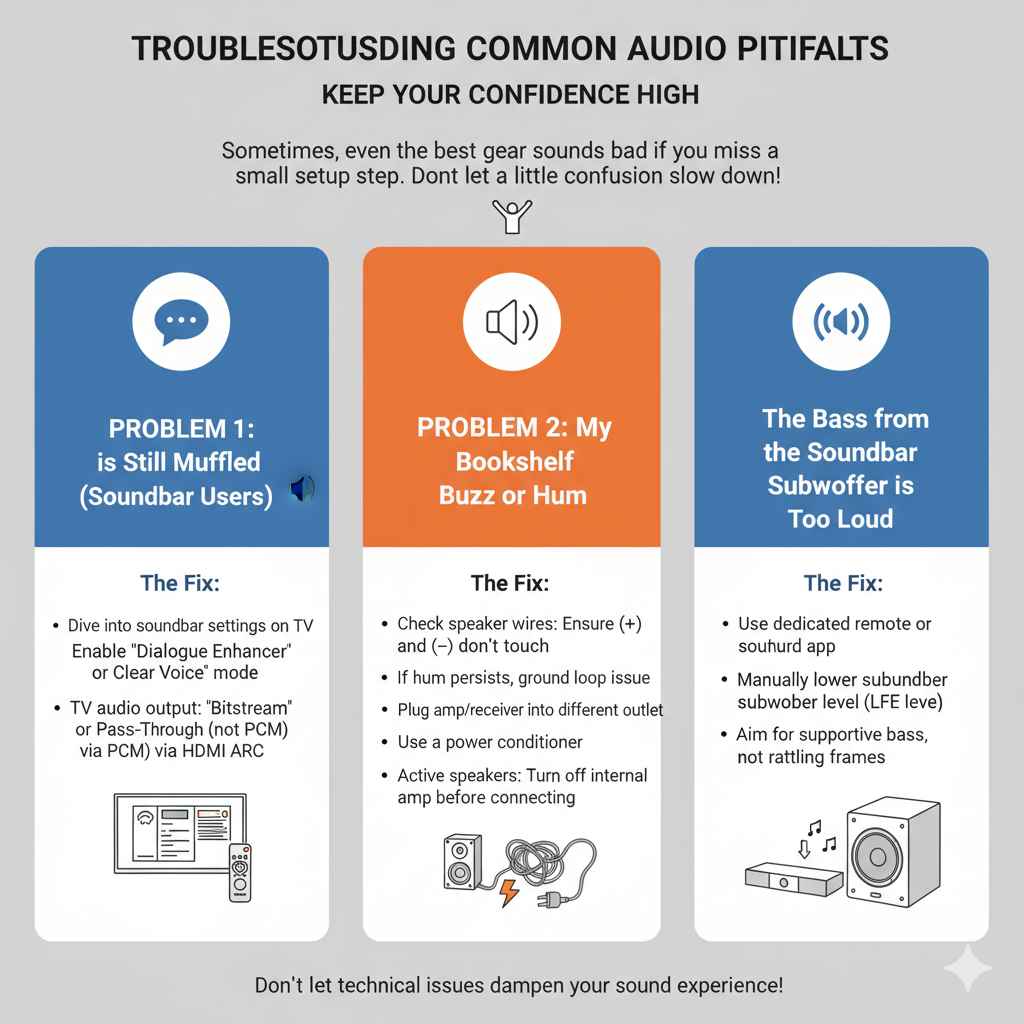
Troubleshooting Common Audio Pitfalls (Keep Your Confidence High)
Sometimes, even the best gear sounds bad if you miss a small setup step. Don’t let a little confusion slow you down!
Problem 1: Dialogue is Still Muffled (Soundbar Users)
The Fix: Dive into the soundbar’s settings menu on your TV. Most soundbars have a specific “Dialogue Enhancer” or “Clear Voice” mode. Turn this up. Also, check your TV’s audio output setting—make sure it is set to “Bitstream” or “Pass-Through” rather than PCM if you are using HDMI ARC, to ensure the soundbar gets the full signal.
Problem 2: My Bookshelf Speakers Buzz or Hum
The Fix: This is often an interference or ground loop issue. First, check the speaker wires—ensure the bare positive wire (+) is not touching the negative wire (-) or the metal casing of the receiver. If the hum persists, you might have a ground loop. Try plugging your amplifier/receiver into a different outlet or using a power conditioner. If you are using active speakers, ensure the internal amplifier is turned off before connecting any cables.
Problem 3: The Bass from the Soundbar Subwoofer is Too Loud
The Fix: Soundbar subwoofers are often tuned aggressively for movies right out of the box. Use the dedicated remote or the soundbar’s app to manually lower the subwoofer level (sometimes called LFE level). Aim for bass that supports the action, not bass that rattles the picture frames.
Frequently Asked Questions (FAQs)
Q1: Can a soundbar ever sound as good as bookshelf speakers?
A: For pure music fidelity and stereo imaging, a traditional pair of bookshelf speakers will almost always outperform a soundbar. The physical separation of two speakers creates a wider, more realistic soundstage. However, high-end Atmos soundbars can come impressively close for movies and casual listening.
Q2: Do I need a subwoofer with bookshelf speakers?
A: Not always, but it helps. Many bookshelf speakers handle mids and highs beautifully but can’t reproduce deep bass below 50–60Hz effectively. Adding a dedicated subwoofer fills in that low-end punch, especially for movies, gaming, and bass-heavy music genres.
Q3: Are active bookshelf speakers better than passive ones?
A: It depends on your goal.
- Active (powered) speakers are easier to set up since they have built-in amplifiers.
- Passive speakers require a receiver but offer more flexibility and long-term upgrade potential.
For beginners who want better sound than a soundbar without a full receiver setup, active bookshelf speakers are a fantastic middle ground.
Q4: Which option is better for apartments or small rooms?
A: Soundbars usually win for compact spaces. They require less separation distance and create minimal clutter. Bookshelf speakers need room to breathe — ideally spaced 5–8 feet apart — to perform at their best.
Q5: Is a receiver always required for bookshelf speakers?
A: Only for passive models. Passive bookshelf speakers must connect to an A/V receiver or integrated amplifier. Active bookshelf speakers do not need a receiver because amplification is built in.
Conclusion: Which One Should You Choose?
The soundbar vs bookshelf debate ultimately comes down to one simple question:
Do you prioritize simplicity or sound quality?
Choose a soundbar if:
- You want quick setup with minimal wires.
- You have limited space.
- Your main goal is improving TV dialogue and movie audio.
- Clean aesthetics matter most.
Choose bookshelf speakers if:
- You value immersive stereo separation.
- Music listening is a priority.
- You want long-term upgrade flexibility.
- You’re willing to manage extra components and space.
If you want the sweet spot between both worlds, active bookshelf speakers provide excellent sound with much simpler setup than a full receiver-based system.
At the end of the day, both options dramatically outperform built-in TV speakers. The right choice is the one that fits your room, budget, and listening habits. Upgrade wisely — your ears will thank you.
Related pick: Check today's price on Amazon