How to Tuft a Headboard: The Complete Engineering Guide
You’ve seen those plush, diamond-tufted headboards in hotel lobbies and designer catalogs. They look like they require a professional workshop and a decade of experience. The reality is more forgiving. With a sheet of plywood, some foam, fabric, and a long needle, you can build one over a weekend. The difference between a professional result and a saggy mess comes down to math and preparation, not luck.
This guide covers the full build process with a focus on structural integrity. You’ll learn how to calculate button spacing for any headboard size, layer foam and batting so the tufts hold their shape, and mount the finished piece so it doesn’t budge. We’ll also cover fixing popped buttons, working with arched tops, and what this project actually costs compared to buying one.

Unique Craft
Unique Craft Upholstery Repair Tufting Needle and…
- Kit Includes 4 Extra Large Needles for Tying Springs to Webbing, Sewing Edges, Stitching Through Padding, Tufting, Attaching Butto…
- Upholstery Sewing Needles are 4 sizes: 6-inch, and 8-inch, Ideal for Tying Springs to Webbing, Stitching Edges and Stitching Throu…
- 25 Yards of Black 5-Cord Waxed Button Thread is Smooth and Consistent and Will Not Stretch or Break. Ideal for hand stitching Fabr…
As an Amazon Associate I earn from qualifying purchases.
Before you start, pick up a proper tufting needle and thread kit. The Unique Craft upholstery repair kit includes four heavy-duty needles in 6, 8, 10, and 12-inch lengths, plus 25 yards of waxed button thread. The shorter needles handle stitching edges and springs, while the 12-inch one reaches through thick foam for button installation. The waxed thread won’t stretch, which matters when you’re pulling buttons tight against the backing.
Why Build a Tufted Headboard Yourself?
Store-bought tufted headboards often use thin plywood and low-density foam. They look fine in a showroom, but after a year of leaning against them, the buttons pull loose and the fabric wrinkles. Building your own lets you choose materials that last. You control the foam density, the fabric quality, and the mounting hardware.
There’s also the fit factor. Standard headboards come in set widths, but your bed frame might sit awkwardly against one. Custom-building lets you match the exact width of your bed frame plus any gap you want on the sides. You can also adjust the height so the headboard lands perfectly on your wall, accounting for baseboards and pillow thickness.
Cost matters too. A quality upholstered headboard from a furniture store runs several hundred dollars. The DIY route, with solid materials, often lands around half that. You’ll spend more time than money, but the result is a piece that’s structurally sound and sized exactly for your room.
Tools and Materials: The Complete Checklist
Gather everything before you start. Running to the hardware store mid-project breaks your workflow and increases the chance of mistakes.
- Plywood base: 3/4-inch thick, sanded plywood. A 4×8 sheet gives you enough for a queen or king headboard.
- Foam padding: 2-inch high-density foam for the main layer. Memory foam works too, but it’s softer and won’t hold deep tufts as crisply.
- Batting: 1-inch polyester batting, at least 2 layers for a smooth surface.
- Upholstery fabric: 3-4 yards for a queen headboard, more if you have a pattern that needs matching.
- Fabric buttons: 1-inch diameter, covered with your fabric. You’ll need one per tuft.
- Tufting needle and thread kit: The Unique Craft needle set covers this. The 12-inch needle is essential for getting through thick foam.
- Drill with a 3/8-inch bit for the button holes.
- Staple gun with 1/4-inch staples. An electric or pneumatic gun saves your hands.
- French cleats: Two 24-inch metal cleats rated for at least 100 pounds.
- Measuring tape, pencil, straight edge, scissors, and a utility knife.
One thing people overlook: a sharp utility knife blade. Cutting foam with a dull blade tears it, leaving uneven edges that show through the fabric. Replace the blade before you start.
Step 1: Design and Measure Your Headboard
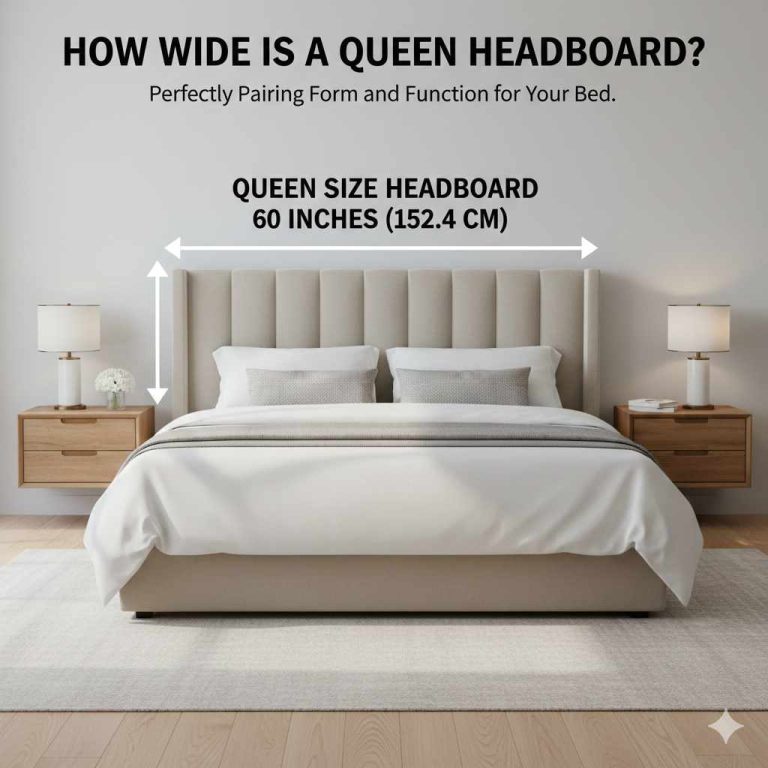
Start with the width. Measure your bed frame across the outside edges. A queen frame is typically 60-62 inches wide. Add 2-4 inches on each side if you want the headboard slightly wider. For a king, plan for 76-80 inches total width.
Height depends on your mattress and pillows. Sit against your pillow and measure from the floor to the top of your head. That’s your minimum height. Most people land between 48 and 60 inches tall. Add 2 inches so the headboard extends above your head when sitting up.
Draw your design on paper first. Mark the outer dimensions, then sketch the tufting pattern. This drawing becomes your reference for button placement, so be precise.
Choosing the Right Tufting Pattern (Diamond vs. Channel)
Diamond tufting creates the classic chevron pattern. Buttons sit in staggered rows, and the fabric folds between them to form diamond shapes. This pattern requires more buttons and more careful folding, but it’s the look most people picture when they hear “tufted headboard.”
Channel tufting runs vertical lines of buttons. The fabric folds into soft vertical ridges. It’s simpler to execute because you only manage one direction of folds. Channel tufting also uses fewer buttons, which means fewer holes to drill and less time spent pulling thread.
For a first project, channel tufting is the smarter choice. Diamond tufting looks better on curved or arched tops, but the learning curve is steeper. If you’re set on diamonds, plan for 20-30% more time and expect to re-fold several sections before they look right.
Calculating Button Placement with a Simple Formula
Button spacing isn’t arbitrary. The formula is straightforward: for diamond tufting, horizontal spacing should be 1.5 to 2 times the vertical spacing. This ratio creates the elongated diamond shape that looks elegant rather than squat.
Here’s the calculation method. Decide on your vertical spacing first. A common choice is 6 inches. For a 54-inch tall headboard, that gives you 9 rows (54 divided by 6). For horizontal spacing, multiply the vertical spacing by 1.75. So 6 inches times 1.75 equals 10.5 inches between buttons in a row.
For a 60-inch wide headboard, divide the width by the horizontal spacing. 60 divided by 10.5 is roughly 5.7. Round down to 5 buttons per row. That leaves extra space at the edges, which is fine. Center the pattern so the edge gaps are equal.
For channel tufting, keep vertical spacing at 6-8 inches and horizontal spacing at 4-6 inches. The channels should be narrower than the vertical gaps to create the ridged effect.
Draw the grid on your plywood with a pencil and straight edge. Mark each button location with an X. Double-check your math before drilling.
Step 2: Cut and Prep the Plywood Base
Cut your plywood to the dimensions from your drawing. A circular saw with a straight edge guide works well. For curved or arched tops, use a jigsaw and sand the edges smooth.
Sand the front face and all edges with 120-grit sandpaper. This removes splinters that can snag fabric. Wipe down the surface with a tack cloth to remove sawdust.
Apply a coat of primer or wood sealer to the front face. This prevents moisture from the foam or fabric from warping the wood over time. It also gives you a clean surface for marking your grid.
If you plan to mount the headboard on the wall, now is the time to attach the French cleat to the back. Position the cleat horizontally, centered, about 6-8 inches from the top edge. Use 1-inch wood screws through the cleat into the plywood. Make sure the screws don’t poke through the front face.
Step 3: Drill Holes and Create Button Depths
Transfer your button grid from the paper drawing to the plywood. Use a tape measure and pencil for accuracy. Mark each button location with a small cross.
Drill a 3/8-inch hole at each mark. Drill straight through the plywood. These holes give the button thread a path to the back of the headboard, where you’ll tie it off.
Now you need to create the button depths. The tufted look requires the foam to compress around each button. Without pre-cut holes in the foam, the fabric won’t fold cleanly and the buttons won’t sit deep enough.
Use a drill bit slightly larger than your button diameter, about 1-1/8 inches. From the front of the plywood, drill into the foam. The hole should be 1 to 1.5 inches deep, depending on your foam thickness. This recess gives the button a pocket to sit in.
For a 2-inch foam layer, drill about 1 inch deep. The remaining 1 inch of foam provides cushioning while allowing the button to pull the fabric inward. Test one hole first. The button should sit flush with the foam surface when pressed in.
Step 4: Layer Foam and Batting Correctly
Cut your foam to match the plywood dimensions. Use an electric carving knife for clean cuts, or a sharp utility knife with a straight edge. Cut slightly oversized, about 1/2 inch on each side. You’ll trim the excess after stapling.
Spray adhesive on the plywood face. Lay the foam on top and press firmly. Let it set for 30 minutes. The adhesive prevents the foam from shifting during the upholstery process.
Next, lay the batting over the foam. Use at least two layers. The batting smooths out the foam surface and prevents the fabric from showing every imperfection. It also adds a soft layer that helps the tufts hold their shape.
Trim the batting to the plywood size, but leave a 2-inch overhang on all sides. You’ll pull it tight and staple it to the back of the plywood. The overhang gives you material to grip.
At each button hole, push a finger through the batting to open the pre-drilled foam recess. This step takes patience. If you skip it, the button won’t have a clear path to the plywood hole.
Step 5: Staple the Upholstery Fabric
Lay the fabric face down on a clean, flat surface. Place the plywood (foam side down) on top of the fabric. Center it, leaving at least 4 inches of fabric overhang on each side.
Pull the fabric over one edge and staple it to the back of the plywood. Start at the center of each side and work outward. Pull the fabric taut, but don’t stretch it so hard that you distort the pattern.
Staple every 2 inches along the edges. At the corners, fold the fabric like a gift wrap. Make clean folds and staple them flat. The corners are the hardest part to make look neat, so take your time.
Before you staple the final side, double-check that the fabric is straight. Look at the grain or pattern lines. If it’s crooked, pull the staples and redo it. A crooked fabric will ruin the entire tufting pattern.
Once the fabric is stapled, trim the excess with scissors. Leave about 1/2 inch of fabric beyond the staples. This prevents the fabric from unraveling at the edges.
Step 6: Create and Attach the Tufted Buttons
Cover your fabric buttons first. Each button kit comes with a metal shell, a back, and a rubber mold. Cut circles of fabric about 1 inch larger than the button shell. Press the fabric into the mold, snap in the shell, and insert the back. The button should be snug with no loose fabric on the edges.
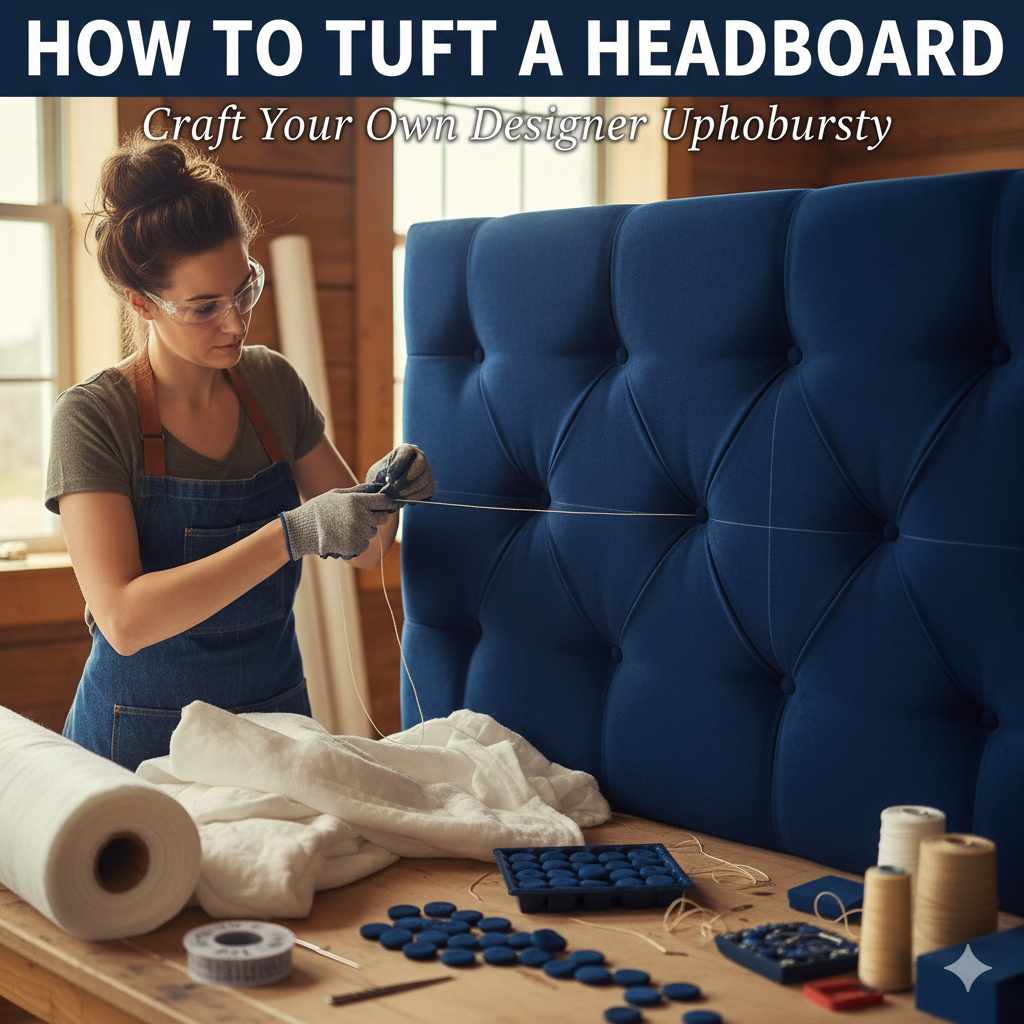
Thread your tufting needle with the waxed thread. Double the thread for extra strength. Push the needle from the front of the headboard, through the fabric, foam, batting, and out the pre-drilled hole in the plywood.
Thread the needle through the button’s shank. Pull the needle back through the same hole, from back to front. The button will follow the thread and seat itself into the recess you drilled earlier.
Pull the thread tight. You want the button to sit deep enough that the fabric folds around it, but not so tight that the foam compresses completely. A good rule: the fabric should form a distinct crease, but you should still feel some give when you press on the button.
Tie the thread off on the back of the plywood. Use a double knot, then a third knot for security. Trim the excess thread. Repeat this process for every button.
For rows of buttons, work from the center outward. This keeps the fabric tension even. If you start at the edges, you might pull the fabric off-center by the time you reach the middle.
The Unique Craft needle kit includes instructions for this exact process. The 12-inch needle is long enough to pass through 2 inches of foam plus batting, which shorter needles can’t do without bending.
How to Fix Loose or Popped Buttons Later
A button will pop loose eventually, especially if you lean against the headboard nightly. The fix doesn’t require removing the whole headboard.
If the button is loose but still attached, pull the thread from the back. You’ll need access to the back of the headboard. If it’s wall-mounted, you might need to take it down partially.
Re-tighten the thread and tie a new knot. If the original thread broke, thread a new piece through the button shank and the existing hole. Use your tufting needle to pull it through.
If the button itself is damaged, you’ll need to cover a new one. Cut the old button off from the back, pull the thread through, and install the new button using the same method as the initial installation. The old hole in the foam will still work as the recess.
To prevent future pops, use a longer thread tail and tie a triple knot. Also, avoid pressing directly on the buttons. Press on the fabric between them.
Step 7: Mount the Headboard Securely (French Cleats)
A tufted headboard is heavy. A queen-size model with plywood, foam, and fabric can weigh 40-60 pounds. Don’t rely on a single screw or a flimsy bracket. Use French cleats.
French cleats are two interlocking metal strips. One mounts to the wall, the other to the headboard. When you hang the headboard, the two strips slide together and lock. The weight distributes across the entire length of the cleat.
Mount the wall cleat first. Use a stud finder to locate the wall studs. Screw the cleat into at least two studs, ideally three. Use 2-1/2 inch lag bolts for a secure hold.
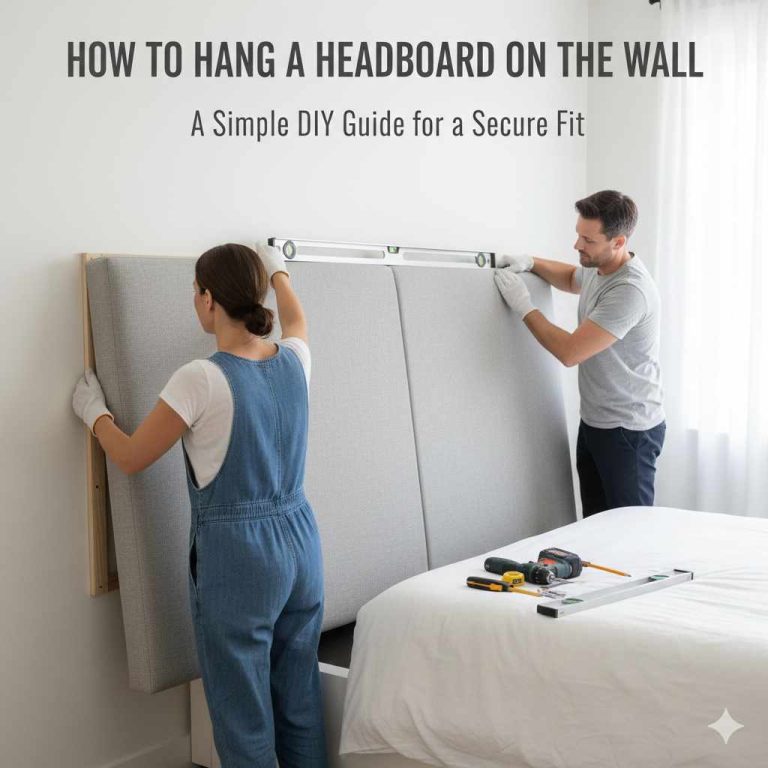
Attach the matching cleat to the back of the headboard, aligning it with the one on the wall. Lift the headboard and set it onto the wall cleat. Have a helper hold it while you check that it’s level.
For added security, drive a couple of screws through the bottom of the headboard into the wall studs. This prevents the headboard from being lifted off the cleat accidentally. If you’re mounting on drywall without studs, use heavy-duty toggle bolts rated for at least 100 pounds.
If you’re attaching the headboard to a bed frame instead of the wall, use metal angle brackets. Screw one side to the headboard and the other to the bed frame. This method is less stable than French cleats, so the headboard may wobble if you lean on it.
Design Variations: Arched, Curved, and Unique Shapes
Rectangular headboards are straightforward, but an arched top adds elegance. The process is the same, with a few adjustments.
Cut the arch with a jigsaw. Draw the curve on the plywood first. A common approach is a semi-circle or a shallow arc. For a semi-circle, mark the center point and use a string and pencil as a compass.
When cutting foam for an arched top, cut it slightly oversized. Trim the excess after stapling. The fabric needs to wrap around the curve smoothly, so stretch it diagonally at the corners.
Button placement on an arched top requires adjustment. The top row of buttons should follow the curve, not the straight top edge. Measure the distance from the top edge at several points along the curve and adjust the grid accordingly.
For a curved top, you’ll need more fabric. The curve consumes fabric faster than a straight edge. Plan for an extra half yard.
The foam and batting also need to follow the curve. Cut them to match the plywood shape, but leave a 1-inch overhang. This extra material wraps around the curved edge and prevents a flat spot at the top.
Cost Breakdown: DIY vs. Store-Bought
Let’s talk numbers. A quality store-bought tufted headboard for a queen bed typically costs between $300 and $800. Designer versions can exceed $1,500. The DIY route costs less, but only if you already own some tools.
| Item | DIY Cost (Estimate) | Store-Bought Cost |
|---|---|---|
| Plywood (3/4-inch sheet) | $40-$60 | Included |
| Foam padding (2-inch, queen) | $50-$80 | Included |
| Batting (2 rolls) | $20-$30 | Included |
| Upholstery fabric (3-4 yards) | $30-$100 | Included |
| Fabric buttons (50-pack) | $10-$15 | Included |
| Tufting needle and thread kit | $15-$25 | Not needed |
| French cleats (2-pack) | $15-$30 | Not included |
| Staple gun (if you don’t own one) | $30-$60 | Not needed |
| Total (with tools) | $210-$400 | $300-$800 |
The hidden cost is tools. If you need to buy a staple gun and drill, your DIY project starts at around $210. If you already own them, the material cost drops to $150-$250. Either way, you’re saving money compared to a comparable store-bought piece.
The trade-off is time. Expect to spend 6-8 hours on this project, spread over a weekend. That’s the real cost. If your time is more valuable than the savings, buy one. But if you enjoy building and want a custom fit, the DIY route wins on both cost and quality.
Maintenance and Cleaning Tips for Tufted Headboards
Tufted headboards collect dust in the folds and creases. Regular maintenance keeps them looking fresh.
Vacuum the headboard weekly with a brush attachment. Focus on the tufted areas where dust settles. Use a soft brush to avoid snagging the fabric.
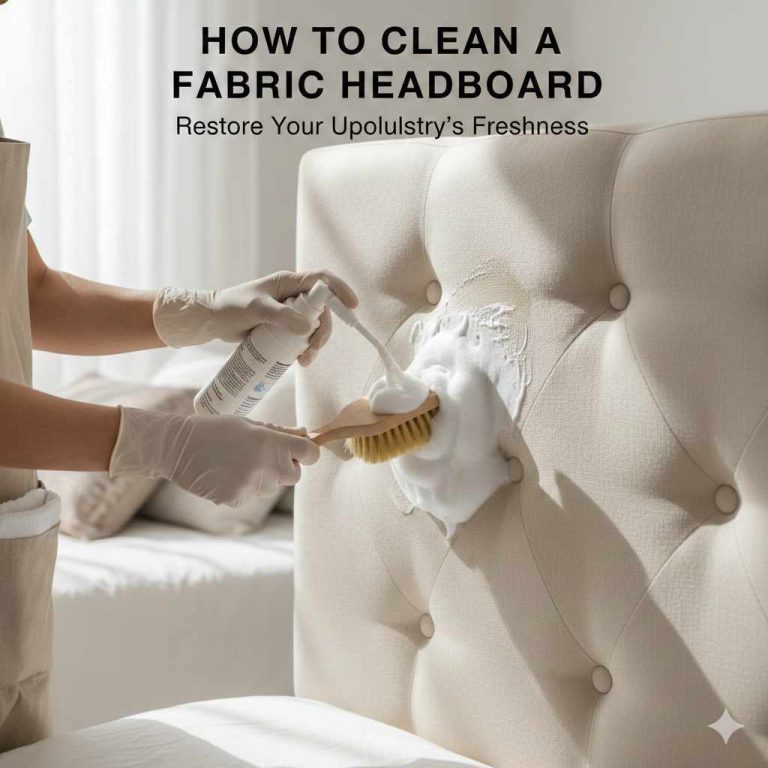
For stains, spot clean immediately. Blot with a damp cloth and mild soap. Don’t rub, as this pushes the stain deeper into the fabric. For stubborn stains, use an upholstery cleaner designed for your fabric type.
Velvet and linen require different care. Velvet needs a gentle touch and no water. Use a dry cleaning solvent or a velvet brush. Linen is more forgiving but can shrink if soaked. Test any cleaner on a hidden area first.
Every few months, check the buttons for looseness. Press on each one. If any feel loose, tighten the thread from the back. Addressing this early prevents the button from popping completely.
If the fabric starts to look flat, steam it lightly. Hold a steamer 6 inches away and pass it over the fabric. This fluffs the fibers and removes wrinkles. Don’t soak the fabric, just steam it briefly.
FAQs About Tufting a Headboard
What is the best fabric for a tufted headboard?
Velvet and linen are the top choices. Velvet has a dense pile that hides the tufting folds well and feels luxurious. Linen is lighter and more breathable, but it wrinkles more easily. Avoid thick fabrics like heavy tweed or faux fur. They’re too bulky to fold cleanly around the buttons, so the tufts look blobby instead of crisp.
How many buttons do I need for a queen headboard?
For a standard 60-inch wide, 54-inch tall queen headboard with diamond tufting, you’ll need around 35-45 buttons. The exact number depends on your spacing. Use the formula: divide the height by vertical spacing (6 inches) and the width by horizontal spacing (10.5 inches). Multiply the two results. For a 60×54 headboard, that’s 9 rows times 5 buttons, which equals 45. Add a few extras for mistakes.
Can I tuft a headboard without drilling holes in the wood?
Technically, yes, but the result won’t last. Without holes, you can’t pull the thread to the back of the board. You’d have to tie off the thread at the front, which leaves visible knots. The buttons won’t sit deep enough, and they’ll loosen quickly. Drill the holes. It’s the only way to get a professional finish.
How do I prevent the fabric from wrinkling between buttons?
Wrinkles happen when the fabric is too loose or the button spacing is too far apart. Keep spacing under 8 inches vertical. When you pull each button tight, smooth the fabric outward from the button with your free hand. This distributes the tension evenly. If you see a wrinkle forming, loosen the button, smooth the fabric, and retighten.
Is memory foam or high-density foam better for tufting?
High-density polyurethane foam is better. Memory foam is too soft and doesn’t spring back after the button compresses it. The tufts will look flat and the button recesses will lose their definition. High-density foam, around 1.8 to 2.0 pounds per cubic foot, holds the shape while still providing cushioning.
Final Checklist Before You Start
You have the full process now. Before you buy materials, run through this list to make sure you’re prepared.
- Measure your bed frame and room. Confirm the headboard width and height before cutting plywood.
- Calculate button spacing on paper. Draw the grid and count the buttons. Buy 10% extra.
- Choose your fabric based on tufting depth. Velvet and linen work best. Avoid thick or stretchy materials.
- Gather all tools, including a staple gun, drill, and a 12-inch tufting needle. The Unique Craft needle kit covers the needle and thread requirements.
- Drill all button holes and foam recesses before stapling fabric. This prevents fabric damage from the drill.
- Staple fabric from the center outward. Keep tension even to avoid a crooked pattern.
- Install buttons from the center of the headboard outward. Tie triple knots on the back.
- Mount with French cleats into wall studs. Don’t skip this step for heavy headboards.
- Vacuum weekly and spot clean stains immediately. Check button tightness every few months.
Building a tufted headboard is a weekend project that pays off every night. The math is simple, the materials are accessible, and the process is repeatable. Take your time on the button placement and fabric tension. Those two steps separate a piece that looks custom from one that looks like a craft project. If you get stuck, refer back to the spacing formula and the layering order. Everything else is just careful execution.
Products related to this article
Sponsored / affiliate links. As an Amazon Associate I earn from qualifying purchases. I may earn additional commission from eligible campaigns.