Carpet Calculator: How Much Carpet Do You Need?
Use a carpet calculator by measuring each room, then choosing the roll width that cuts the fewest seams; a common rule of thumb is to add about 10% waste for simple rooms and about 15% to 20% for stairs or irregular layouts. The wrong width, or too little waste, can leave you short, force extra seams, or send you back for a second order. This guide shows how to measure, estimate square footage, factor roll width, and calculate cost without overbuying.
How is this calculated?
Press Calculate to see the math with your numbers.
Calculate carpet amount and cost
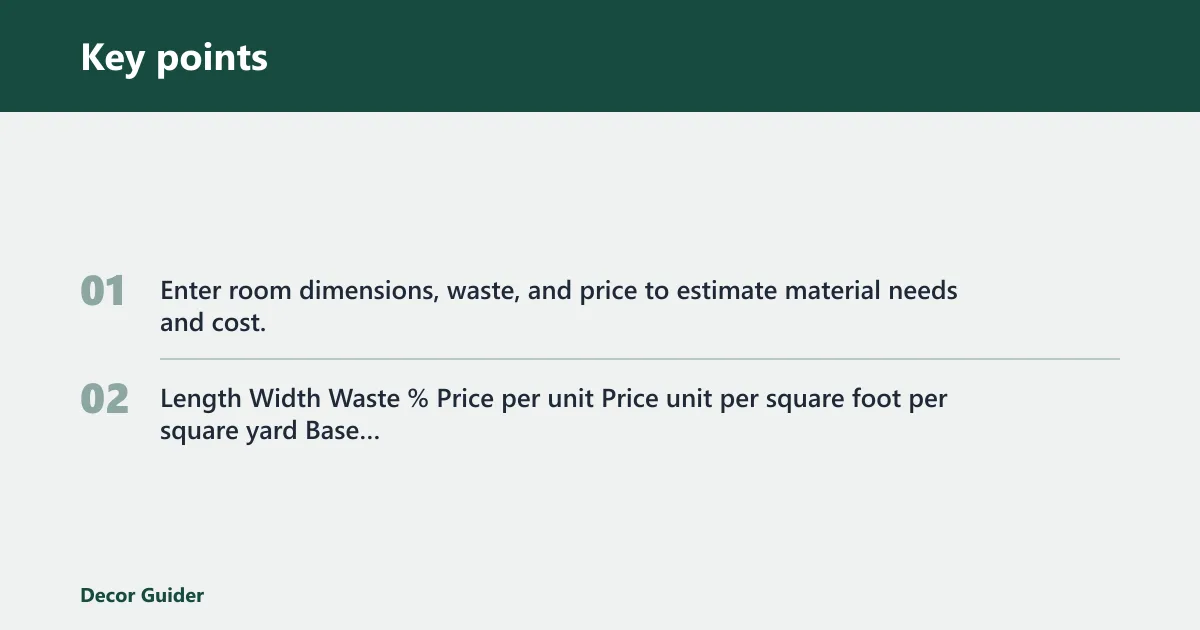

Enter room dimensions, waste, and price to estimate material needs and cost.
Use square feet first, then convert to square yards when the product is sold that way.
How a carpet calculator works
A carpet calculator estimates three things: room area, material quantity, and optional cost. Most tools start with length × width, then convert that result into square yards when you need retail ordering units. Some calculators also accept price inputs, padding, and installation labor, so you can estimate total project cost instead of only carpet area.
What the calculator estimates first
The first number you need is square footage. Measure each section wall-to-wall, multiply length by width, and add separate sections together if the space is not a single rectangle. That starting number tells you how much carpet surface you need before waste, seams, or roll width are considered.
Say your bedroom is 12 feet by 14 feet. The base area is 168 square feet. A calculator can then convert that area to square yards, suggest waste, and show what that means for order size.
Why area is only the starting point
Area alone does not place an order. Roll width changes how the carpet is cut, and the cut plan determines whether you need seams. A room that fits a 12-foot roll cleanly can need less extra material than the same square footage laid across a narrow hallway or an L-shaped plan.
When cost inputs belong in the estimate
Use cost inputs after you know the area and the likely order size. Carpet price may be listed per square foot or per square yard, and the unit must match the calculator. Padding may be priced separately, and installation labor may be added per square foot or per square yard. Some calculators note cost inputs after area is calculated, and one calculator recommends about 10% extra for mistakes and installation waste.
How do you measure carpet for a calculator?
Measure each section wall-to-wall, not baseboard to baseboard, and record the longest usable length and width for each area. If the room has a closet, alcove, bump-out, or connected section, measure those parts separately and add them together. Use the same unit throughout so the calculator does not mix feet, yards, centimeters, meters, or inches.
Measure wall to wall
For a simple room, measure the full length and width of the finished floor area. If the room is irregular, split it into rectangles or other simple shapes, calculate each section, and total them. Inch Calculator allows multiple room or area inputs, which is useful when the carpet order covers more than one space.
How to handle multiple rooms or sections
Combine connected spaces only after measuring each one on its own. A bedroom plus a closet is not one rectangle if the closet changes the cut pattern. A calculator that accepts separate inputs helps you keep the total area accurate before you choose the roll width.
- Measure the room wall-to-wall in feet, yards, centimeters, meters, or inches.
- Split irregular rooms into rectangles, hallways, or other simple sections.
- Add all sections together to get total square footage.
- Convert to square yards if the carpet is sold that way.
- Choose a waste allowance based on room shape, stairs, and pattern repeat.
- Check roll width so the plan avoids unnecessary seams.
Carpet order checklist
This checklist helps you choose waste and cut plan before entering price. The goal is to order enough material in the right width, not only enough area on paper. Round up to the next roll width whenever the planned cut would force a seam through a main traffic path, a visible centerline, or a stair run.
| Room type | Recommended waste % | Ordering notes |
|---|---|---|
| Standard bedroom | 10% | Use 12-foot roll if the width fits with the fewest seams. Round up to 15-foot roll if the room width plus pattern match would force a center seam. |
| L-shaped room | 15% | Split into rectangles first. Round up when the inside corner creates a narrow offcut or when a seam would land in the turn. |
| Closet/alcove | 15% | Small spaces waste more trim. Round up if the closet width is too short for a clean cut from the main room piece. |
| Hallway | 15% | Hallways often benefit from a wider roll if it lets you run the carpet lengthwise with fewer seams. Round up if the hallway width plus margins cannot be cut cleanly from the roll. |
| Stairs | 15% to 20% | Measure steps, tread, riser, and nose wrap. Round up early because stair cuts are short and waste rises quickly. |
| Patterned carpet | 15% to 20% | Match the repeat before ordering. Round up if the pattern alignment would push a seam into a visible area or require extra length to keep the design aligned. |
What carpet width should you plan for?
Plan width before price. Carpet is commonly sold in 12-foot rolls, and wider 15-foot rolls can reduce seams in large rooms or open layouts. The better width is the one that lets you cover the room with the fewest seams and the least wasted offcut, even if the square footage is the same.
12-foot rolls and common room fits
HowMuchFlooring states that carpet is sold in 12 ft wide rolls. That width works well for many bedrooms, but it is not always the best fit. If the room width is close to 12 feet, adding a little extra for trimming can be fine. If the room is just over 12 feet, a seam may become unavoidable unless you switch widths or change the layout.
When 15-foot rolls reduce seams
A 15-foot roll is useful when a wider piece can span the room without a seam in the center. That matters in living rooms, long bedrooms, and open spaces where a visible seam would be hard to hide. Wider carpet can also reduce waste if the room width is awkward for a 12-foot roll.
Suppose a room is 13 feet wide. A 12-foot roll will not cover the full width in one piece, so a seam becomes likely. A 15-foot roll may let you cover the width with one sheet and trim the edges instead of joining pieces through the middle.
Decision rules for widths, hallways, and large rooms
Choose the roll width that keeps the seam out of the main sightline. For hallways, think lengthwise first. For large rooms, think about where the seam falls after the carpet is cut. If the cut plan leaves a thin strip at one edge, round up to a wider roll or reconsider the direction of the layout.
How much waste should you add?
Ten percent is a solid baseline for simple rooms with few cuts and a straightforward layout. Use 15% to 20% when the room has closets, alcoves, corners, stairs, or a pattern that must line up. Waste covers trimming, seam matching, and offcuts, so the right number depends on the cut plan, not only the room size.
Why 10% is the baseline
Omni Calculator recommends about 10% extra for mistakes and installation waste, and Best Calculators also uses a 10% waste allowance for seams, patterns, and cuts. US Calculator applies a default 10% waste allowance. That makes 10% a reasonable starting point for a plain rectangular room with no special matching demands.
When to use 15% to 20% instead
Use more waste when the room shape increases offcuts or when the installation requires extra matching. Closets, alcoves, and inside corners often need more than 10% because the leftover pieces are harder to reuse. Hallways and stairs also push waste higher because their cuts are narrow and repetitive. The same source lists common waste factors of 5%, 10%, 15%, and 20%.
How pattern repeat changes waste
Pattern repeat changes where you can cut, because the design must line up across seams. That usually means extra length beyond the base area calculation. If the pattern must be matched in more than one seam, move from 10% toward 15% or 20% so the order includes enough material for alignment.
Square feet, square yards, and price units
Square feet should be your starting unit, because room measurements usually begin with length × width. Convert to square yards when the retailer lists carpet that way. One square yard equals 9 square feet. Keep the unit consistent before you price the job, or the vinyl plank vs carpet cost per square foot will be off.
How do you convert square feet to square yards for carpet?
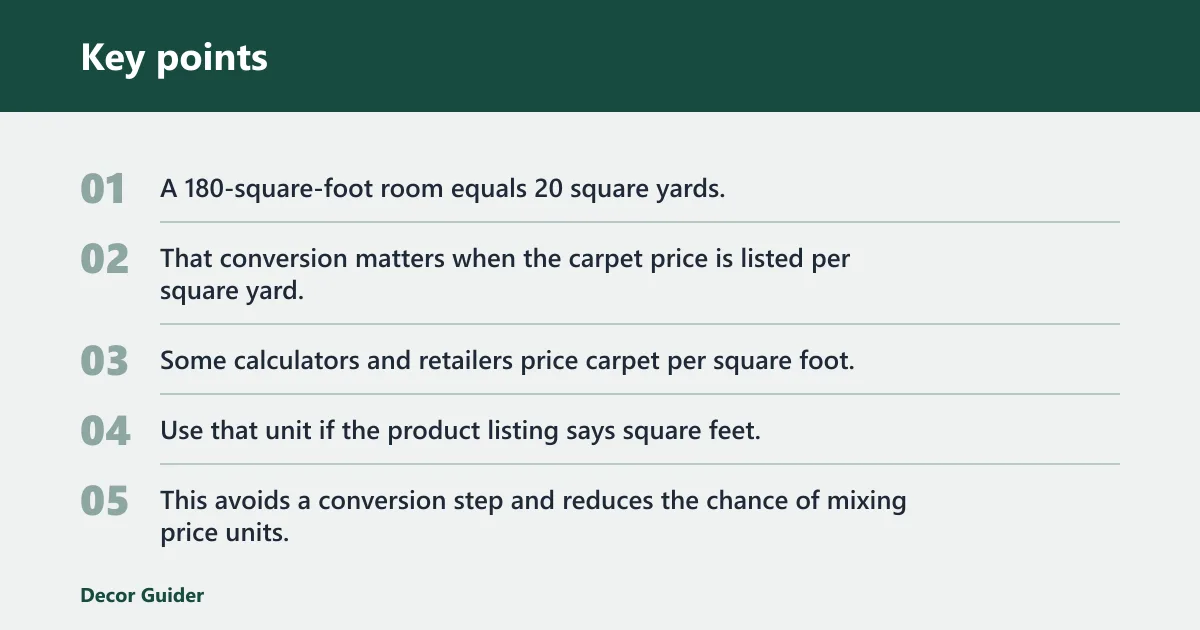
Divide square feet by 9 to get square yards. A 180-square-foot room equals 20 square yards. That conversion matters when the carpet price is listed per square yard, while padding or labor may still be quoted per square foot.
When carpet is priced per square foot
Some calculators and retailers price carpet per square foot, which is the simplest format when your measurement is already in feet. Use that unit if the product listing says square feet. This avoids a conversion step and reduces the chance of mixing price units.
When carpet is priced per square yard
Use square yards when the seller lists carpet that way, which is common in retail ordering. Convert only after the area is correct. US Calculator notes that results exclude padding, tack strips, seam tape, installation labor, and sales tax, so those items should be added separately if you want a fuller estimate.
Padding and labor costs
Padding often adds about $0.25 to $0.75 per square foot, depending on thickness and material, while installation labor commonly runs about $0.50 to $2.00 per square foot. Seam tape and small accessory items can add a little more, especially when the layout needs multiple joins or stairs. Use these line items after you calculate the carpet area.
Worked example for total installed cost
If a room is 12 by 14 feet, the base area is 168 square feet. Add 10% waste for 184.8 square feet, then convert to 20.53 square yards if the carpet is priced that way. At $3.50 per square foot for carpet, plus $0.50 for padding, $1.25 for labor, and about $0.10 for seam tape, the installed total is about $896.40 before tax.
How do you measure carpet for stairs?
Stairs need a different measurement method than flat rooms. Count the steps, measure stair width, and include tread, riser, and nose wrap in the plan. A runner may use a narrower strip than wall-to-wall stair coverage, but both need extra material because each step creates a short repeated cut.
Step count, tread, and riser measurements
Count every step in the run, then measure the tread depth and riser height for the stair profile. The carpet must cover the visible tread and rise, and it usually needs extra for wrapping the nose. Inch Calculator supports up to 5 stairway inputs, which fits more than one stair run in the same project.
Nose wrap and landing transitions
Nose wrap is the part that turns over the front edge of each step. It needs extra length, and that extra length should be part of the waste allowance. If the stairs end at a landing, include the transition so the carpet does not come up short at the top or bottom.
Runner versus wall-to-wall stair coverage
A stair runner covers the center strip of the steps and leaves exposed edges, while wall-to-wall coverage spans the full width. The runner usually uses less carpet, but it still needs careful measuring because the pattern and edge finish affect the cut. Wall-to-wall stairs use more material and often need a higher waste factor.
Frequently asked questions
How much carpet do I need for my room, and how do I measure it for a calculator?
Measure wall-to-wall, multiply length by width, and add 10% for a simple room or 15% to 20% for tricky layouts. Then split irregular spaces into rectangles before entering the numbers. That gives you the base square footage first, which is the figure most calculators need before waste and cost are added.
What measurements should I enter first?
Enter the longest length and widest width of each finished floor section first. For connected rooms, closets, or alcoves, add each section separately rather than guessing one overall dimension. That rule keeps the calculator from undercounting hidden corners, and it makes the waste allowance easier to apply correctly.
How many square yards of carpet do I need?
Divide total square feet by 9. That gives square yards, which many carpet sellers use for ordering. If your calculator shows square feet and square yards, check which unit the price uses before you enter cost, since the wrong unit will skew the estimate.
How much waste should I add when ordering carpet?
Use 10% for a plain room with few cuts. Use 15% to 20% for stairs, closets, alcoves, corners, or any project with pattern repeat and seam matching. More waste is safer when the layout is irregular or when the roll width forces extra trimming.
How much carpet cost calculator should I use?
Use a calculator that handles area, waste, and price units, then lets you add padding and labor separately. Inch Calculator includes room and stair inputs, while Omni Calculator and Best Calculators both support area-based estimating with cost inputs. The best one for you is the one that matches your room shape and pricing unit.
Products related to this article
Sponsored / affiliate links. As an Amazon Associate I earn from qualifying purchases. I may earn additional commission from eligible campaigns.