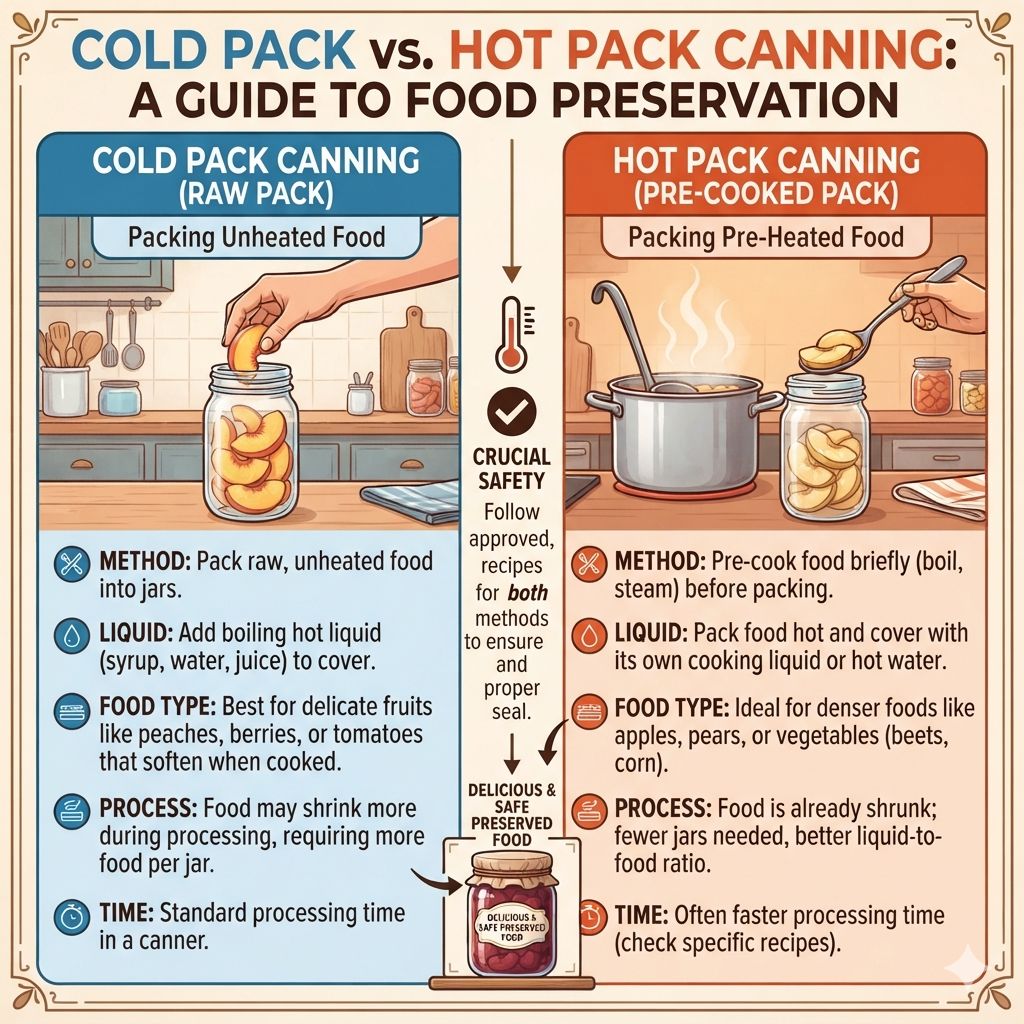
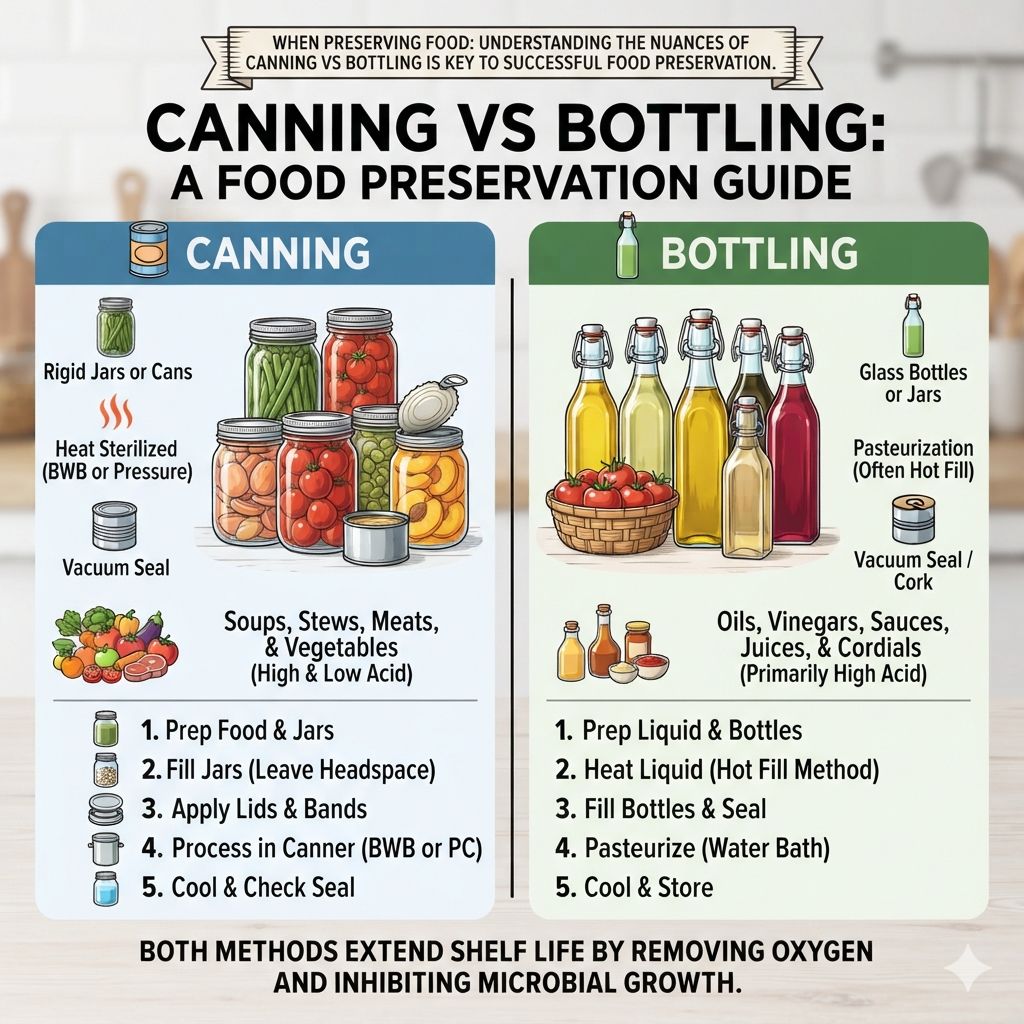
In short, canning typically uses metal cans or glass jars heated to high temperatures to sterilize food, often requiring specialized equipment for sealing, while bottling generally refers to sealing food or beverages in glass bottles, sometimes involving pasteurization rather than full sterilization. The choice depends on the food type, desired shelf life, and available tools.
Key Takeaways
- Canning vs bottling differs significantly in packaging materials and sterilization processes.
- Canning typically uses airtight metal cans or jars and high-heat sterilization for long-term shelf stability.
- Bottling often involves glass bottles and can range from pasteurization for shorter shelf life to high-heat processing for longer preservation.
- The effectiveness of both methods relies on proper sealing and processing to prevent spoilage and ensure safety.
- Choosing between canning vs bottling depends on the food’s acidity, desired storage duration, and available equipment.
What is Canning?
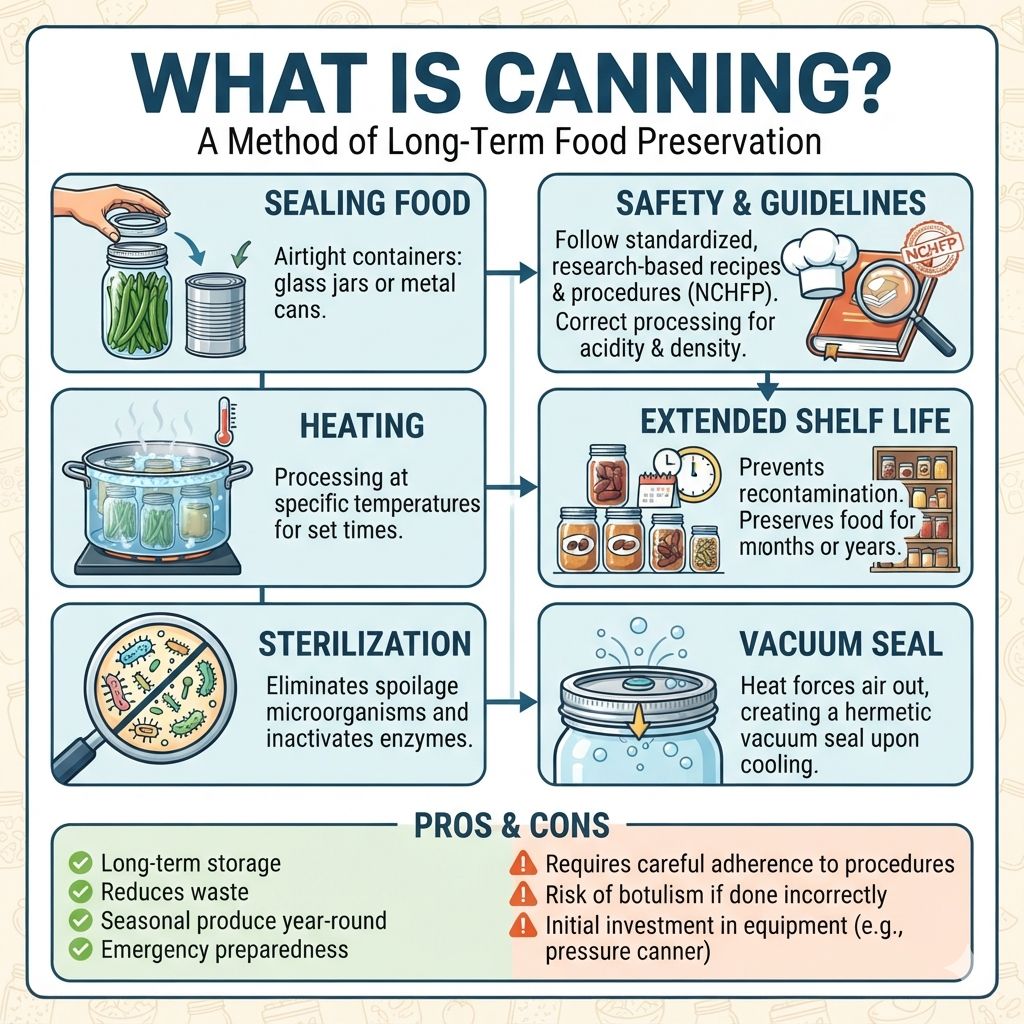
Canning is a method of food preservation that involves sealing food in an airtight container, typically a metal can or a glass jar, and then heating it to a specific temperature for a set amount of time. This process eliminates microorganisms that cause spoilage and inactivates enzymes that can degrade food quality. The heat also causes the air inside the container to expand, pushing out and creating a vacuum seal when the container cools.
This vacuum seal is crucial for preventing recontamination and extending the shelf life of the preserved food, often for years.
The effectiveness of canning hinges on achieving a sufficient internal temperature to destroy harmful bacteria, yeasts, and molds, along with ensuring a hermetic seal. Different types of food require different processing temperatures and times due to variations in acidity and density. For instance, high-acid foods like fruits and pickles can be processed using a boiling water bath, while low-acid foods such as vegetables, meats, and poultry require a pressure canner to reach temperatures high enough (above 240°F or 115°C) to kill botulism spores.
Organizations like the National Center for Home Food Preservation (NCHFP) provide standardized, research-based guidelines to ensure safety.
The primary advantage of canning is its ability to preserve food for very long periods, making it an excellent strategy for stockpiling and reducing waste. It allows you to enjoy seasonal produce year-round and provides a reliable food source in emergencies. However, it requires careful adherence to tested recipes and procedures to prevent foodborne illnesses.
The equipment, particularly a pressure canner, can also be an initial investment.
Types of Canning Containers
- Metal Cans: Commonly used for commercial production, these are typically made of steel or aluminum and are sealed using specialized machinery that crimps the lid onto the can body. They are highly durable and offer excellent protection.
- Glass Jars: Preferred by home canners, these jars come with a two-piece lid system: a flat metal lid with a sealing compound and a screw band. The flat lid is used once and is responsible for creating the vacuum seal.
- Specialty Containers: Some foods may be preserved in other materials, but for home canning, metal cans and glass jars are the most prevalent and safest options.
Canning Process Steps
- Preparation: Wash jars, lids, and bands. Prepare food according to tested recipes.
- Filling: Pack food into jars, leaving the recommended headspace. Remove air bubbles.
- Sealing: Wipe jar rims clean. Place lids and screw on bands fingertip-tight.
- Processing: Process jars in a boiling water bath or pressure canner for the specified time.
- Cooling: Remove jars from canner and let them cool undisturbed for 12-24 hours.
- Checking Seals: Remove bands and check for secure seals. Store properly.
Canning Pros and Cons
| Pros | Cons |
|---|---|
| Very long shelf life (1-5+ years) | Requires specialized equipment (especially pressure canners) |
| Preserves food quality and nutrients effectively | Strict adherence to tested recipes is critical for safety |
| Reduces food waste and allows for year-round consumption of seasonal items | Some nutrient loss can occur with high-heat processing |
| Reliable for emergency food storage | Some foods may undergo texture changes |
What is Bottling?
Bottling, in the context of food and beverage preservation, refers to the process of packaging items into glass bottles. While often associated with liquids like juices, wines, beers, and sauces, it can also be used for preserving solid foods. The preservation method within bottles can vary significantly, ranging from simple pasteurization to high-temperature sterilization, depending on the product and desired shelf life.
Unlike canning, which typically implies a long-term, shelf-stable product, bottling can sometimes refer to shorter-term preservation methods, especially for refrigerated items.
For beverages, bottling often involves ensuring the bottle is clean and then sealing it with a cap (like a crown cap for beer or a twist-off cap for juices) or a cork. Pasteurization, a process involving heating the liquid to a moderate temperature for a short duration, is commonly used to kill most spoilage-causing microbes while retaining more of the product’s flavor and nutritional profile than full sterilization. This is why many bottled juices and milk products have a limited shelf life and often require refrigeration.
When bottling solid foods, similar principles to canning apply. The jars must be sterilized, the food packed, and the jars sealed. However, the term “bottling” might be used more loosely here, sometimes referring to processes that are less rigorous than full home canning standards, especially if the intent is for immediate or refrigerated consumption.
The key differentiator is often the container (glass bottles versus jars) and the range of preservation techniques employed. For instance, commercially bottled sauces or jams often undergo significant heat treatment to achieve shelf stability comparable to canned goods.
Bottling Methods and Applications
- Pasteurization: Heating liquids to a specific temperature (e.g., 160-185°F or 71-85°C) for a short period to kill harmful bacteria and extend shelf life. Common for milk, juices, and some fermented beverages.
- High-Heat Processing: Similar to canning, where bottles are filled with food and then heated in a retort or autoclave to achieve commercial sterility. Used for shelf-stable products like sauces, baby foods, and some fruit preserves.
- Fermentation & Carbonation: Some beverages are bottled in a way that allows for secondary fermentation, creating natural carbonation. This often requires specific bottle types and careful handling.
- Refrigerated Bottling: For products that are not intended for long-term shelf storage, bottling might simply involve clean bottles and a secure seal, with the expectation that the product will be kept refrigerated.
Bottling vs. Canning: A Closer Look
| Feature | Canning | Bottling |
|---|---|---|
| Typical Container | Glass jars or metal cans | Glass bottles |
| Primary Preservation Method | High-heat sterilization (boiling water bath or pressure canning) | Variable (pasteurization, high-heat, or refrigeration) |
| Typical Shelf Life | Very long (1-5+ years, shelf-stable) | Variable (short for refrigerated, long for shelf-stable) |
| Common Products | Fruits, vegetables, meats, soups, jams | Juices, wines, beers, sauces, pickles, oils |
Bottling Considerations
- Bottle Type: Ensure bottles are specifically designed for preservation and can withstand the processing temperatures.
- Seal Integrity: The cap or closure must create an airtight seal. For hot-fill methods, the seal is critical for preventing spoilage.
- Product Acidity: As with canning, the acidity of the product influences the required processing method.
- Sterilization: Thorough cleaning and sterilization of bottles and closures are essential.
| Bottling vs. Canning Scenarios | Best Suited For | Why |
|---|---|---|
| Long-Term Shelf-Stable Fruits & Vegetables | Canning (in jars) | Proven methods for complete sterilization and vacuum sealing for years of storage. |
| Fresh Juices or Smoothies (Refrigerated) | Bottling (with refrigeration) | Maintains fresher taste and nutrients. Shelf life is limited to weeks, requiring cold storage. |
| Home-brewed Beer or Kombucha | Bottling (often with specific caps for carbonation) | Allows for natural carbonation build-up and is traditional for these beverages. Requires careful handling due to pressure. |
| Commercial Sauces or Pastes | Bottling (often with high-heat processing) | Achieves commercial sterility and long shelf life in a familiar bottle format. |
This table highlights how the choice between canning and bottling often comes down to the specific product, its intended shelf life, and the desired preservation outcome.
Key Differences Summarized
The fundamental distinction between canning and bottling lies in their primary packaging, processing methods, and typical applications. Canning is almost exclusively associated with achieving long-term shelf stability through high-temperature sterilization in metal cans or sealed glass jars. The term “canning” itself implies a robust preservation process designed to last for years at room temperature.
Bottling, on the other hand, is a broader term. While it can achieve long-term shelf stability using methods akin to canning, it is also frequently used for shorter-term preservation, especially for beverages and products that benefit from pasteurization rather than full sterilization. The choice of container—bottles versus jars—also plays a role in perception and application, with bottles often associated with liquids and jars with semi-solids or solids.
For home food preservation, understanding these differences is crucial. If your goal is to store fruits, vegetables, or meats for many years without refrigeration, you will be canning them using tested recipes and equipment. If you are preserving juices, kombucha, or homemade sauces for shorter periods or for immediate consumption with extended refrigeration, bottling might be your method of choice, potentially with less intensive processing than full canning.
Processing Temperatures and Times
- Boiling Water Bath Canning: Used for high-acid foods (fruits, jams, jellies, pickles). Typically involves processing jars in boiling water (212°F or 100°C) for 10-20 minutes, depending on the recipe and altitude.
- Pressure Canning: Essential for low-acid foods (vegetables, meats, poultry, fish). Requires a pressure canner to reach temperatures of 240-250°F (115-121°C) to destroy botulism spores. Processing times vary from 20 minutes for pints to 75 minutes for quarts.
- Pasteurization: Applied to many bottled beverages and some sauces. Temperatures are typically between 160-185°F (71-85°C) for a few minutes. This does not achieve commercial sterility and often requires refrigeration.
- Hot Fill: Some products are heated and then filled into bottles or jars while still hot, relying on the heat to kill surface microbes and the subsequent cooling to create a vacuum seal. This method is less reliable for long-term shelf stability compared to full sterilization.
Impact on Food Quality
The processing method significantly impacts food quality. High-temperature canning can lead to some loss of heat-sensitive vitamins like Vitamin C and some B vitamins. Texture can also be affected, with some foods becoming softer.
However, for many items, canning preserves nutrients and quality remarkably well for extended periods.
Bottling, particularly when employing pasteurization or hot-fill methods, can sometimes preserve a fresher taste and higher levels of certain heat-sensitive nutrients. However, these methods may result in a shorter shelf life or require refrigeration, meaning the trade-off is often between nutrient/flavor preservation and long-term, shelf-stable storage.
For optimal results in both canning and bottling, using fresh, high-quality ingredients and following tested procedures precisely is paramount. Deviations can lead to suboptimal quality, spoilage, or safety concerns.
| Preservation Goal | Recommended Method | Why |
|---|---|---|
| Long-term storage of vegetables without refrigeration | Pressure Canning (in jars) | Ensures complete destruction of botulism spores and creates a hermetic seal. |
| Preserving fresh fruit flavor with a shorter shelf life | Boiling Water Bath Canning (in jars) or Hot Fill Bottling (with refrigeration) | High-acid foods are safer with boiling water, while hot fill can retain freshness but requires cold storage for safety. |
| Beverages requiring mild preservation | Bottling with Pasteurization | Reduces microbial load while retaining flavor and characteristics, typically requiring refrigeration. |
| Commercial shelf-stable sauces or condiments | Bottling with High-Heat Processing | Commercial sterilization in bottles for extended shelf life. |
This comparison guides the selection of the most appropriate method based on the specific preservation objective.
Safety Considerations for Canning and Bottling
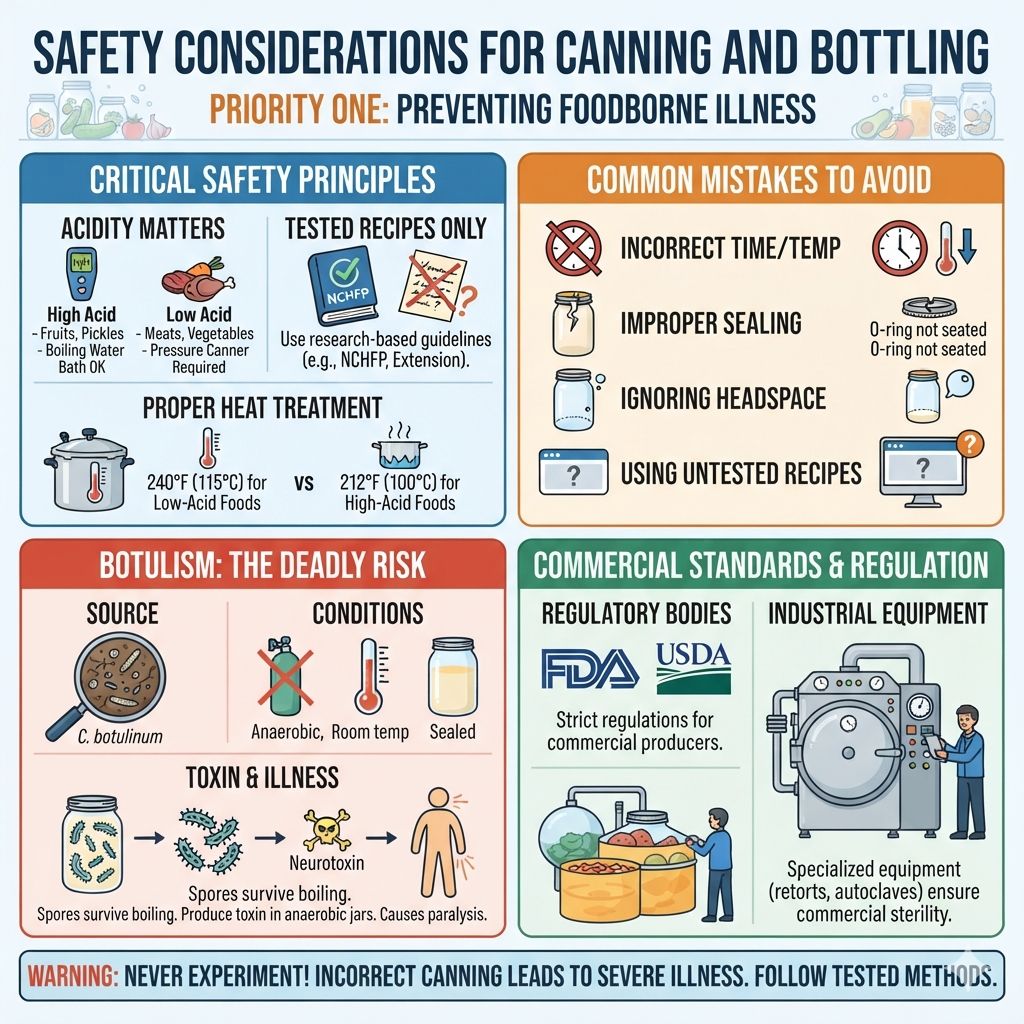
Safety is paramount in both canning and bottling. Improperly processed low-acid foods can harbor Clostridium botulinum, a bacterium that produces a deadly toxin. This is why using a tested recipe and a pressure canner for low-acid foods is non-negotiable.
For high-acid foods, boiling water bath canning is generally safe when instructions are followed meticulously.
For bottling, the risks are similar. If a bottled product is intended to be shelf-stable, it must be processed to the same standards as canned goods. This means understanding the pH of the food and using the appropriate heat treatment.
For any bottled product that is not fully sterilized, proper storage (usually refrigerated) and adhering to expiration dates are critical to prevent the growth of harmful bacteria or spoilage organisms.
Always consult reliable sources like the NCHFP or university extension offices for up-to-date, scientifically-backed guidelines. These organizations provide tested recipes and processing recommendations that have been rigorously evaluated for safety and effectiveness.
Warning: Never experiment with canning or bottling recipes. Always use tested methods for the specific food you are preserving. Incorrect processing can lead to severe foodborne illnesses, including botulism.
Common Mistakes to Avoid
- Incorrect Processing Time/Temperature: Not processing for long enough or at a high enough temperature is the most critical safety error.
- Improper Sealing: Using damaged lids, overtightening bands, or not wiping rims can prevent a proper seal, leading to spoilage.
- Over-processing: While safety is key, over-processing can degrade food quality significantly.
- Ignoring Headspace: Incorrect headspace can interfere with vacuum sealing or lead to spoilage.
- Using Untested Recipes: Relying on family “traditions” or unverified online recipes can be dangerous.
Botulism: A Serious Risk
Clostridium botulinum spores are commonly found in soil and can contaminate raw foods. They can survive boiling temperatures if not subjected to the higher heat of a pressure canner. In the anaerobic (oxygen-free) environment of a sealed container and at room temperature, these spores can germinate into bacteria that produce a potent neurotoxin.
Ingesting this toxin can cause botulism, a severe and potentially fatal illness characterized by paralysis. Properly canning low-acid foods at the correct temperature (240°F/115°C or higher) is the only way to reliably destroy these spores.
Regulatory Standards (Commercial)
For commercial food producers, regulations set by bodies like the U.S. Food and Drug Administration (FDA) are stringent. These often mandate specific processing parameters, record-keeping, and Good Manufacturing Practices (GMPs) to ensure the safety and quality of canned and bottled goods available to consumers.
Commercial operations typically use specialized equipment like retorts and autoclaves, which provide precise temperature and pressure control.
Frequently Asked Questions
What is the primary difference between canning and bottling?
The main difference lies in the container and the typical preservation method. Canning usually refers to sealing food in metal cans or glass jars using high-heat sterilization for long-term shelf stability. Bottling often involves glass bottles and can use methods like pasteurization or hot-fill, with shelf life and storage requirements varying.
Can I bottle high-acid foods like fruits using the same method as low-acid vegetables?
No, you must use different methods. High-acid foods (pH 4.6 or lower) can be safely processed in a boiling water bath, while low-acid foods (pH above 4.6) require a pressure canner to reach temperatures high enough to kill dangerous bacteria like Clostridium botulinum.
How do I know if my canned or bottled food is spoiled?
Look for signs of spoilage such as bulging lids, leaks, cloudy or foamy liquid, off-odors, mold, or spurting liquid when opened. If you are unsure, it is always best to discard the food to avoid the risk of illness.
What types of food are best suited for canning versus bottling?
Canning is ideal for preserving vegetables, meats, poultry, fish, soups, and fruits for long-term storage. Bottling is more common for beverages like juices, wines, and beers, as well as sauces, pickles, and some oils, with preservation levels varying from refrigerated to shelf-stable.
Is it safe to reuse canning jars for bottling?
Yes, you can reuse canning jars for bottling or other canning projects, provided they are free from chips, cracks, or other damage. However, the lids and seals must be replaced with new ones for each canning or hot-fill process to ensure a proper vacuum seal.
Final Thoughts
Understanding canning vs bottling reveals distinct approaches to food preservation, each with its own strengths and applications. While canning focuses on achieving extreme longevity through robust sterilization, bottling offers a broader range of preservation possibilities, from shelf-stable products to those requiring refrigeration. Regardless of the method chosen, adherence to tested recipes, precise processing, and diligent inspection are paramount for ensuring both the quality and safety of your preserved foods.