When Did Canning Start? A Fascinating History
When did canning start? The origins of food preservation through canning trace back to a pivotal moment in history driven by military necessity. This revolutionary process not only changed how food was stored but also profoundly impacted global exploration, warfare, and daily life. Understanding this history reveals the ingenuity behind a practice we often take for granted today.

As an Amazon Associate I earn from qualifying purchases.
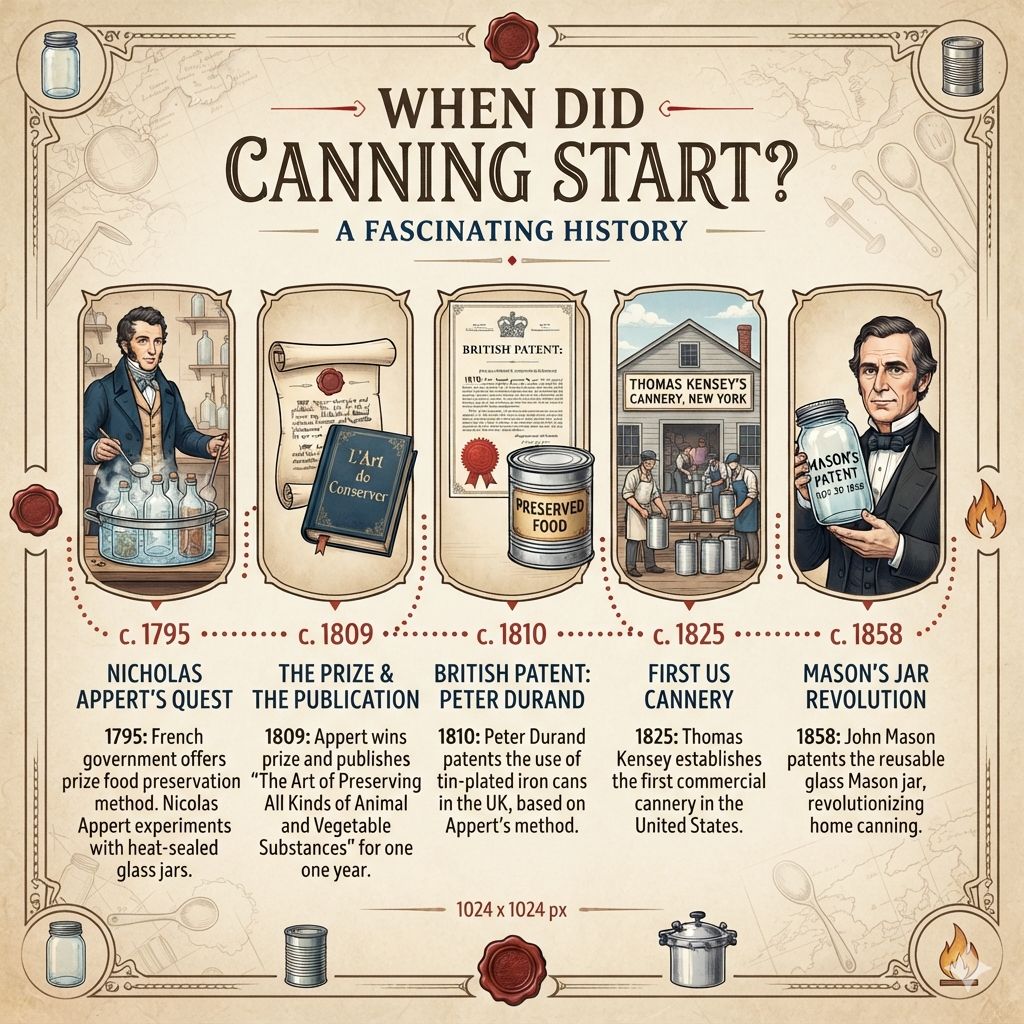
In short, food canning officially began in France around 1809 when Nicolas Appert developed a method of preserving food in sealed glass jars, driven by a government prize to find a way to feed Napoleon’s armies. This invention laid the groundwork for modern canning techniques.
Key Takeaways
- The invention of canning was a direct response to the need for a reliable food preservation method for military use, particularly for Napoleon’s armies.
- Nicolas Appert, a French confectioner, is credited with developing the first successful canning process in the early 19th century, using sealed glass jars and heat sterilization.
- Early canning relied on glass containers and a lengthy heating process, which evolved significantly with the introduction of tin cans and improved sterilization techniques.
- The widespread adoption of canning revolutionized food availability, enabling longer military campaigns, facilitating exploration, and transforming domestic food storage.
- Advancements in canning technology, including sterilization methods and can manufacturing, have continued to improve safety and efficiency over the centuries.
The Genesis of Canning: A Military Imperative
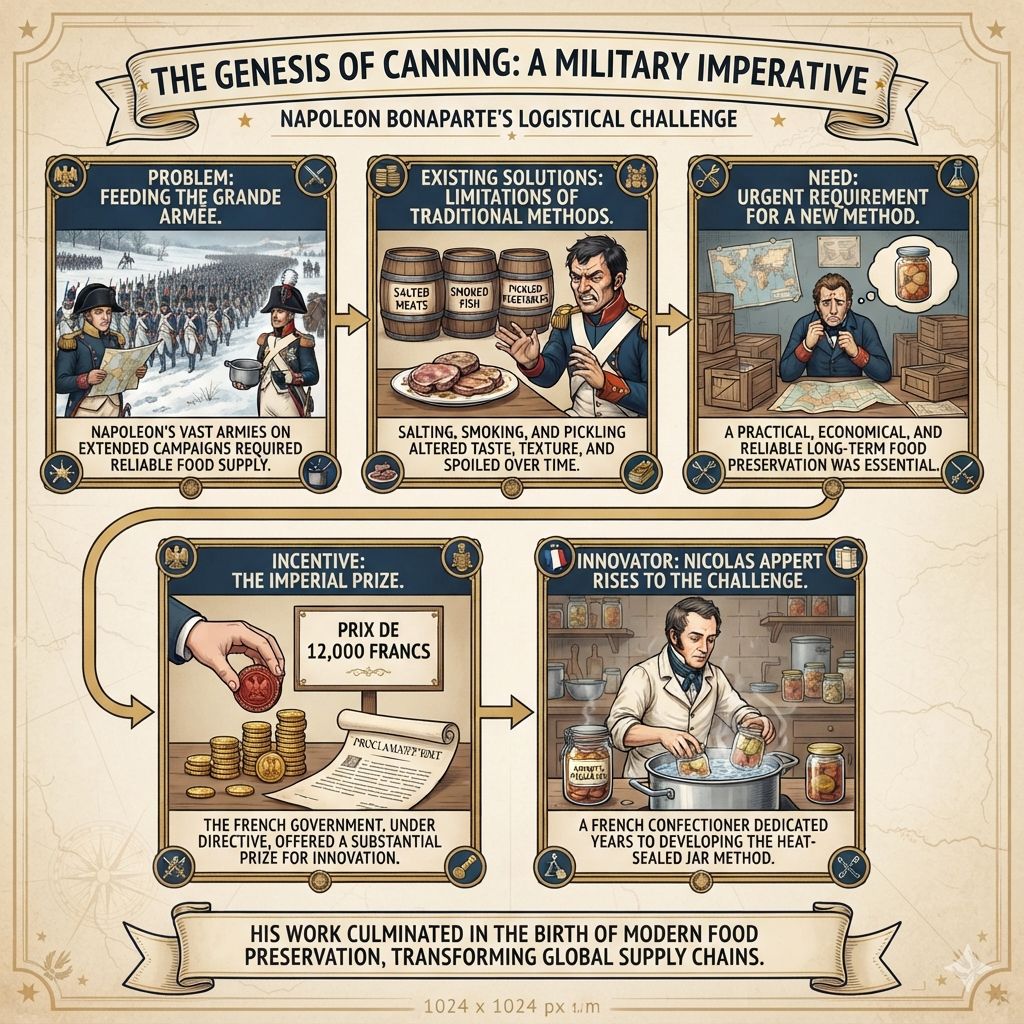
The question of when did canning start is intrinsically linked to the ambitions of one of history’s most influential military leaders, Napoleon Bonaparte. The late 18th and early 19th centuries were a time of frequent and extensive warfare across Europe. Feeding vast armies on extended campaigns proved to be a significant logistical challenge, often dictating the success or failure of military endeavors.
Existing methods of food preservation, such as salting, smoking, and pickling, had limitations; they altered the taste and texture of food and were not always effective in preventing spoilage over long periods.
Recognizing this critical vulnerability, the French government, under Napoleon’s directive, offered a substantial prize of 12,000 francs to anyone who could devise a practical and economical method for preserving food. This prize acted as a powerful incentive for innovation. Nicolas Appert, a French confectioner and brewer, dedicated years of his life to experimenting with various food preservation techniques.
His work culminated in a method that would eventually transform food supply chains worldwide.
- Problem: Feeding Napoleon’s large, mobile armies on long campaigns was a major logistical challenge.
- Existing Solutions: Salting, smoking, and pickling were common but had significant drawbacks.
- Need: A new, reliable, and economical method for long-term food preservation was urgently required.
- Incentive: The French government offered a substantial prize for a viable solution.
- Innovator: Nicolas Appert, a French confectioner, devoted himself to solving this problem.
Nicolas Appert’s Breakthrough: The “Appertization” Process
Nicolas Appert’s groundbreaking method, which he termed “appertization,” involved placing food into glass jars, sealing them tightly with corks and wax, and then immersing these jars in boiling water for a specific period. The exact duration of boiling varied depending on the type of food. Appert’s genius lay in understanding that heat, when applied correctly and followed by a complete seal, could prevent spoilage.
He carefully documented his experiments and the results, showcasing the effectiveness of his method in preserving a wide variety of foods, including meats, vegetables, fruits, and dairy products.
Appert published his findings in 1810 in a book titled “The Art of Preserving All Kinds of Animal and Vegetable Substances for Several Years.” This publication was a crucial step in disseminating his discovery. While Appert’s process was remarkably effective, it was also labor-intensive and relied on relatively fragile glass containers. The high cost and susceptibility to breakage meant that widespread adoption was slow, especially among the general populace.
However, his invention laid the essential foundation for all future canning technologies and provided a definitive answer to when did canning start in a practical sense.
Key Elements of Appert’s Method:
- Food Preparation: Foods were prepared and placed into clean glass bottles or jars.
- Sealing: Jars were sealed with cork stoppers, secured with wire or string, and then sealed with wax to ensure airtightness.
- Heating: The sealed containers were submerged in boiling water baths. The duration of heating depended on the type of food being preserved.
- Cooling: After heating, the jars were removed and allowed to cool gradually.
- Storage: Preserved foods could then be stored for extended periods in a cool, dry place.
Appert’s method was revolutionary because it addressed the core issue of microbial spoilage by using both heat and an airtight seal. This two-pronged approach was far more effective than any previous preservation technique and provided soldiers with access to nutritious food regardless of season or location.
The Transition to Tin Cans: A New Era
While Nicolas Appert’s glass-jar method was foundational, its practical limitations spurred further innovation. The real revolution in mass food preservation, which made canning accessible and affordable on a global scale, came with the adoption of tin-plated iron cans. This transition occurred in Britain shortly after Appert’s invention.
In 1810, Peter Durand, an English inventor, patented a tin canister for preserving food. Durand’s design aimed to create a more durable and robust container than glass, one that could withstand the rigors of transportation and handling.
Durand’s patent described a method using tin cans, which were more resistant to breakage than glass jars. However, the early production of these tin cans was slow and laborious. They were often made by hand, hammered into shape, and then sealed.
The process of opening them was also challenging, often requiring a hammer and chisel. Despite these initial hurdles, the durability of tin cans made them ideal for military use and long-distance shipping, especially for naval expeditions and colonial ventures. The ability to transport preserved food without significant risk of breakage was a game-changer.
| Feature | Glass Jars (Appert) | Tin Cans (Durand) |
|---|---|---|
| Durability | Fragile, prone to breakage | Durable, resistant to impact |
| Portability | Less suitable for rough transport | Ideal for long voyages and military campaigns |
| Opening Method | Cork stopper, wax seal | Initially required tools (chisel, hammer) |
| Mass Production | Limited by glass manufacturing | Eventually revolutionized by industrialization |
The shift to tin cans, though initially challenging to open, proved to be a critical step in making preserved food a practical commodity for broader applications beyond the battlefield.
The Impact of Canning on Society and Exploration
Once the process of canning, particularly with tin cans, became more industrialized and accessible, its impact on society was profound. It fundamentally altered how people sourced and consumed food. For the first time, it was possible to store food for extended periods without significant loss of nutritional value or quality, regardless of the season.
This breakthrough had far-reaching consequences for exploration, military logistics, and the daily lives of ordinary citizens.
During the Age of Exploration and into the 19th century, naval expeditions were often constrained by the need to carry vast quantities of perishable provisions. Canning provided a solution, allowing ships to undertake longer voyages into uncharted territories. Sailors and explorers could be sustained with reliable food sources, enabling them to venture further and stay at sea for unprecedented durations.
This contributed significantly to mapping the globe and understanding new regions. Similarly, military campaigns could be provisioned more effectively, reducing the reliance on local foraging and supply lines, which were often vulnerable.
- Extended Voyages: Exploration missions could cover greater distances and last longer.
- Military Logistics: Armies could be supplied with food independent of local conditions.
- Food Security: Reduced reliance on seasonal harvests and local availability of food.
- Urbanization: Provided a consistent food supply for growing urban populations.
- Economic Development: Fueled the growth of food processing industries and related trades.
- Dietary Variety: Introduced a wider range of foods to diets throughout the year.
The ability to preserve food also played a crucial role in the development of industrialized nations. As populations shifted to urban centers, reliable and affordable food sources became paramount. Canning helped ensure that even those living far from farms could access a diverse diet, contributing to public health and stability.
Advancements in Canning Technology Over Time
The journey of food canning didn’t stop with Appert and Durand. Continuous advancements in science and technology have refined the canning process, making it safer, more efficient, and more versatile. A critical area of development was the understanding of microorganisms and their role in spoilage.
Louis Pasteur’s work in the mid-19th century on pasteurization provided the scientific basis for the heat sterilization techniques used in canning. This deeper understanding allowed for more precise control over heating times and temperatures, crucial for killing harmful bacteria while preserving food quality.
The development of industrial machinery in the late 19th and early 20th centuries dramatically increased the speed and scale of can production and filling. Automated machinery reduced the manual labor involved, lowered costs, and improved consistency. Innovations in can manufacturing, such as the widespread adoption of double-seaming technology, created more reliable seals that were less prone to leakage.
Furthermore, the development of retort pouch technology and aseptic packaging in the latter half of the 20th century offered new alternatives to traditional rigid cans, providing lighter, more flexible packaging options.
Key Technological Milestones in Canning:
- 1850s-1860s: Louis Pasteur’s research on germ theory and pasteurization provided a scientific foundation for heat sterilization.
- Late 19th Century: Industrialization of can manufacturing and filling processes, leading to mass production.
- Early 20th Century: Introduction of double-seaming technology for more secure can sealing.
- Mid-20th Century: Development of improved heating and cooling methods for more consistent results.
- Late 20th Century: Emergence of aseptic packaging and retort pouches as alternatives to traditional cans.
- Modern Era: Continued refinement of sterilization processes, material science for can linings, and quality control measures.
These ongoing innovations have ensured that canning remains a relevant and vital method for preserving food globally, contributing to food security and consumer convenience.

Canning Today: Modern Practices and Global Significance
Today, food canning is a multi-billion dollar global industry. While the fundamental principles established by Appert and Durand remain, modern canning operations are highly sophisticated. Automated facilities ensure precise control over every stage of the process, from food preparation and filling to sealing and sterilization.
The types of food that can be canned have expanded dramatically, encompassing everything from fruits, vegetables, and meats to soups, sauces, and even ready-to-eat meals.
Safety is a paramount concern in modern canning. Strict regulations and quality control measures are in place to prevent foodborne illnesses. This includes rigorous testing of raw materials, monitoring of processing parameters, and checks on the integrity of the final sealed product.
The development of lacquered or coated tin cans and BPA-free linings has also addressed health concerns associated with the materials used in can construction. Globally, canning plays a crucial role in food security, particularly in regions where access to fresh food is limited or seasonal. It allows for the efficient storage and distribution of food, helping to combat hunger and malnutrition.
Furthermore, it supports the food processing industry, creating jobs and contributing to national economies.
| Aspect | Modern Canning | Historical Canning |
|---|---|---|
| Automation | High level of automation in all stages | Primarily manual labor |
| Scientific Understanding | Based on advanced microbiology and food science | Empirical observation and trial-and-error |
| Container Safety | Modern linings, BPA-free options, strict quality control | Early concerns about lead solder and tin contamination |
| Speed & Efficiency | High-speed production lines | Slow, time-consuming processes |
| Regulatory Oversight | Strict government regulations and industry standards | Limited or no formal regulation |
The evolution from a military necessity to a cornerstone of global food systems highlights the enduring significance of the canning process.
Frequently Asked Questions
When was the first successful food canning process developed?
The first successful food canning process was developed by Nicolas Appert in France around 1809. He created a method using sealed glass jars and heat sterilization to preserve food, primarily to supply Napoleon’s military forces.
What was the primary motivation for inventing canning?
The primary motivation was a military need. Napoleon Bonaparte’s government offered a significant prize for a practical method of preserving food to sustain his armies during long campaigns and expeditions.
Who is credited with inventing the tin can for food preservation?
Peter Durand, an English inventor, patented the use of tin canisters for preserving food in 1810, shortly after Appert’s invention. This innovation was crucial for making canning more durable and scalable.
How did early canning differ from modern canning?
Early canning relied heavily on manual labor, glass jars, and less precise heating methods. Modern canning utilizes highly automated processes, tin cans with improved seals, and scientifically controlled sterilization techniques for greater safety and efficiency.
What is the scientific principle behind canning?
The scientific principle is to heat-seal food in an airtight container to destroy existing microorganisms and prevent new ones from entering. This process inhibits spoilage and extends the shelf life of food significantly.
Final Thoughts
The question of when did canning start leads us back to the early 19th century and the inventive spirit of Nicolas Appert, driven by military necessity. From its humble beginnings as a way to feed armies, canning has evolved into a vital global industry that ensures food availability and security. The transition from fragile glass jars to durable tin cans, coupled with scientific advancements, has made preserved food a cornerstone of modern diets and a testament to human ingenuity.
Related pick: Check today's price on Amazon
Products related to this article
Sponsored / affiliate links. As an Amazon Associate I earn from qualifying purchases. I may earn additional commission from eligible campaigns.