Method Bathroom Cleaner Review
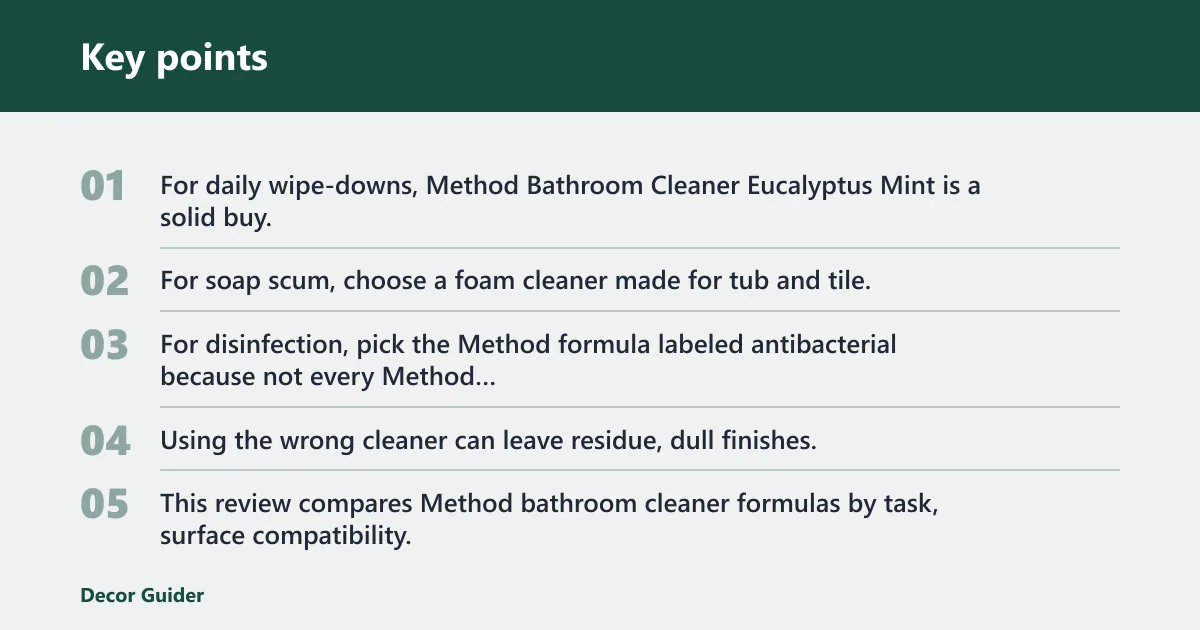
For daily wipe-downs, Method Bathroom Cleaner Eucalyptus Mint is a solid buy. For soap scum, choose a foam cleaner made for tub and tile. For disinfection, pick the Method formula labeled antibacterial because not every Method bathroom spray is meant to kill germs. Using the wrong cleaner can leave residue, dull finishes, or miss the cleaning job you needed. This review compares Method bathroom cleaner formulas by task, surface compatibility, scent, and safety so you can buy the right one.
Verdict

- Removes mold and mildew stains effectively
- Helps dissolve soap scum build-up
- Bleach-free formula for safe surfaces
Based on the product details and label claims, the eucalyptus mint spray is the best all-purpose pick for routine bathroom cleaning on sinks, tubs, showers, tile, porcelain, fiberglass, and chrome. It is a 28-ounce spray bottle with a biodegradable formula, plant-based surfactants, and a eucalyptus mint scent. It is not the strongest answer for heavy soap scum or hard water stains.
Specs at a glance
| Formula | Best for | Key claim or format | Size or note |
|---|---|---|---|
| Method Bathroom Cleaner Eucalyptus Mint | Routine bathroom cleaning | Biodegradable, bleach-free, plant-based surfactants | 28-ounce spray bottle; eucalyptus mint scent |
| Method Antibacterial Bathroom Cleaner | Bathroom disinfection | Kills 99.9% of germs; EPA-registered formula | Spearmint scent; 10-minute contact time |
| Method Foaming Tub + Tile Cleaner | Soap scum and tub or tile buildup | Foaming spray format; vertical spray nozzle | 28 ounces |
| Method Daily Shower Spray | Daily maintenance | Quick spray-and-leave use | Built for shower buildup prevention |
| Packaging notes | Sustainability-minded buyers | Recyclable materials, recycled ocean plastic, cruelty-free positioning | Shown across Method cleaning bottle sustainability claims |
Who it
Method bathroom cleaner fits shoppers who want a light, spray-on cleaner for regular bathroom upkeep, not a heavy-duty restoration product. It also suits buyers who care about plant-based surfactants, recyclable materials, recycled ocean plastic, and cruelty-free positioning. It is a weaker match if your main problem is thick soap scum, mineral buildup, or germ disinfection.
Say your guest bath gets wiped down twice a week, the sink has toothpaste splatter, and the chrome faucet needs a quick clean without a strong bleach odor. The eucalyptus mint spray fits that job well. Suppose the shower door has cloudy mineral lines and the tile has been left alone for weeks; you will likely need more than the standard spray-and-wipe routine.
Pros and cons
- Pros: good for routine cleaning, works on common bathroom surfaces, and comes in a straightforward spray bottle.
- Pros: the eucalyptus mint formula is biodegradable and bleach-free, with plant-based surfactants.
- Pros: Method also offers an antibacterial version and a foaming tub-and-tile option for narrower jobs.
- Cons: soap scum often needs scrub time and repeat passes.
- Cons: hard water stains can resist eco cleaners and may need stronger chemistry.
- Cons: not every Method bathroom spray disinfects, so the label matters.
What works
Method bathroom cleaner works best on everyday bathroom soil: light grime, toothpaste film, and regular wipe-downs on sinks, tubs, showers, tile, porcelain, fiberglass, chrome, and shower doors. House Cleanify lists the cleaner for toilets, tiles, sinks, tubs, and shower doors, and HomeFixMagic says it is effective on tile, porcelain, fiberglass, and chrome. That range makes it a practical general-purpose choice.
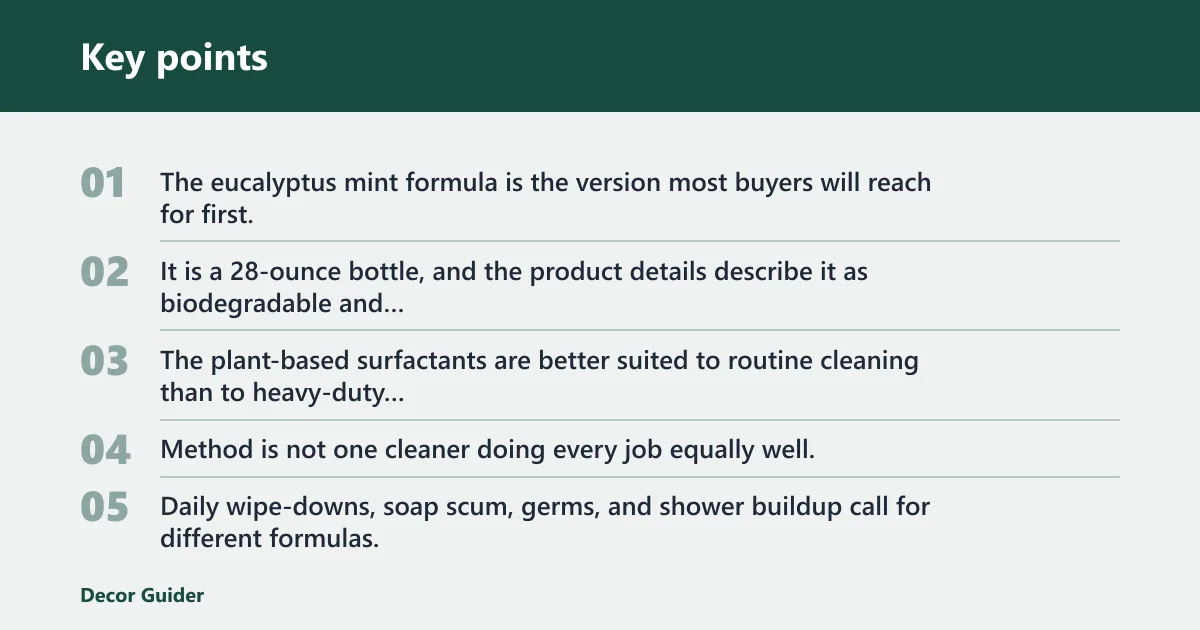
The eucalyptus mint formula is the version most buyers will reach for first. It is a 28-ounce bottle, and the product details describe it as biodegradable and bleach-free. The plant-based surfactants are better suited to routine cleaning than to heavy-duty stain removal, which is why the formula feels more like a maintenance cleaner than a rescue product.
Which Method formula is best for each bathroom mess?
Method is not one cleaner doing every job equally well. Daily wipe-downs, soap scum, germs, and shower buildup call for different formulas, and that is where many shoppers get tripped up. The right pick depends on what you are removing and how much time you want to spend scrubbing.
Daily wipe-downs
For everyday splashes, the eucalyptus mint bathroom cleaner is the best all-round choice. It suits sinks, tubs, showers, tile, porcelain, fiberglass, and chrome when the soil is light and the goal is a quick reset. If you want a spray bottle you can grab after the sink gets spotted, this is the easiest fit.
Soap scum
For soap scum, Method Foaming Tub + Tile Cleaner is the better match because foam clings better to vertical surfaces and gives the chemistry more time on the mess. Soap scum is a common bathroom soil that usually needs scrub time and often needs repeated passes. A standard spray can work, but it is not the fastest path.
Germ control
If you need disinfection, use Method Antibacterial Bathroom Cleaner, not the regular eucalyptus mint spray. Its claim is to kill 99.9% of germs, and it requires a 10-minute contact time. That wait matters. If you wipe it away too soon, you do not get the stated disinfecting performance.
Shower buildup
For keeping shower buildup from getting out of hand, Method Daily Shower Spray is the maintenance option. It is positioned for daily use and spray-and-leave convenience, so it is meant to slow buildup before it turns into a scrubbing project. It is a prevention step, not a cure for stubborn deposits.
Method bathroom cleaner decision matrix
This matrix ties mess type, surface, and user priority to the best Method formula. It also tells you when to skip a formula and what to remember about contact time. That keeps you from buying a general cleaner when the job needs a specialty spray.
| Mess type | Surface | User priority | Best Method formula | Buy this if | Skip this if | Contact-time reminder |
|---|---|---|---|---|---|---|
| Daily splatter and light grime | Sink, tub, shower, tile, porcelain, chrome | Fast wipe-down | Eucalyptus Mint Bathroom Cleaner | You want a routine spray for regular upkeep | You need disinfection or heavy stain removal | Use as directed on the label; no special dwell time is listed for routine cleaning |
| Soap scum | Tub, tile, shower walls | Less scrubbing | Foaming Tub + Tile Cleaner | You want foam that clings to vertical surfaces | You expect a one-pass fix on thick buildup | Let the foam sit long enough for the soil to loosen, then scrub if needed |
| Germs | Bathroom touch points and washable surfaces | Disinfection | Antibacterial Bathroom Cleaner | You need a labeled antibacterial product | You want a quick wipe-and-done routine | Wait 10 minutes before wiping for the germ-kill claim |
| Shower buildup prevention | Shower walls and doors | Low effort | Daily Shower Spray | You want to slow buildup between deep cleans | You need to remove existing hard deposits | Spray and leave; this is a maintenance product |
| Hard water stains | Glass, tile, chrome | Stain removal | None is a sure fit | You can repeat applications and scrub | You expect one eco spray to erase mineral deposits | Contact time alone may not be enough; stronger chemistry may be needed |
What surfaces can it clean?
Method bathroom cleaner is commonly used on tile, porcelain, fiberglass, chrome, sinks, tubs, showers, and shower doors. That covers the main bathroom surfaces most people clean each week. The safest approach is to treat it as a spray cleaner for washable, finished surfaces, then check the label before using it on anything special.
Tile and grout lines
Tile is a good match for Method’s regular bathroom spray and for the foaming tub-and-tile version. Grout lines often need extra agitation because soil sits in the joints. If the dirt is mostly surface grime, the cleaner is a reasonable fit. If the grout is stained or mineral-heavy, expect repeat passes.
Porcelain and fiberglass
Porcelain and fiberglass are among the surfaces HomeFixMagic lists for the cleaner. That makes the spray suitable for common tubs, sinks, and shower inserts, provided the finish is ordinary and washable. Do not use a cleaner on a surface you cannot confidently identify.
Chrome fixtures and shower doors
Chrome and shower doors are sensible targets for a light spray cleaner because they usually need film removal more than deep scrubbing. The eucalyptus mint formula should work well for routine spots, while soap scum or water spots may need the foaming cleaner or a second pass. Use a soft cloth to avoid scratching polished finishes.
When to avoid sealed stone or specialty finishes
Do not assume every spray cleaner is safe on sealed stone, natural stone, or specialty finishes. Those surfaces often need a pH-appropriate product and clearer label approval. If the label does not explicitly approve the surface, skip it and use a cleaner made for that material.
What does not?
The main drawback is strength. Method bathroom cleaner is good for routine grime, but soap scum and hard water stains can outrun it. Soap scum often needs scrub time and repeated passes. Hard water stains may resist eco cleaners and often need stronger chemistry or more effort than a standard spray can provide.
Another limit is formula confusion. The regular eucalyptus mint spray is not the antibacterial cleaner, and the daily shower spray is not a deep-cleaning product. Use the wrong one and the job gets slower. Also, a cleaner that works on tile or chrome should not be assumed safe for sealed stone or specialty coatings.
Safety and use basics
Method bathroom cleaner is best treated like any household spray: read the label, use ventilation, and follow the directions printed on the bottle. For the antibacterial formula, the 10-minute contact time is not optional if you want the germ-kill claim. If the product label says to rinse a surface, rinse it.
Safe Household Cleaning lists the ingredients as water, alcohol denat, lactic acid, and caprylyl capryl glucoside, and says the product is effective unless users are sensitive to sulfates or fragrances. That does not mean it is right for everyone. Good airflow matters, and anyone with fragrance sensitivity should check the scent before buying.
For family and pet households, the common rule is simple: keep people and pets away from wet surfaces until the cleaner has dried or been rinsed as directed. Do not mix bathroom sprays with bleach, ammonia, or other cleaners. Mixing chemicals creates avoidable risk.
Pros and cons for regular bathroom cleaning
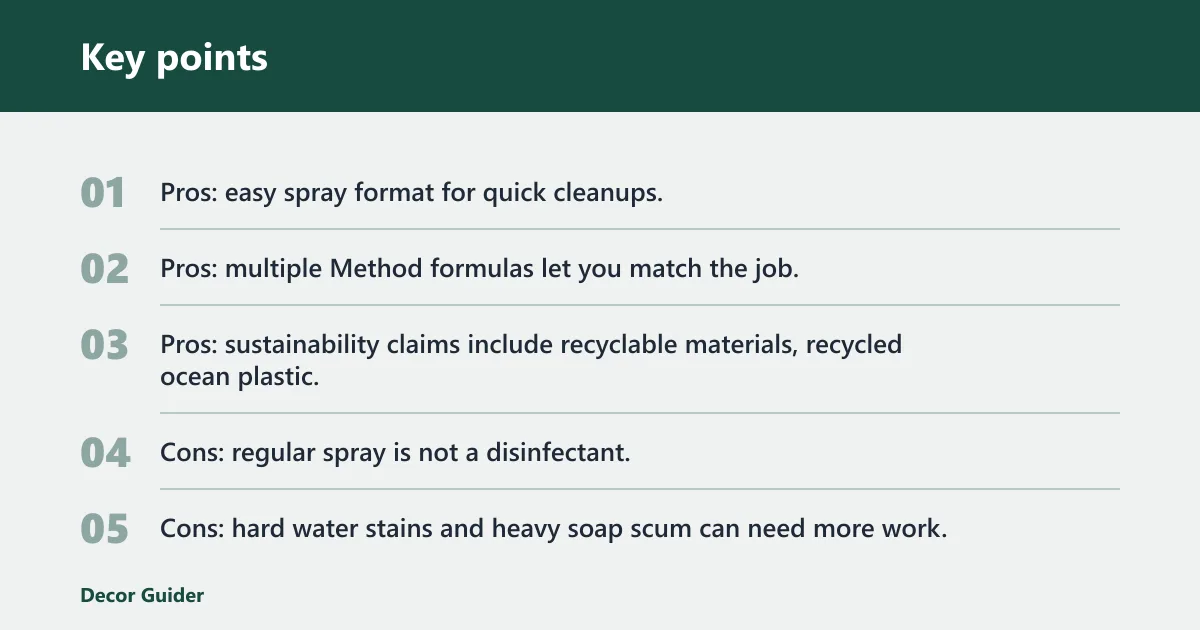
- Pros: easy spray format for quick cleanups.
- Pros: multiple Method formulas let you match the job.
- Pros: sustainability claims include recyclable materials, recycled ocean plastic, and cruelty-free positioning.
- Cons: regular spray is not a disinfectant.
- Cons: hard water stains and heavy soap scum can need more work.
- Cons: some buyers will prefer a stronger cleaner for neglected bathrooms.
Alternatives
If Method does not match your cleanup goal, the main alternative in the comparison set is a stronger foaming multi-surface bathroom spray. Compare the job first, then the price, then the scent. A stronger cleaner is useful when soap scum is thick or when you want a single product with more bite.

- Foaming power cuts through soap scum easily
- Includes starter kit bottle and refills
- Streak-free shine on tiles and glass
Mr. Clean Clean Freak Foaming Bathroom Surface Cleaner is the comparison pick if you want a foaming format and a grapefruit scent. Based on its product details, it is built for soap scum and streak-free shine on tiles and glass, and the starter kit plus refill bundle gives you more liquid in one purchase. The drawback is that it is not a Method formula, so it does not match Method’s plant-based positioning or bottle sustainability claims.
Within Method’s own line, the strongest job match is usually this: eucalyptus mint for daily cleaning, foaming tub and tile for soap scum, antibacterial for disinfection, and daily shower spray for prevention. That is the most practical way to buy Method. Treating every bottle as interchangeable is the fastest route to a weak result.
Should you buy it?
Buy Method if you want a reliable everyday bathroom cleaner and you value a lighter formula, a straightforward spray bottle, and sustainability-minded packaging. Buy the antibacterial version only when you need disinfection. Buy the foaming or daily shower spray versions when the mess is soap scum or recurring buildup, not just general grime.
If your bathroom has heavy hard water stains, thick soap scum, or a surface that needs a specialty cleaner, Method may be only part of the answer. In that case, choose a stronger cleaner or a surface-specific product. For regular bathroom cleaning, though, Method is worth it because the line lets you match the formula to the task instead of forcing one spray to do everything.
Frequently asked questions
Is Method bathroom cleaner good?
Yes, Method bathroom cleaner is good for routine bathroom cleaning when you choose the right formula for the job. The eucalyptus mint spray works well for light grime and regular wipe-downs, while the foaming tub-and-tile and antibacterial versions cover more specific needs. It is less convincing on heavy stains and mineral buildup.
Is Method bathroom cleaner safe?
It is generally safe when you use it as directed, with ventilation and the label instructions followed closely. The antibacterial version needs a 10-minute contact time, and all formulas should be kept off surfaces the label does not approve. If you have fragrance sensitivity, check the scent and ingredient list before buying.
Which Method bathroom cleaner is best?
The best Method bathroom cleaner depends on the mess. Eucalyptus mint is best for everyday cleaning, foaming tub and tile is better for soap scum, antibacterial is best for disinfection, and daily shower spray is best for buildup prevention. There is no single Method bottle that wins every bathroom task.
How do you use Method bathroom cleaner?
Spray the cleaner onto the approved surface, let it sit long enough for the job, then wipe or scrub as needed. For the antibacterial formula, keep the surface wet for 10 minutes before wiping. On soap scum or buildup, expect more dwell time and a second pass if the residue is heavy.
Does Method bathroom cleaner work on soap scum?
It can help with soap scum, but the job often needs scrubbing and repeat passes. Method Foaming Tub + Tile Cleaner is the better choice for that mess because the foam clings to vertical surfaces longer. If the scum is thick or old, a standard spray will usually feel slow.
Is Method bathroom cleaner good for hard water stains?
Not usually as a first-choice solution. Hard water stains are stubborn mineral deposits, and House Cleanify notes that Method may struggle with them. If the stains are light, repeated applications may help. If they are set in, a stronger acid-based cleaner or a stone-safe mineral remover is often the better route.
What surfaces can Method bathroom cleaner be used on?
It is used on sinks, tubs, showers, tile, porcelain, fiberglass, chrome, and shower doors. Some sources also list toilets for the general bathroom cleaner. Avoid assuming it is safe for sealed stone or specialty finishes unless the label explicitly says so, because those surfaces can need a different chemistry.
Is Method bathroom cleaner worth it for regular bathroom cleaning?
Yes, if your main goal is routine cleaning rather than deep restoration. Method gives you a simple spray format, several formula choices, and sustainability-minded packaging claims. It is worth it for everyday bathrooms, but less worth it if most of your cleaning time is spent fighting hard water stains or heavy soap scum.
Products related to this article
Sponsored / affiliate links. As an Amazon Associate I earn from qualifying purchases. I may earn additional commission from eligible campaigns.