How to Fix Soft-Close Drawer Slides That Slam
Check the drawer with the load removed: if it still slams, the soft-close damper or slide is faulty; if it closes normally empty, fix alignment or load imbalance first. If you ignore the root cause, the drawer keeps slamming, joints wear faster, and you may replace the wrong slide. This guide shows how to identify the failure mode, inspect the hardware, and correct the right part.
This guide is part of our Dresser and Drawer Repair: Fixing Sticking Drawers, Slides, Smells and Finishes series.
What you’ll need


- Phillips screwdriver
- Drill/driver
- Tape measure
- Level
- Square
- Shims
- Replacement screws
- Replacement soft-close slide or damper, if the part is worn or unavailable separately
Drawer symptom decision table
| Drawer behavior | Most likely fault | Inspection step | Recommended fix |
|---|---|---|---|
| Slams at the end | Damper failure or a slide that has lost closing resistance | Pull the drawer out and check whether the last 1 to 2 inches of travel slow down at all | Inspect for leakage, broken linkage, or weak spring action; replace the damper or the full slide if the part is not serviceable |
| Bounces open after closing | Misadjusted catch, excess friction, or a drawer that is out of square | Watch whether the drawer fully seats on both sides and whether one slide reaches home first | Realign the slides, tighten loose screws, and check the box for square |
| Closes only on one side | Racking, sagging, or unequal side-to-side clearance | Measure both gaps and compare front and rear positions | Shim the low side, reset the mounting screws, and square the drawer box |
| Closes slowly but not softly | High friction from debris, worn bearings, or a weak damper | Move the drawer by hand and feel for drag before the last 1 to 2 inches | Clean the track, inspect the ball-bearing slide, and replace damaged parts |
| Sticks halfway closed | Binding, bent rail, or a warped drawer box | Look for rub marks, bent metal, and swollen wood edges | Correct alignment first; replace bent or worn hardware if the drawer still binds |
Why the drawer slams
The fast check is simple: remove the load, then close the empty drawer. If the last 1 to 2 inches still do not slow down, the integrated damper or slide mechanism is often the likely fault. If the empty drawer closes softly, the problem usually comes from weight, imbalance, or misalignment rather than a dead damper.
Identify the slide type first
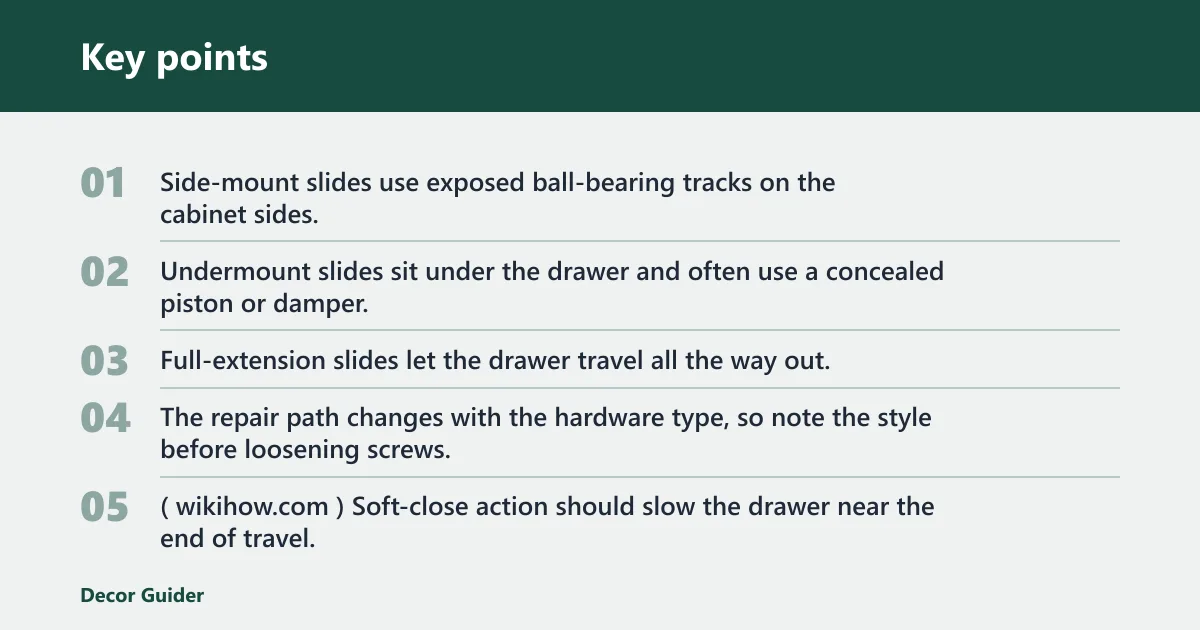
Side-mount slides use exposed ball-bearing tracks on the cabinet sides. Undermount slides sit under the drawer and often use a concealed piston or damper. Full-extension slides let the drawer travel all the way out; partial-extension models stop short. The repair path changes with the hardware type, so note the style before loosening screws. (Wikihow)
Check the last 1 to 2 inches
Soft-close action should slow the drawer near the end of travel, then pull it shut with a controlled finish. If resistance disappears early, the damper mechanism may be leaking oil, losing spring force, or missing its linkage. If resistance feels uneven on one side, look for alignment or racking before replacing parts.
Say your 18-inch undermount drawer closes softly when empty, but a stack of pans makes it snap shut. That points to load imbalance first, not a failed damper. Shift the heaviest items toward the center and retest before you buy parts.
How do you remove the drawer?
Take the drawer out with the slides fully visible, then inspect both sides at the same time. Most clip-release slides let you press a lever on each member, then pull the drawer straight out. Set it on a flat surface so you can check the box, corners, and bottom without the cabinet in the way.
Release the slide clips or levers
On many side-mount ball-bearing slides, the inner member releases with a tab or lever. On undermount systems, the drawer often lifts after you release clips under the front corners. If the drawer sticks, do not pry hard. That can bend the rail or tear a rear bracket from the cabinet.
Inspect the box on a flat surface
Check for square corners, a flat bottom, and loose dovetail or butt joints. A warped drawer box changes slide geometry and can keep the damper from engaging at the right point. Also check weight distribution. A heavy front load can make one side close before the other.
How do you fix alignment?
Alignment problems are a common cause of soft-close failure. If the slides are not level, the drawer can rack, bind, or drift open. If the front-to-back position is off, the damper may engage late or miss the catch point. Fix the cabinet setup before replacing a slide that is still mechanically sound.
Check side-to-side clearance
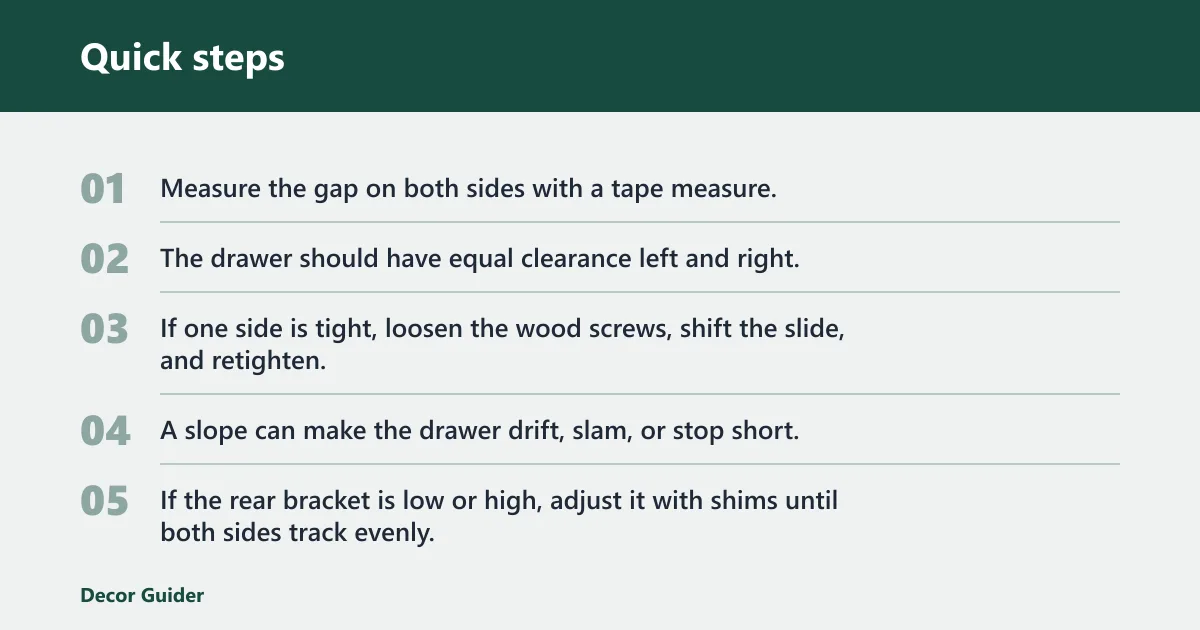
Measure the gap on both sides with a tape measure. The drawer should have equal clearance left and right, with no rubbing at the face frame or cabinet side. If one side is tight, loosen the wood screws, shift the slide, and retighten. Use a square to keep the slide parallel.
Verify levelness and front-to-back position
Set a level on the slide or drawer bottom. A slope can make the drawer drift, slam, or stop short. If the rear bracket is low or high, adjust it with shims until both sides track evenly. For frameless cabinets, confirm the front mounting points sit at the same height.
Tighten loose screws and reset the slide
Loose wood screws let the slide move under load. That creates racking and changes how the damper meets the drawer at the end of travel. Tighten the screws first. If the holes are stripped, use replacement screws with a better bite. A drill/driver helps only if the pilot holes are already sized correctly.
Suppose a 24-inch side-mount drawer closes cleanly on the left but drags on the right after a quick cabinet repair. That usually means the right slide shifted by a few millimeters. Re-square the drawer, then retest before touching the damper.
How do you fix the damper?
If alignment is correct and the drawer still slams, inspect the damper mechanism itself. Oil-filled dampers can leak. Spring-assisted units can lose force or break at the linkage. If the part still resists in the final 1 to 2 inches but feels weak, adjustment may help. If it feels dead, replacement is usually the better call.
Look for leakage, broken linkage, or weak return action
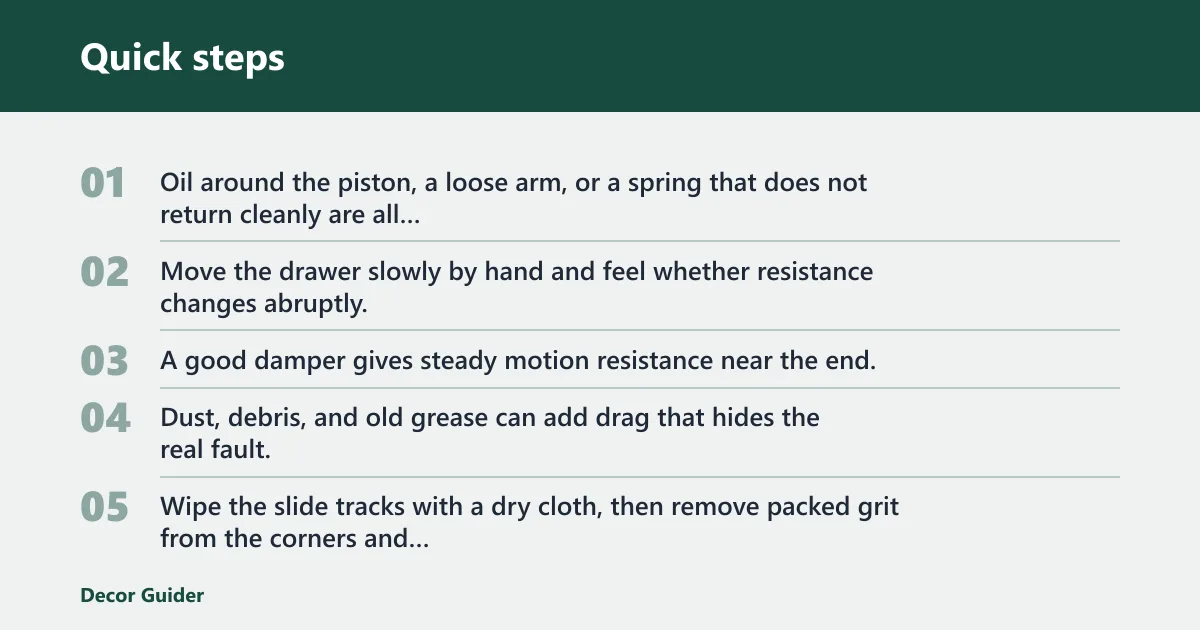
Oil around the piston, a loose arm, or a spring that does not return cleanly are all failure signs. Move the drawer slowly by hand and feel whether resistance changes abruptly. A good damper gives steady motion resistance near the end, then closes the drawer without a snap.
Clean the track and check the running surfaces
Dust, debris, and old grease can add drag that hides the real fault. Wipe the slide tracks with a dry cloth, then remove packed grit from the corners and grease buildup from the bearing race. Look for worn rollers or bearings, bent rails, and rough spots. If a ball-bearing slide feels gritty or uneven, the closing speed can change even when the damper is intact.
Decide between adjustment, part replacement, or full replacement
Use adjustment when the mechanism still slows the drawer but engages too early, too late, or unevenly. Replace the damper if it leaks or the linkage is broken. Replace the full slide if the model is worn, the part is unavailable, or the rail is bent. Old hardware with missing parts is usually not worth piecemeal repair.
What should you check before replacing soft close drawer slides?
Check the drawer weight, the mounting style, and the condition of the box before ordering new slides. A heavy or unevenly loaded drawer can mimic slide failure. Face-frame and frameless cabinets use different brackets and mounting points, so the new hardware must match the cabinet and drawer length.
Confirm the slide length and weight rating
Measure the old slide from the front edge to the back end. Match that length before buying replacements. Also check the weight rating. A slide that is too light for the drawer contents can close slowly one day and slam the next as the load shifts.
Check mounting hardware and rear support
Loose rear brackets, bent clip releases, or poor screw bite can change slide geometry. On face-frame cabinets, the front mounting point matters as much as the rear. On frameless cabinets, the side panel must be flat enough for the slide to sit true. Shims help when the cabinet side is not perfectly level.
Look for drawer-box damage
Swelling, warping, and spread joints can force the slide out of line. If the corners are no longer square, the soft-close mechanism may never catch at the right point. Repair the box first when the drawer is visibly out of square or the bottom bows under load.
How do you install soft close drawer slides correctly?
Install the slides level, parallel, and matched to the drawer size. A soft-close slide works only when both sides move together and the drawer face seats evenly. Start with the cabinet side, then fit the drawer, then test the closing speed before fully loading the drawer.
- Measure the cabinet opening and confirm the slide length matches the drawer depth.
- Set the cabinet member level and square on both sides.
- Drive the front and rear screws by hand first, then tighten them after checking alignment.
- Install the drawer member so both sides sit at the same height.
- Test the empty drawer several times, then add weight and retest.
If that didn’t work, try this next
- Loosen the screws, add 1 to 2 mm of shim only where the drawer sags, then retighten.
- Check whether the clip release is fully engaged on both sides.
- Replace the slide if the damper still misses the final closing range.
Common mistakes
- Replacing the slide before checking level, clearance, and square.
- Assuming every slam means a failed damper.
- Ignoring drawer weight distribution after moving contents back in.
- Leaving a bent rail, loose rear bracket, or stripped screw hole in place.
- Reinstalling the drawer without testing the full closing cycle several times.
- Using mismatched hardware on face-frame versus frameless cabinets.
Picture a 30-inch drawer that closes smoothly when empty, then starts bouncing open after the silverware tray is refilled. The fix is usually to rebalance the load or correct the slide height, not to replace the entire cabinet set.
Frequently asked questions
How do I fix soft close drawer slides that slam?
Start with the empty drawer. If it still slams, inspect the damper, linkage, and last 1 to 2 inches of travel. If the empty drawer closes softly, correct alignment, levelness, and load balance first. Replace the slide only after confirming the rail is worn, bent, or missing parts.
Why is my soft close drawer not slowing down anymore?
The damper may be leaking, the spring may be weak, or the slide may be out of alignment so the mechanism engages too late. Check for oil residue, broken arms, and uneven movement on both sides. If the hardware is intact but the drawer is heavy, reduce the load and test again.
How do I adjust soft close drawer slides?
Loosen the mounting screws, shift the slide until the drawer runs level and even, then retighten. Use a level and square while you work. A 1 to 2 mm shim can correct a low side or rear bracket that sits off plane. Retest with the drawer empty before loading it again.
How do I remove soft close drawer slides without damaging the cabinet?
Release the clip or lever on each slide member, then pull the drawer straight out. Do not pry on the cabinet side or twist the rails. Set the drawer on a flat surface, then inspect the mounting points before removing the remaining hardware with a Phillips screwdriver.
Can soft close drawer slides be repaired, or do they need replacing?
Repair makes sense when the issue is loose screws, dirt, slight misalignment, or a catch that is still usable. Replace the damper or the full slide when the piston leaks, the linkage is broken, the rail is bent, or the correct part is no longer available. Match the new slide length and weight rating.
Why do my drawers slide open by themselves after repair?
That usually points to a drawer that is pitched slightly forward, a slide that sits out of level, or a rear bracket mounted too high. Check front-to-back position and side-to-side clearance first. If the drawer still drifts open, the catch may not be engaging because the slide is not fully seated.
Products related to this article
Sponsored / affiliate links. As an Amazon Associate I earn from qualifying purchases. I may earn additional commission from eligible campaigns.