How to Choose Balcony Furniture for Tight Spaces
Match balcony furniture to how you will use the space, then check the layout. Pick a bistro set for dining, one chair or a bench for lounging, and folding or stackable pieces if you need the floor clear. Size alone can leave you with blocked doors, tight walkways, or furniture that never leaves storage. This guide covers measuring tight balconies, choosing shapes that fit corners and narrow runs, and picking storage-friendly materials and mechanisms.
How much space do you really have?
The usable footprint is the floor area left after you account for railing posts, door swing, fixed planters, storage, and the path you need to walk. Measure width and depth, not wall-to-wall dimensions alone. A compact patio bistro set works only when the table, chairs, and door swing clear the same space.
Measure usable width and depth
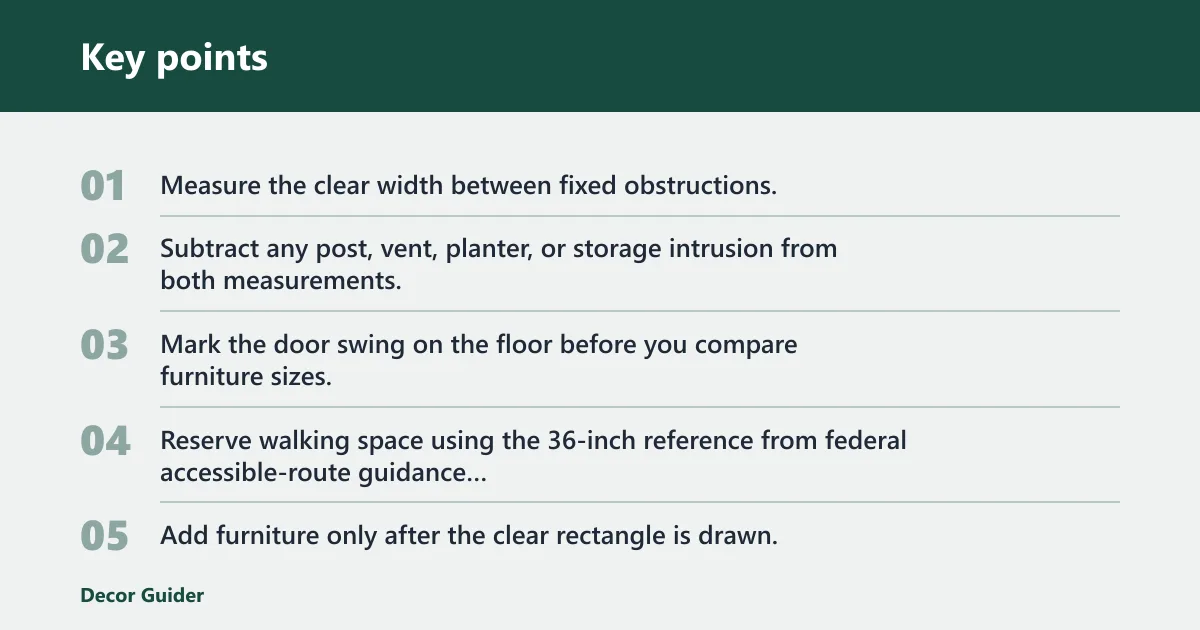
- Measure the clear width between fixed obstructions, then measure the clear depth from the door line to the railing or wall.
- Subtract any post, vent, planter, or storage intrusion from both measurements.
- Mark the door swing on the floor before you compare furniture sizes.
- Reserve walking space using the 36-inch reference from federal accessible-route guidance if your balcony needs to stay easy to pass through.
- Add furniture only after the clear rectangle is drawn.
Balcony furniture checklist
Use this once, then compare every furniture option against the same notes. Keep the tape measure, painter’s tape, and a notepad together so you do not double-count space or forget the tightest point.
- Clear width at the narrowest point
- Clear depth at the shallowest point
- Door swing path marked on the floor
- Railing posts, vents, planters, and AC clearances
- Chair pull-out room behind the seat
- Storage location for folded or stacked pieces
Check door swing, chair pull-out, and folded storage depth
Use painter’s tape to map the door arc, the table edge, and the chair’s pull-back path before you buy. Then measure the folded depth of any folding chair or table and compare it to the closet, nook, or wall space where it will live. A piece that folds but still sticks out too far usually fails in practice.
Say your balcony is 48 inches deep and the door swings inward. A table that technically fits can still fail if the chair backs block the swing path or leave no standing room near the latch. In that case, a folding table or wall-mounted table is a better match than a fixed dining set.
Check railing posts and fixed obstacles
Posts change usable depth more than many shoppers expect. On a narrow balcony, one post can turn a centered table into an awkward off-center layout. If the balcony has a Juliet railing or a rail-mounted planter, measure the deepest clear point and the narrowest pinch point separately.
Balcony furniture decision matrix
Use balcony shape, depth, and daily use to choose the type of furniture first. The best option is the one that fits the real footprint and still leaves the balcony usable when you are not sitting there.
| Balcony shape and depth | Best use case | Best furniture type | Fit checklist |
|---|---|---|---|
| Narrow run, under 2 meters deep | Daily open floor, quick coffee, renter setup | Wall-mounted folding table or one small side table with folding chairs | Door swing marked; chair pull-out space confirmed; storage spot ready; wind exposure checked |
| Corner balcony with one wider end | Two-person dining or mixed lounge and dining | Round table with compact chairs or a bistro set | Table base width checked; corner clearance checked; chair backs do not pinch the turn |
| Tiny balcony with almost no spare depth | One person, no permanent layout | Folding chair plus folding side table, or skip the table | Folded dimensions verified; storage method ready; walking path stays open |
| Long balcony that still needs daily circulation | Dining first, but open floor most days | Compact bistro set with folding or stackable chairs | Chair stack or fold space confirmed; table removed from door path; weather exposure checked |
What the matrix tells you fast
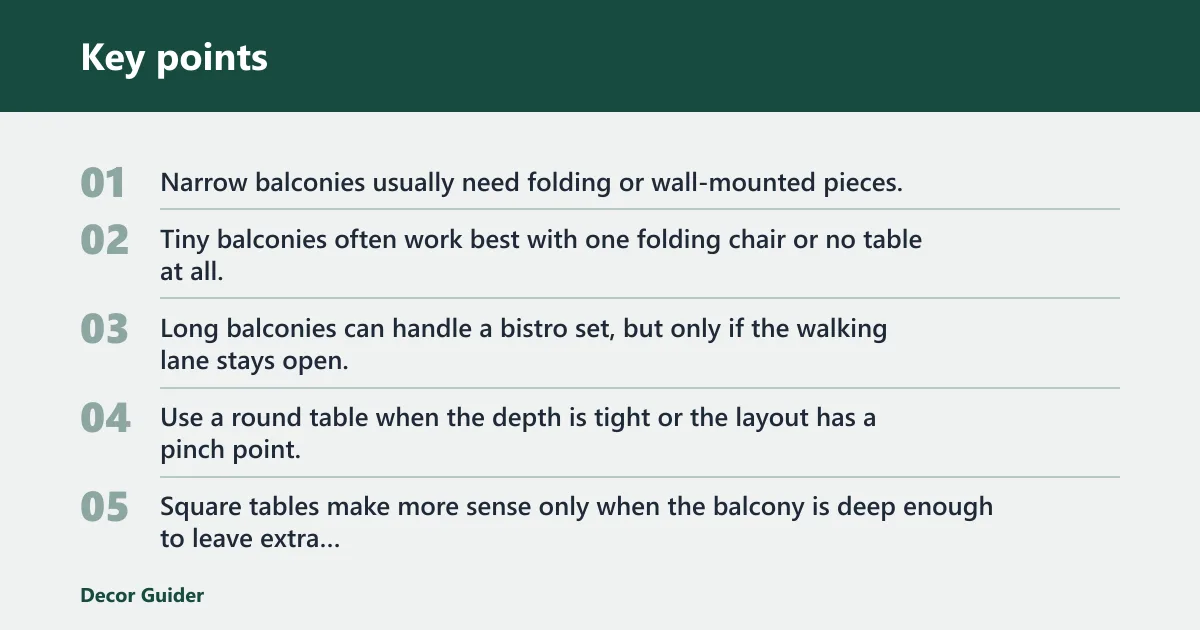
Narrow balconies usually need folding or wall-mounted pieces, while corner layouts can support a round table if the widest part sits in the open end. Tiny balconies often work best with one folding chair or no table at all. Long balconies can handle a bistro set, but only if the walking lane stays open.
Round-versus-square by balcony depth band
Use a round table when the depth is tight or the layout has a pinch point, because corners are what usually snag chair arms and knees. Square tables make more sense only when the balcony is deep enough to leave extra clearance at the edges. If the depth band is narrow, round usually wins.
What size table fits best?
For compact balcony use, round tables commonly fall in the 24 to 30 inch diameter range. A compact round table is usually enough for drinks or a light meal for two, but the base width matters as much as the tabletop diameter. Check both before deciding that a table “fits.”
Round tables and base width
A round tabletop can fit where a square one feels cramped because there are no corners to catch on chair arms or railing posts. But the pedestal or leg spread can still block knees and chair tuck-in space, so check the base footprint before you buy. A narrow top with a wide base can be harder to live with than a wider top on a slimmer base.
Bistro set sizing for two
A two-person balcony table usually works best in the 27 to 30 inch range when you want a real meal setup, not just a place for drinks. That size is only helpful if both chairs can clear the table without hitting the wall, railing, or door swing. The table should support the routine, not crowd it.
When to skip a table altogether
Skip the table if the balcony needs to stay open and you cannot preserve both chair pull-out space and a walking lane. A small wall shelf, folding side table, or one chair can be the more usable choice. This is especially true on balconies that double as storage access routes.
Which chair style should you choose?
Choose the chair by storage behavior, not by the listing photo. Folding chairs suit renter-friendly layouts because they store flat. Stackable chairs work only when the product explicitly lists stacking, and they still need a real place to keep the stack. Swivel motion does not prove a chair stacks or tucks away.
Folding chairs
Folding chairs are the best fit when you need to clear the floor after use or move out without leaving bulky furniture behind. Check the actual folded dimensions, not just the open size. If the chair folds but still needs a deep storage slot, it may not solve a tight-balcony problem.
Stackable chairs
Stackable chairs can reclaim floor space, but only if the product explicitly says it is stackable. Make sure you have a storage spot for the stack, because a stack still occupies floor area somewhere. For balconies that double as storage corridors, the stack location matters as much as the chair itself.
Tuck-under and armrest clearance
Armrests and swivel seats often widen the real footprint. A chair may look compact from the front and still fail when the arms hit the table apron or the railing. Check the chair’s widest point, then test whether it tucks under the table without forcing the seat to sit crooked.
Balcony furniture checklist
Weather resistance is not one material choice. You need to verify the frame, fabric, cushion fill, and care instructions together. Covered balconies still face sun and humidity, while uncovered balconies need storage or cover planning for rain, wind lift, and faster wear.
Materials checklist
- Powder-coated steel, aluminum, or rust-resistant frame finish
- Fasteners and joints protected from corrosion
- Quick-dry or water-resistant cushion covers
- Washable covers if spills are likely
- Foldable or stackable parts if storage is limited
- Cover, closet, or indoor storage plan for stormy weather
Frame materials to check
Look for corrosion resistance if the balcony is exposed to humidity or rain. Powder-coated steel helps, but the coating still needs care if scratches expose bare metal. Aluminum is lighter and resists rust, but light frames can move in wind if the furniture is not stable enough.
Fabric, cushion, and fill details
Check whether cushion covers are water-resistant or machine washable, and confirm whether the fill dries quickly. Wet-out is a common failure point on uncovered balconies, especially if cushions absorb water and stay damp. Manufacturer recommendations can help here, but the safest choice is still a material plan that works if the balcony gets splashed or rained on.
Covered versus uncovered exposure
A covered balcony can tolerate more fabric and cushion use, but sunlight and humidity still age materials. An uncovered balcony needs a stricter approach: folding pieces, quick-dry fabrics, and a place to move items when wind picks up. Plastic parts should also be checked for brittleness under sun exposure if the balcony gets long hours of light.
Our picks by need
Two-person dining: Decksplore Bistro Table & chairs set of 2

This is the straightforward two-seat choice when you want a compact dining setup with no assembly. Based on the published specs, the folding steel frame and floor pads suit outdoor use, and the set is built for small-space balcony layouts. The main drawback is size: the chair footprint is still substantial, so it needs real chair pull-out room and a clear door swing.
One more limit is storage. Folding helps, but the set still needs a place to go when you want the balcony open. A 400-pound weight capacity per seat is helpful, but it does not change the need to measure the usable footprint first.
Renter-friendly storage: GIANTEX round folding side

This works best when you need a small surface that folds away. The tempered glass top is easy to maintain, and the no-assembly design suits move-in or move-out situations. Its drawback is obvious: it is a side table, not a full dining solution, so it fits drinks and snacks better than two-person meals.
For a tight balcony, a round folding table can be easier to place than a square one because the shape avoids corner clashes. Still, verify the base footprint and the open-table diameter before you assume it will tuck beside a chair.
Narrow balconies: Adjustable wall-Mounted folding
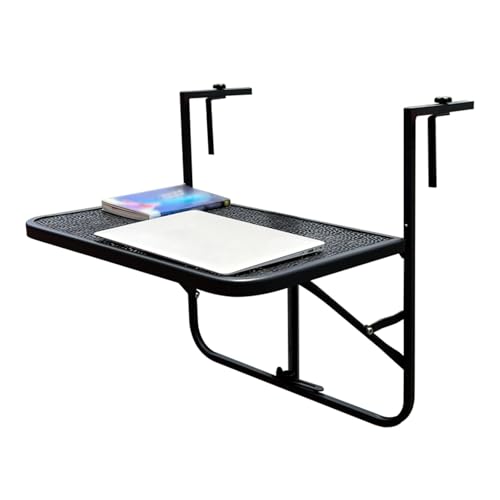
This is the strongest fit when floor space is the main constraint. A wall-mounted folding table leaves the floor open when folded and is designed to mount on balcony railings. The tradeoff is that it depends on a suitable mounting surface and may not fit every lease or balcony rule set.
It is also less flexible than a freestanding table if you move often. Check no-drill requirements, railing compatibility, and local building rules before you plan around it. If the balcony is rented and move-out speed matters, confirm that the mounting plan stays reversible.
Storage-first setup: Erotr stackable PE rattan Patio Dining chairs

These suit a balcony where the chairs need to disappear into a stack between uses. The product is explicitly stackable, has no assembly requirement, and uses an aluminum frame with PE rattan for outdoor use. The drawback is the size and commitment: the listed chair dimensions are large enough that they are not a micro-balcony shortcut.
They make more sense when you already have a storage spot for the stack and want a more lounge-like chair than a light folding seat. The chair arms also mean you should check tuck-under clearance before buying a table around them.
Mistakes to avoid
The most common error is buying furniture before checking the usable footprint. That means door swing, railing posts, and walking room never make it into the decision. Another mistake is choosing by tabletop size alone and ignoring base width, chair arms, and the space needed to sit down.
Do not assume a chair that swivels or folds also stacks. Stackable status must be stated, and swivel motion does not prove it. Do not forget balcony load limits either; they are property-specific, not universal, and can vary by building, lease, and the structural design of the balcony itself.
A common first-timer mistake is choosing a covered-balcony material plan for an uncovered balcony. The result is often cushion wet-out, corrosion, or furniture that blows around in wind. If you need a renter-friendly setup, prioritize no-drill pieces, flat folding parts, and easy move-out handling.
Frequently asked questions
How do I choose balcony furniture for a tight space?
Start with usable width and depth, then subtract door swing and fixed obstacles. After that, match the layout to the use case: a bistro set for dining, one chair or bench for lounging, and folding or stackable pieces if you need daily open floor space.
What size balcony table fits two people?
For compact balcony use, a 24 to 30 inch round table is the usual target range. For coffee or drinks, 24 to 26 inches is the tighter fit; for everyday dining for two, 27 to 30 inches is the better choice. Check the base width too.
Should I get folding or stackable balcony chairs?
Choose folding chairs if you want the easiest renter-friendly storage and a clear flat-folding profile. Choose stackable chairs only when the product explicitly says it stacks and you have a real place to keep the stack. Swivel chairs do not count as stackable by themselves.
What materials are best for small balcony furniture?
Pick materials by exposure, not by looks alone. Powder-coated metal, aluminum, and weather-rated wicker can work well, but the key is whether the frame resists corrosion, the cushions resist wet-out, and the care instructions fit your balcony’s sun and humidity level.
How much clearance do I need around balcony furniture?
Use the 36-inch reference from federal accessible-route guidance as a practical benchmark when space allows, then verify chair pull-out room and door swing on your own balcony. If the balcony is much smaller, keep the walking lane continuous and avoid blocking the entry path.
Can I use a bistro set on a tiny balcony?
Yes, if the table, chairs, and door swing all clear the same space. A bistro set is a good fit when you want two-seat dining and can store or tuck the chairs away afterward. On a very shallow balcony, a folding or wall-mounted setup may fit better.
What furniture works best for a narrow balcony?
For a narrow balcony, choose folding or wall-mounted pieces first. Round shapes also help reduce corner conflicts in tight runs, and the right choice is usually the one that preserves a continuous walking path. If the balcony is too shallow, skip the dining set and favor a single folding chair.
Sources
- U.S. Access Board, ADA Accessibility Guidelines and Federal accessibility guidance on accessible routes and clear width benchmarks
- International Code Council, International Residential Code guidance on design loads for decks and balconies
- U.S. Consumer Product Safety Commission, general outdoor furniture safety and stability guidance
- University extension resources on corrosion, moisture, and outdoor material care for metal furnishings
- Manufacturer instructions for folding, stacking, railing-mount, cushion care, and weather exposure recommendations for the products referenced above
Products related to this article
Sponsored / affiliate links. As an Amazon Associate I earn from qualifying purchases. I may earn additional commission from eligible campaigns.