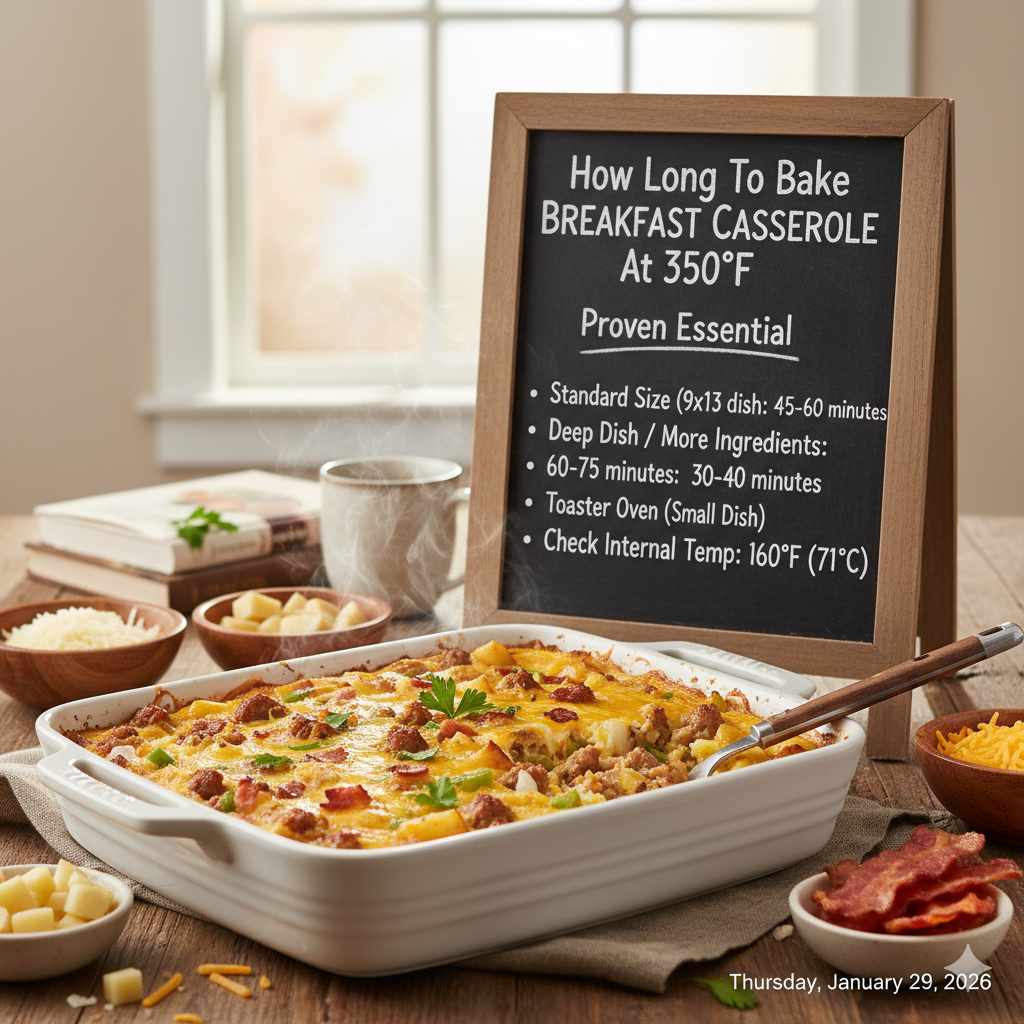
To properly bake most standard breakfast casseroles at 350°F, plan for a cooking time between 45 to 60 minutes. Always check for a set center and golden-brown top. Use a thermometer to ensure the internal temperature reaches 160°F for safety and the perfect texture.**
Baking a perfect breakfast casserole can feel tricky. You want that delicious, golden top but a center that is fully cooked, not runny. Many recipes suggest 350°F, but the actual time changes based on your pan size and ingredients. Getting the timing right means the difference between a fantastic brunch centerpiece and a soggy mess.
Mastering the Clock: How Long to Bake Breakfast Casserole at 350°F
The 350°F oven setting is the gold standard for casseroles. Why? It’s hot enough to cook through without burning the edges too fast. However, “350°F” is just the starting line. The actual required time—how long to bake breakfast casserole at 350—depends heavily on what is inside and what you are baking it in.
The Golden Rules of Casserole Baking Time
Think of baking time like an oil change—it has ranges. You cannot just follow the clock; you must watch the food. Here are the core factors that determine your final baking duration:
- Depth of the Dish: A thin casserole cooks faster than a deep one. A 9×13 inch pan is much shallower than a 9-inch deep-dish pie plate.
- Ingredient Density (Moisture Level): A casserole loaded with heavy sausage and lots of cheese will take longer to heat through than one mostly made of bread cubes and light eggs.
- Starting Temperature: If you assemble the casserole the night before and put it straight from the fridge into the oven (cold bake), add 10 to 15 minutes to the bake time.
- Pan Material: Glass pans conduct heat differently than metal or ceramic. Darker pans absorb more heat, sometimes requiring slightly reduced cooking times to prevent burnt edges.
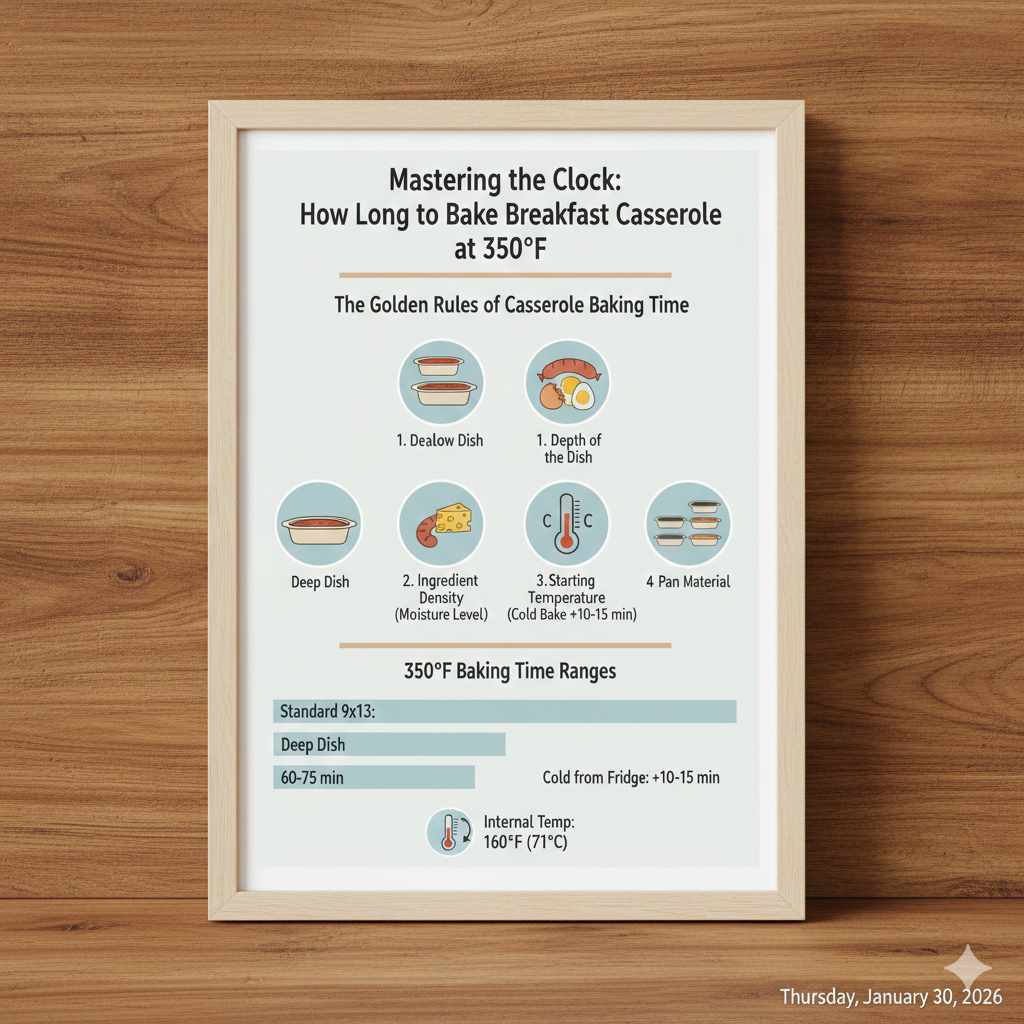
Standard Time Ranges for 350°F Baking
For the average, pre-soaked, refrigerator-cold breakfast casserole prepared in a standard 9×13 inch dish, here is the best starting point. Remember, this is your baseline, not the final answer.
| Casserole Type | Typical Pan Size | Estimated Bake Time at 350°F |
|---|---|---|
| Standard Egg & Bread Casserole (Soaked Overnight) | 9×13 Inch | 50 – 60 minutes |
| Deep Dish (e.g., Lasagna-style or large volume) | 9×13 Inch Deep | 60 – 75 minutes |
| Individual/Small Batch (e.g., 8×8 or Ramekins) | 8×8 Inch or Smaller | 35 – 45 minutes |
| Fully Cooked Ingredients (Pre-cooked meat/veggies) | 9×13 Inch | 40 – 50 minutes |
As you can see, even small changes in depth can swing the time by 15 minutes or more. Always use the low end of the estimate as your first check time.
The Step-by-Step Method: Checking for Doneness Like a Pro
Knowing how long to bake breakfast casserole at 350 isn’t as useful as knowing how to tell when it is actually done. Trusting your senses and simple tools will always beat sticking rigidly to the recipe’s timeline. Here are four reliable ways to confirm perfection.
Step 1: Setting Up Your Oven and Pan
Before you even think about time, make sure your oven is ready. A common mistake is putting a cold casserole into a cold oven. You must preheat!
- Preheat Thoroughly: Set your oven to 350°F and let it preheat for at least 15–20 minutes. This ensures the temperature gauge is accurate. If you are unsure about your oven’s accuracy, consider using an inexpensive oven thermometer, as many home ovens run hot or cold compared to the dial setting.
- Rack Position: Place your oven rack in the middle position. This position provides the most even heat circulation around the dish. Avoid the top or bottom racks unless the recipe specifically calls for it (like a crispier top crust).
- Pan Placement: If you notice the edges browning too quickly, you can place your casserole dish on a slightly lower rack, away from the top heating element.
Step 2: The Initial Check (The 45-Minute Mark)
If your recipe called for 55 minutes, do not wait until the 55-minute mark to look. Around the 40 to 45-minute mark, start your visual inspection. This is especially important for cold casseroles.
- Look: The edges should look slightly firm, and the top should show some color—golden brown is the goal.
- Listen: You might hear gentle bubbling, which is good. If it’s vigorously boiling or spitting everywhere, the heat might be too high, or it needs more time to reach equilibrium.
Step 3: Visual and Physical Test (The Jiggle Test)
This is where most beginners feel nervous, but it’s very simple. The goal is to see if the liquid egg mixture has completely set around the edges and center.
The Jiggle Test: Gently shake the counter near the oven (or carefully tap the side of the pan). If the center still sloshes or looks watery, it needs more time, usually 5 to 10 more minutes. If it jiggles just slightly, like firm gelatin, it’s very close!
Step 4: The Internal Temperature Check (The Most Reliable Method)
Just like checking pork or chicken, using a digital thermometer is the fail-safe method. This is the safest and most accurate way to determine doneness, especially crucial when dealing with eggs and meat.
For any egg-based casserole, for both texture and food safety (to ensure bacteria have been killed), the internal temperature must read at least 160°F (71°C). You can find excellent, quick-read digital thermometers online or at most home goods stores. Always check the temperature in the very center of the casserole.
For reference on food safety standards, the U.S. Department of Agriculture (USDA) recommends cooking eggs until the yolks and whites are firm, equating to 160°F.
When to Tent with Foil
If you reach the 45-minute mark and the top is beautifully golden brown, but the center is still noticeably wet, you risk burning the top while waiting for the middle to set. This is the time to intervene.
Quickly—and carefully—tent the baking dish tightly with aluminum foil. Reinsert into the oven. The foil will insulate the top crust, allowing the internal heat to focus on cooking the center through without scorching the surface. Continue baking for another 10 to 15 minutes, then remove the foil for the final 5 minutes if you need a little extra color.
Factors That Add or Subtract Time: Know Your Ingredients
The ingredients you choose directly impact how long to bake breakfast casserole at 350. Dense, high-moisture ingredients slow things down significantly.
Ingredient Density Breakdown
Use this guide to estimate if your casserole will lean toward the shorter end (40-50 minutes) or the longer end (55-70 minutes) of the typical range:
- Faster Baking Items (Less Time): Mostly bread cubes, dry savory herbs, minimal cheese, pre-cooked vegetables (like sautéed mushrooms).
- Slower Baking Items (More Time): High moisture ingredients like diced potatoes (even if par-cooked),เยอะ heavy dairy (sour cream or heavy cream bases), or lots of fresh spinach (which releases water as it cooks).
- The Meat Factor: If you use raw sausage or bacon, the total time might increase slightly as that meat releases fat and moisture that the eggs must absorb or evaporate. Fully cooked meats will require less time adaptation.
Impact of Resting Time (Temperature Conversion)
We mentioned the cold-bake scenario, but it is worth repeating because it is a huge time variable. If you are substituting a recipe, knowing the difference between a cold and room-temperature start is vital.
| Starting Temperature | Adjustment Needed at 350°F |
|---|---|
| Room Temperature (30 mins out of fridge) | Stick to the stated recipe time (or estimate 50 min). |
| Refrigerator Cold (Direct from fridge) | Add 10–15 minutes to the expected bake time. |
| Frozen (Rare, but possible) | Increase time significantly (up to 90 minutes) and use foil well. Check temperature frequently! |
If you are an early bird and need to save time in the morning, preparing the casserole the day before and baking it straight from the fridge is a lifesaver, as long as you plan for that extra 10 to 15 minutes of cooking!
Troubleshooting Common Baking Issues
Even when aiming for a specific time, things can go wrong. Don’t panic! Most issues related to how long to bake breakfast casserole at 350 are easily fixed with simple adjustments.
Problem 1: Edges Are Burning, Center Is Raw
This is the classic culprit of a pan that is too small or an oven that runs too hot on the sides.
- The Fix: Immediately cover the top tightly with aluminum foil to prevent further direct heat exposure. If the center still doesn’t look set after 15 minutes under foil, consider moving the entire dish one rack level lower (but make sure it’s not touching the bottom heating element if you have a gas oven).
Problem 2: Casserole Looks Done But Weeps When Cut
This means the egg structure hasn’t fully coagulated, often because of high liquid content (like milk or excess moisture from vegetables).
- The Fix: Put it back in the oven, uncovered, for another 5 to 10 minutes. If it still won’t set, you can use an immersion blender carefully on the top to create small entry points, which allows trapped steam and moisture to escape. Re-bake uncovered for 5 minutes.
Problem 3: Top Is Pale and Undercooked After Time is Up
Your oven might run cool, or you put a very cold casserole in. You need more heat applied to the top surface.
- The Fix: Switch your oven setting from ‘Bake’ to ‘Broil’ for the last 1 to 2 minutes. Watch this like a hawk! Broilers work very fast, and you only want to kiss the top with browning, not turn it to charcoal. This works best if the casserole is already mostly set internally.
Remember, achieving consistent results in baking often involves learning your own appliance. Even professional chefs adjust recipes based on their specific oven environment. For more insight into how ovens work and temperature calibration, resources like those from the National Institute of Standards and Technology (NIST) often provide background on appliance accuracy.
The Essential Tools for Perfect Casserole Baking
To take the guesswork out of how long to bake breakfast casserole at 350, having the right tools on hand makes all the difference. You don’t need a full mechanic’s toolbox for this, just a few smart kitchen items.
Must-Have Gear List
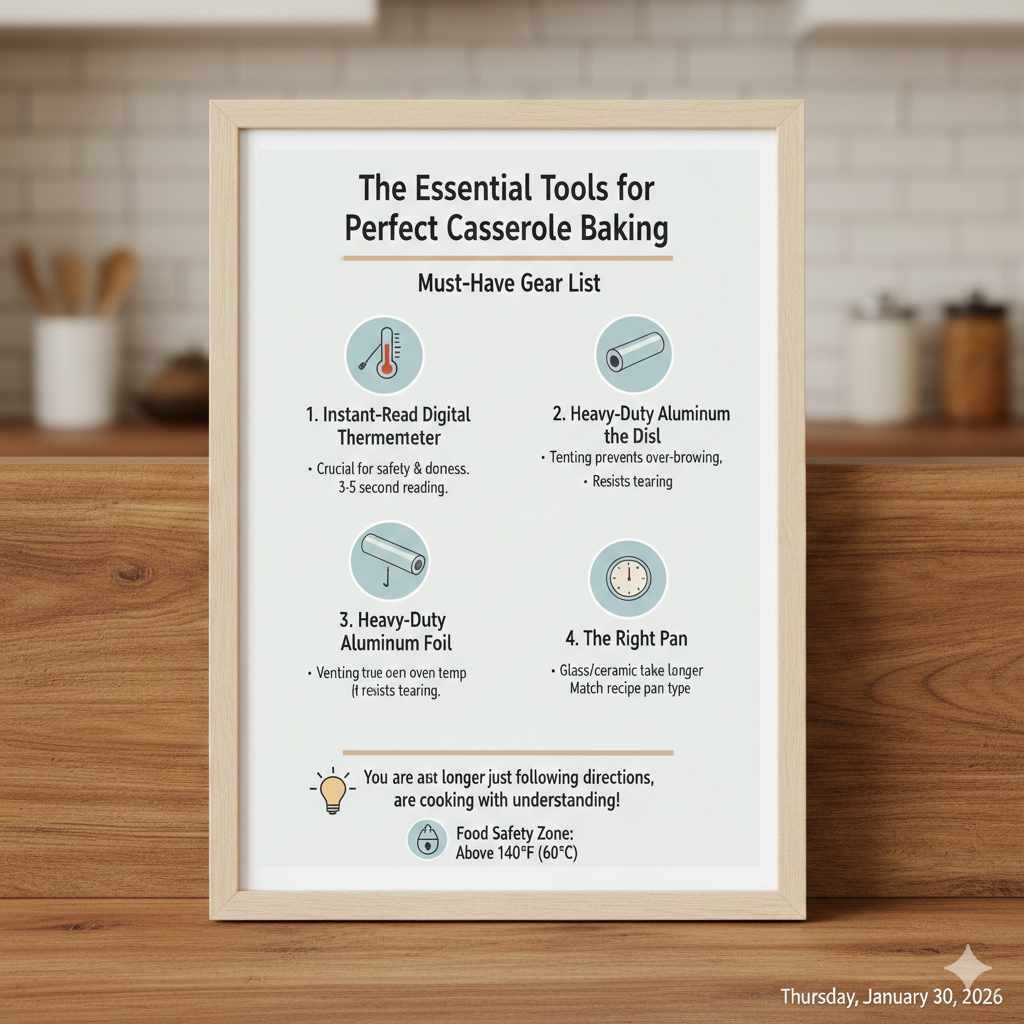
- Instant-Read Digital Thermometer: This is non-negotiable for safety and doneness. Look for one that registers temperature within 3–5 seconds.
- Heavy-Duty Aluminum Foil: Essential for tenting when the top browns too fast. Heavy duty resists tearing when you lift it off a hot dish.
- Oven Thermometer: If you are serious about consistent baking times, verify your oven is truly at 350°F using an inexpensive hanging thermometer.
- The Right Pan: Glass or ceramic pans require more time than thin metal ones. Use the same type of pan the recipe calls for, or compensate with extra time if you switch to a deeper material.
By marrying the standard estimates with these simple testing methods—jiggle, visual cue, and temperature check—you gain complete control over the process. You are no longer just following directions; you are cooking with understanding!
Frequently Asked Questions (FAQ) About Baking Breakfast Casseroles
Q1: Can I bake my breakfast casserole right out of the refrigerator at 350°F?
Yes, you can, but you must increase the baking time by about 10 to 15 minutes compared to a room-temperature dish. Always rely on internal temperature (160°F) rather than the clock for cold bakes.
Q2: What is the minimum safe internal temperature for an egg casserole?
The safe minimum internal temperature for any dish containing eggs is 160°F (71°C). Use your thermometer in the center of the dish to confirm this for safety and texture.
Q3: My casserole always burns on the bottom. What am I doing wrong?
This often happens when using a dark metal pan or placing the dish too close to the bottom heating element (common in gas ovens). Try placing the dish on the middle rack, perhaps even on top of a cookie sheet to insulate it slightly from the bottom heat.
Q4: Should I cover my breakfast casserole while baking at 350°F?
Generally, no. You should keep it uncovered so the top can brown and dry slightly, achieving that desirable golden crust. Only cover it with foil if the top browns significantly before the center is set.
Q5: What if I bake it too long? Will it ruin the texture?
If you significantly overbake an egg casserole, it can become rubbery, dry, and pull away from the sides of the pan excessively. If you realize it’s overbaked by just 10 minutes, cover it with foil and let it rest longer after removing it from the oven to help retain some moisture.
Q6: Does the type of bread used change the necessary baking time?
Yes, slightly. Denser bread, like Texas toast or thick-cut sourdough, absorbs liquid slower and requires a few extra minutes to fully soften and set compared to lighter cubed white bread.
Q7: Should I use the convection setting instead of bake?
If you use the convection setting (which circulates air), you must lower the temperature by 25°F (so bake at 325°F) or decrease the time by about 25%. If you keep it at 350°F convection, it will finish much faster and likely burn the top.
Conclusion: Confident Baking Every Time
You now have the essential knowledge you need on how long to bake breakfast casserole at 350°F. The biggest takeaway is this: the recipe’s time estimate is a suggestion, but your thermometer reading is the law. For a standard 9×13 dish, aim for that 45-to-60-minute window, but check early and often.
By remembering to preheat properly, checking for that slight gelatinous jiggle in the middle, and confirming the internal temperature has hit 160°F, you eliminate the guesswork. Baking a legendary brunch centerpiece doesn’t require a culinary degree; it just requires a bit of simple process control. Grab your spatula, set your timer for 45 minutes, and get ready to pull out a perfectly cooked, ready-to-eat masterpiece. You’ve got this!