Quick Summary
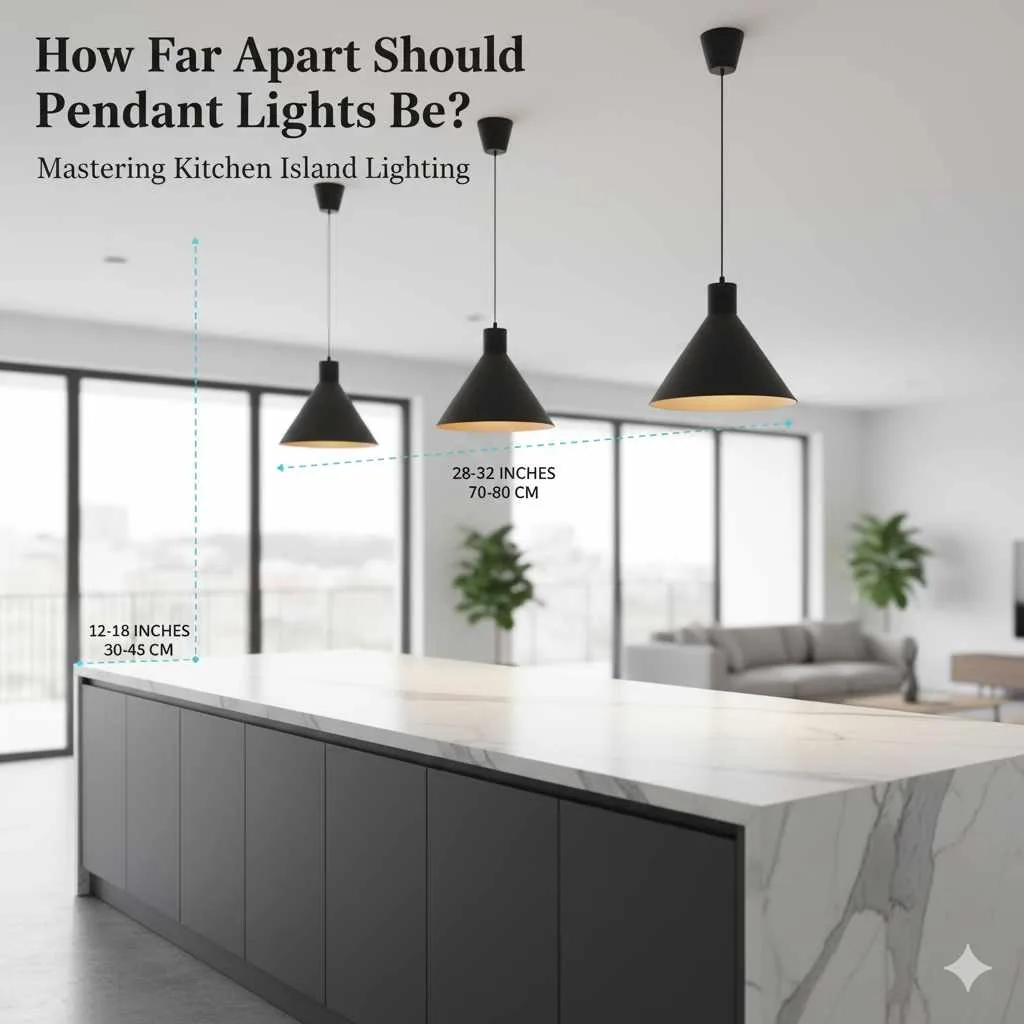
For pendant lights over an island, aim for spacing that balances illumination and esthetics. Generally, leave 24-36 inches between pendants and 30-40 inches from the edge of your counter. However, the ideal distance depends on island size, pendant size, and desired effect.
Struggling with pendant light placement can feel like a puzzle! You envision that perfectly balanced, beautifully lit kitchen or dining nook, but when it comes to how far apart those gorgeous pendants should hang, it’s easy to get stuck. Don’t worry, we’ve all been there! Getting the spacing just right ensures your lights are functional and a stunning focal point. This guide will walk you through everything you need to know, step-by-step, so you can confidently choose the perfect distance for your space. Let’s make your home shine!
Understanding the Basics: Why Spacing Matters
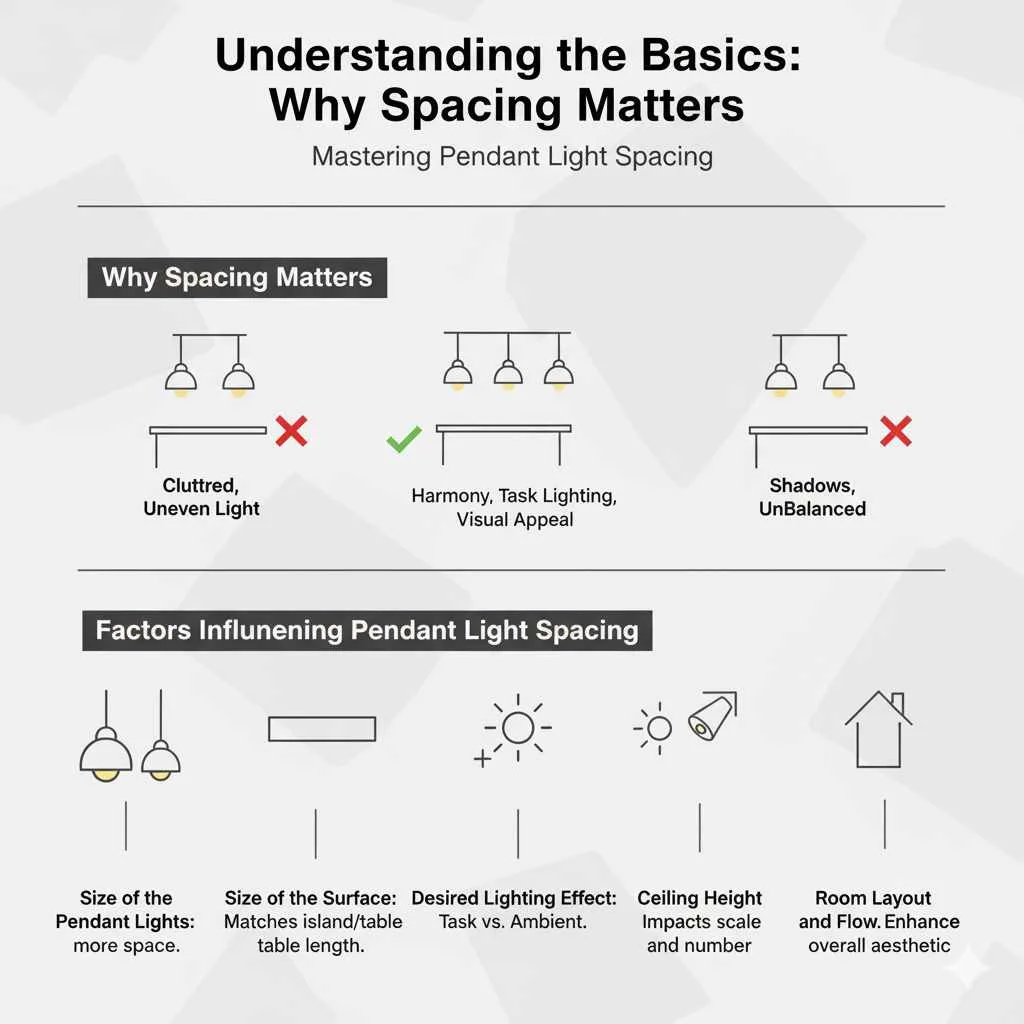
Pendant lights are more than just sources of light; they are design elements that can dramatically enhance the look and feel of a room. When you get the spacing right, they create harmony, provide adequate task lighting, and draw the eye to key areas. Too close, and they can feel cluttered. Too far apart, and you might end up with shadowy spots or an unbalanced appearance. The goal is to achieve both visual appeal and practical illumination, transforming your space into a more inviting and functional area.
Factors Influencing Pendant Light Spacing
Before we dive into specific measurements, let’s consider the key elements that influence how far apart your pendant lights should be. Think of these as the building blocks for your perfect lighting arrangement.
Size of the Pendant Lights: Larger pendants naturally need more space between them to avoid overwhelming the area. Smaller, delicate pendants can be grouped more closely together.
Size of the Surface: The length of your kitchen island, dining table, or countertop is the primary guide. A longer surface can accommodate more or larger pendants spaced accordingly.
Desired Lighting Effect: Are you aiming for bright, unified task lighting, or a more ambient, decorative feel? This will influence how spread out or clustered your pendants are.
Ceiling Height: While not directly about spacing, significant ceiling heights might influence the overall scale and how many pendants feel appropriate, indirectly affecting spacing.
Room Layout and Flow: Consider how the lights will impact the room’s flow and how they relate to other design elements. You want them to enhance, not impede, movement or the overall aesthetic.
Standard Spacing Guidelines: A Starting Point
Let’s get to the numbers! These are generally accepted guidelines, but remember they are starting points. Your specific situation might require slight adjustments.
Pendant Spacing Over Kitchen Islands and Countertops
This is perhaps the most common scenario for pendant lights. The key here is to provide good task lighting for food prep and a welcoming atmosphere.
General Rule: A good rule of thumb is to space pendants so that the distance between the center of each light fixture is roughly equal to the width of the fixture itself. However, a more practical and widely used guide is to aim for 24 to 36 inches apart from the center of one pendant to the center of the next. For islands over 8 feet long, you might consider three pendants.
Edge Spacing: You’ll also want to ensure the pendants aren’t too close to the edges of the island. Aim for 30 to 40 inches from the edge of the island to the center of the outermost pendant. This creates a balanced look and prevents light from spilling too far off the working surface.
Here’s a simple table to visualize:
| Measurement | Typical Range | Notes |
|---|---|---|
| Between Center of Pendants | 24 – 36 inches | Adjust based on pendant size and island length. |
| From Island Edge to Outer Pendant Center | 30 – 40 inches | Ensures balanced illumination and visual appeal. |
| From Pendant Bottom to Countertop | 30 – 36 inches | Provides ideal task lighting without glare. Check manufacturer recommendations. |
Pendant Spacing Over Dining Tables
Over a dining table, pendant lights serve both to illuminate the dining area and to act as a decorative centerpiece. The spacing here is often dictated by the table’s size and shape.
Centered Approach: For most dining tables, a single pendant or a cluster of pendants will be centered directly over the table. If using multiple pendants, they should be spaced evenly along the length of the table.
Spacing Strategy: A common approach is to divide the length of your dining table by the number of pendants plus one. For example, on a 6-foot (72-inch) table with two pendants, you’d have three equal spaces: 72 inches / (2 + 1) = 24 inches per space. This means each pendant would be 24 inches from the end of the table and 24 inches from each other.
Height Recommendation: Ensure the bottom of the pendant is about 30 to 36 inches above the tabletop. This height provides enough light for dining without being obstructive or causing glare.
Consider these spacing examples for dining tables:
| Table Length | Number of Pendants | Spacing (Center to Center) | Spacing from Table Edge |
|---|---|---|---|
| 6 ft (72 in) | 1 | N/A | Centered |
| 6 ft (72 in) | 2 | 24 in | 24 in |
| 8 ft (96 in) | 3 | 24 in | 24 in |
| 10 ft (120 in) | 3 | 30 in | 30 in |
Step-by-Step Guide to Spacing Your Pendant Lights
Ready to put this into practice? Follow these simple steps to achieve perfect pendant light spacing in your home.
Step 1: Measure Your Surface
First, grab your trusty measuring tape! Accurately measure the length of the surface where your pendant lights will be installed. This could be your kitchen island, dining table, peninsula, or even a long countertop. Knowing the exact dimensions is crucial for all subsequent calculations.
Step 2: Determine the Number of Pendants
Consider the size of your space and the size of the pendants you’ve chosen. A good starting point is to ensure there’s enough light without the fixtures looking cramped or too sparse. For kitchen islands, a common choice is two pendants for islands up to 6 feet long, and three for islands longer than 6 feet. For dining tables, one large pendant or a symmetrical arrangement of two or three is typical.
Step 3: Calculate the Distance Between Pendants
This is where the magic happens. There are a couple of ways to approach this:
The “Equal Spacing” Method: Measure the total length of your surface. If you’re using multiple pendants, imagine an equal number of spaces between them and also at either end of the surface. So, for two pendants, you’ll have three equal spaces. For three pendants, you’ll have four equal spaces. Divide the total length by the number of spaces. This will give you the ideal distance between the centers of your pendants and the distance from the end pendants to the edges of your surface. For example, on a 72-inch island with two pendants, you have 3 spaces: 72 inches / 3 spaces = 24 inches per space.
The “Pendant Width” Method: As a rough guide, you can also aim for the space between the centers of your pendant lights to be roughly equal to the diameter or width of the pendant itself. If your pendants are 8 inches wide, look for about 8 inches between them. This method works well when you have a strong visual of the pendant size in relation to the space.
Step 4: Factor in Edge Clearance
It’s important not to place pendants too close to the edges of your island or table. This can make the arrangement look unbalanced and might mean light isn’t directed where you need it most. As a general rule, the center of the outermost pendant should be at least 30 inches from the edge of the surface. Some prefer 36 or even 40 inches for a more dramatic effect or with larger islands. You can use the “Equal Spacing” method from Step 3, which often naturally incorporates good edge clearance.
Step 5: Consider Pendant Height
While not about spacing between lights, the height at which they hang is crucial for functionality and aesthetics. For task lighting (like over a kitchen island or workspace), aim for the bottom of the pendant to be 30 to 36 inches above the countertop. For ambient lighting (like over a dining table), 30 to 36 inches above the tabletop is also standard. Always check the pendant’s manufacturer recommendations, as some designs have specific height requirements for optimal light diffusion.
Step 6: Mark and Double-Check
Once you’ve done your calculations, it’s a great idea to visualize them. Use painter’s tape on your ceiling to mark the intended center points of each pendant. You can even hang some balloons or paper cutouts at the calculated height to get a 3D sense of the spacing and how it will look. This is your chance to make final adjustments before any permanent installation.
Pendant Light Spacing Beyond the Kitchen and Dining Room
While kitchens and dining rooms are popular spots for pendant lights, you can also use them to enhance other areas of your home.
Entryways and Hallways
In a spacious entryway or a long, wide hallway, a well-placed pendant or a linear arrangement of smaller pendants can add a touch of elegance and provide a welcoming glow. Stick to consistent spacing similar to dining tables, ensuring they don’t obstruct traffic flow. For hallways, consider placing them every 6 to 8 feet, depending on ceiling height and desired effect.
Living Rooms and Bedrooms
Pendant lights can act as stylish bedside lamps or provide accent lighting in a living area. When used as bedside lamps, the spacing is dictated by the width of your nightstands and beds. Ensure they are at a comfortable height for reading. In a living room, a single statement pendant over a coffee table or a symmetrical arrangement can create a cozy focal point.
Bathrooms
For bathroom vanities, pendant lights can be a chic alternative to traditional sconces. Spacing is usually determined by the vanity width. You might opt for two smaller pendants, spaced equidistant from the center of the vanity and a few inches in from the sides. Ensure they are installed in a damp-rated location if required. Remember to consult electrical codes and best practices for bathroom installations to ensure safety, such as those outlined by organizations like the National Fire Protection Association (NFPA).
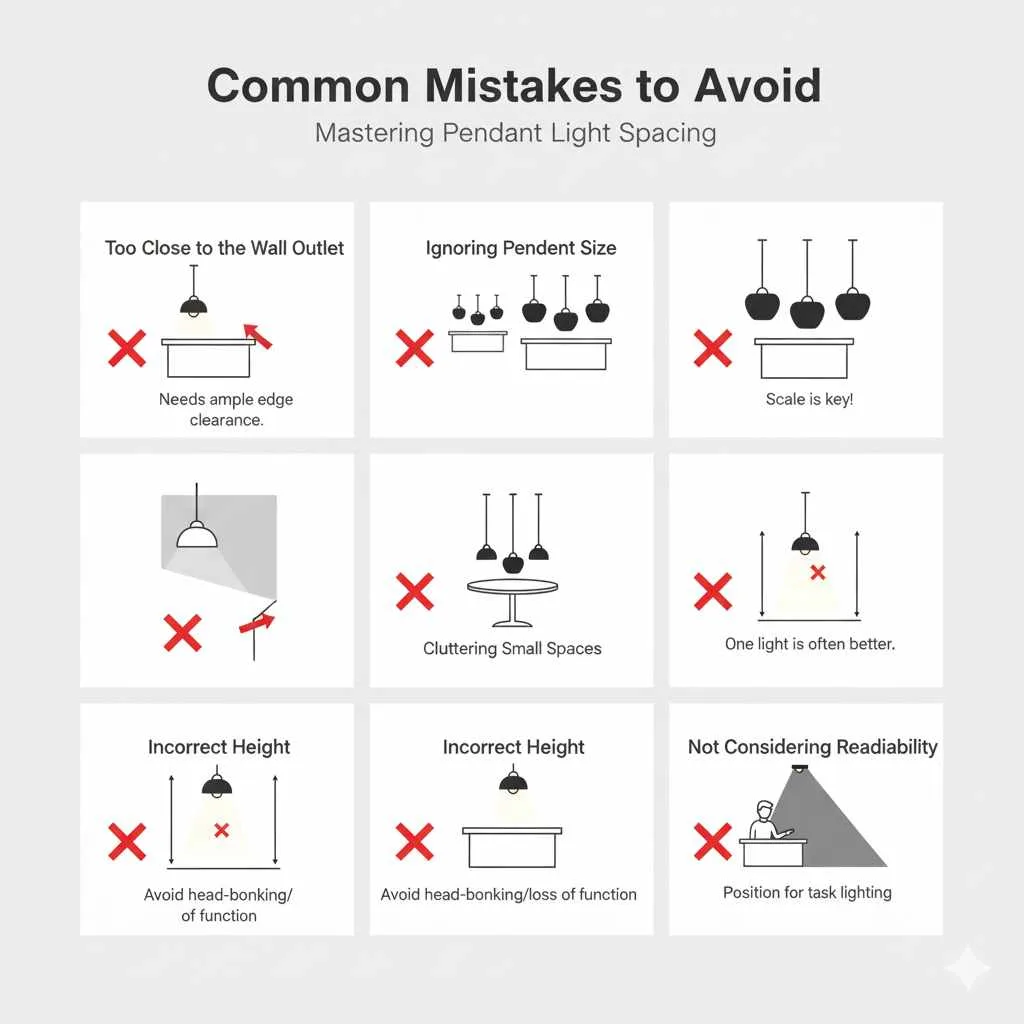
Common Mistakes to Avoid
Even with guidelines, it’s easy to stumble. Here are a few common pitfalls to steer clear of:
Too Close to the Wall Outlet: Placing pendants too close to the edge of an island or table can make it look like it’s about to fall off. Always ensure ample edge clearance.
Ignoring Pendant Size: Using tiny pendants on a massive island, or huge, chunky pendants on a narrow surface, will look out of proportion. Scale is key!
Cluttering Small Spaces: For very small islands or tables, one well-placed pendant is often better than trying to fit in two or more.
Incorrect Height: Pendants hanging too low can be a head-bonking hazard and create glare. Too high, and they lose their impact and lighting function.
Not Considering Readability: In areas like kitchens, ensure pendants are positioned to provide sufficient task lighting without casting shadows on your work surfaces.
FAQs About Pendant Light Spacing
Let’s tackle some frequently asked questions about pendant lighting placement.
Q1: How do I know if I need two or three pendants over my kitchen island?
A good rule of thumb is to consider the length of your island. For islands up to about 6 feet long, two pendants are often sufficient. For islands longer than 6 feet, three pendants can provide more balanced and effective lighting. Always consider the size of your pendants, too – larger pendants may require more space.
Q2: What is the standard height for pendant lights?
For task lighting over kitchen islands or countertops, the bottom of the pendant should typically hang 30-36 inches above the surface. For dining tables, the same 30-36 inch range above the tabletop is common. Always check your specific pendant’s recommendations.
Q3: Can I hang pendant lights closer than 24 inches apart?
While 24 inches is a common minimum, you can hang them closer if you have smaller pendants or want a cozier, more integrated look. However, be mindful that they don’t look cramped. A good visual check is if the space between them is roughly the width of the pendant itself. For very close spacing, ensure they are on a dimmer to control brightness.
Q4: What if my island is an odd shape?
For L-shaped or U-shaped islands, treat each section of the island as its own area. Apply the spacing rules to the length of each section. For curved islands, you might use a flexible cable system or space them based on visual balance and the arc of the curve.
Q5: How do I calculate spacing if my pendants have cords of different lengths?
Pendants with different cord lengths are usually hung for a more eclectic or artistic look (like in a cluster). For linear arrangements, it’s best to have cords of the same or very similar lengths to maintain a clean, balanced appearance that allows for consistent spacing. If you’re aiming for a clustered look, the “center” calculation might be less critical, and you’ll rely more on visual balance and ensuring they don’t obstruct each other.
Q6: Should I account for the width of the electrical box when spacing?
The spacing measurements typically refer to the center of where the pendant will hang, which aligns with the electrical box. When you’re marking on the ceiling, you mark the center of the box. The fixture’s canopy will then cover the box. Your spacing calculations should focus on the distance between these center points.
Q7: Who can help me install pendant lights?
For any electrical work, it’s always best and safest to hire a qualified electrician. They can ensure the wiring is done correctly and safely, install the junction boxes, and hang the fixtures securely. While you can plan the spacing yourself, the installation is often best left to the professionals. You can find local electricians through online directories or by asking for recommendations.
Conclusion: Lighting Your Way to a Beautiful Home
Choosing the right spacing for your pendant lights might seem daunting at first, but by understanding the key factors and following these simple guidelines, you can achieve a stunning and functional lighting design. Remember to measure carefully, consider the size of your space and your fixtures, and don’t be afraid to visualize before you commit. Whether you’re illuminating a culinary workspace, a cozy dining nook, or adding a touch of sparkle to your entryway, perfectly spaced pendant lights have the power to transform your home. So go ahead, embrace the process, and let your creativity shine!