3 Best Boxes for Books and Small Furniture (2026): We Compared
Use small book boxes for dense books, medium boxes for mixed loads under about 40 pounds, and double-wall boxes for heavy furniture parts, especially wood panels or hardware bags; split anything that makes the box bulge or exceeds safe lifting weight. Overfilled boxes tear, bottom out, and make stairs and truck loading far harder, which can damage books and hardware. This guide gives a packing decision tree by weight, size, and fragility, plus exact box choices and load-splitting rules.
Quick comparison
| Product | Badge | Best for | Price | ||
|---|---|---|---|---|---|
 |
U-Haul Small Moving Boxes – Pack of 10 Boxes with Handles –U-Haul | Our pick | Small box · 10-pack · U-Haul | $34.95
Price as of 22 Oct 2026
|
View |
 |
Aviditi HD181824DW Heavy-Duty Double Wall CorrugatedBOX USA | Upgrade pick | 18x18x24 box · Double wall · 10-pack | $89.45
Price as of 22 Oct 2026
|
View |
 |
BOX USA Moving Boxes Holds 65lbs, 18"L x 14"W x 12"HBOX USA | Budget pick | 18x14x12 box · 32 ECT · 10-pack | $23.99
Price as of 22 Oct 2026
|
View |
 |
Bankers Box 10-Pack Small Classic Moving Boxes withBankers Box | Also great | 15x12x10 box · Tape-free · 10-pack | $35.99
Price as of 22 Oct 2026
|
View |
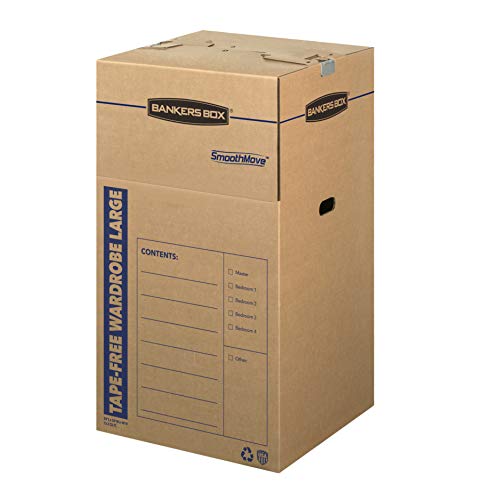 |
Bankers Box 3-Pack Tall Tape-Free Wardrobe Moving Boxes,Bankers Box | Also great | $62.99
Price as of 22 Oct 2026
|
View |
Start with box size, then check wall strength and shape. If the load is dense, awkward, or likely to scratch, choose the smaller or stronger carton before you add more padding.
How we chose
The comparison below follows four checks: box footprint, wall type and ECT strength, practical liftability, and the amount of padding each load needs. It also weighs the likely failure mode, because a box that looks “big enough” can still fail at the bottom seam, the corners, or the handle cutouts.
For this topic, the right box is the one that keeps weight controlled and parts separated. That matters more than raw cubic volume.
Best box choice by item type
| Item | Recommended box size | Wall type | Max practical fill | Padding needed | Red-flag failures |
|---|---|---|---|---|---|
| Hardcovers | Small book box, about 16 x 12 x 12 inches | Single-wall if fresh and clean; double-wall if the stack is dense | Hardcover books should be packed at about 30 to 40 pounds per box before splitting the load. | Packing paper around corners; flat filler on top | Bottom blowout, crushed spines, box bowing |
| Paperbacks | Small book box, about 16 x 12 x 12 inches | Single-wall or reinforced handles | About 35 pounds, then split | Minimal paper, but fill voids so books cannot settle | Handle tear, seam split, leaning stack that crushes edges |
| Textbooks | Small book box; use two boxes if titles are thick | Double-wall if the load is dense or the route has stairs | Textbook boxes should stay at about 25 to 35 pounds. | Packing paper between uneven surfaces | Bottom sag, corner crush, painful carry weight |
| Drawer hardware | Small box or a medium box with compartments | Double-wall preferred | Light by volume; keep each bag under a few pounds | Bubble wrap for metal edges; paper to stop rattling | Lost fasteners, punctured bag, mixed hardware from different rooms |
| Table legs | Medium box, or a double-wall carton for long, heavy legs | Double-wall if wood is heavy or lacquered | Table-leg cartons should stay under 40 pounds and should not force the flaps shut. | Bubble wrap on corners; paper blocks between legs | Scratched veneer, corner chipping, box wall flex |
| Shelves | Medium box if flat-packed; double-wall if thick hardwood | Double-wall for weight and edge protection | Shelf boxes should stay at about 30 to 40 pounds. | Packing paper around edges; cardboard spacer if needed | Edge crush, gouged finish, warped panel from point pressure |
| Stool parts | Medium box for one stool kit; split if several parts are dense | Double-wall for wood or metal bases | About 35 to 40 pounds | Bubble wrap for feet and caps; paper between parts | Scratched finish, dented legs, loose screws lost in the box |
| Mixed book-and-part loads | Small box first choice; medium only if the mixed load stays light | Double-wall when hardware or wood parts are added | Keep each carton under about 40 pounds | Paper separators, bubble wrap for hard edges, void fill | Bulging walls, bottom blowout, hardware damage, imbalance on carry |
The matrix is built around one rule: if the load is dense, make the box smaller or stronger before you make it larger. Books and furniture parts fail boxes in different ways, but both punish excess volume.
Quick picks
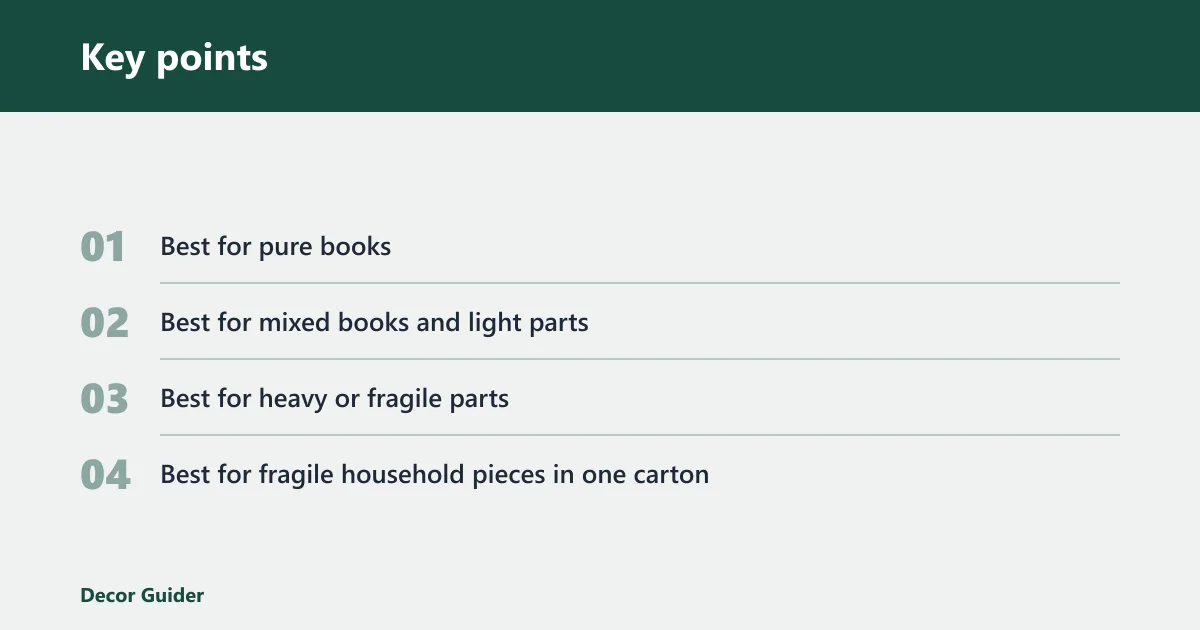
- Best for pure books: small moving boxes around 16 x 12 x 12 inches.
- Best for mixed books and light parts: medium moving boxes with careful weight control.
- Best for heavy or fragile parts: double-wall corrugated boxes.
- Best for fragile household pieces in one carton: dishpack cartons with dividers.
What size moving boxes are best for books?
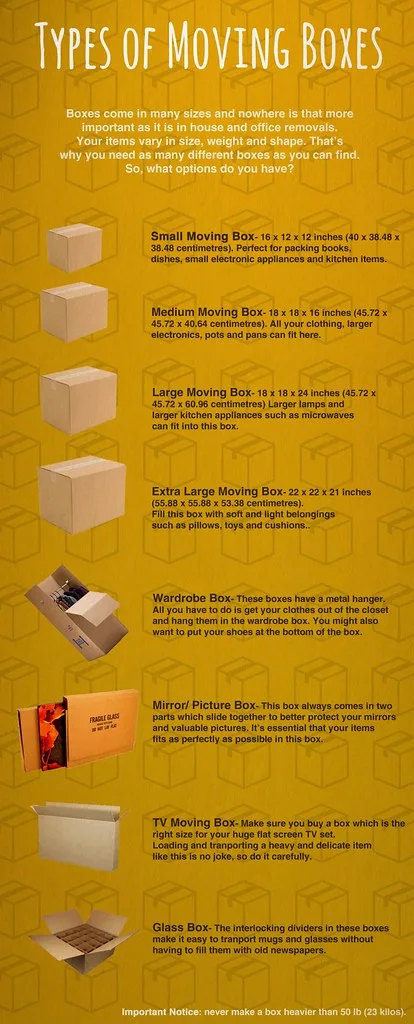
Small moving boxes are the best starting point for books because they keep dense loads manageable. A typical book box footprint is around 16 x 12 x 12 inches, which limits weight before the carton becomes hard to lift or likely to split at the bottom seam.
Hardcovers, paperbacks, and textbooks
Hardcovers and textbooks create the biggest pressure on the base of the carton, so they belong in the smallest practical box. Paperbacks are lighter, but they can still create a packed, heavy load if you fill every corner and leave no voids.
Use one carton for one category when possible. A box of mixed textbook sizes often settles unevenly, and that uneven top layer can crush the lower books or force the side walls to bow.
Why small boxes reduce bottom blowouts
Bottom blowouts happen when the box carries more weight than the base can support, especially on stairs, during a tilt, or when the carton is set down hard. Smaller boxes keep the center of gravity lower and stop the load from becoming a brick-shaped weight problem.
Book boxes also make stacking safer. A dense, compact carton sits flatter on a dolly or truck floor than a larger carton that flexes in the middle.
When to split a heavy book load
Split the load as soon as the carton becomes hard to lift with one hand at the side handles or when the top flaps refuse to close without a bulge. That is the practical sign that the contents have crossed from “packed” to “overfilled.”
Say your book stack reaches the top of a small box and still leaves no room for a flat hand to press the lid down. Split the load into two cartons, even if that means one holds only a partial row of titles. The extra box is cheaper than a torn seam and damaged spines.
Can medium boxes handle small furniture?
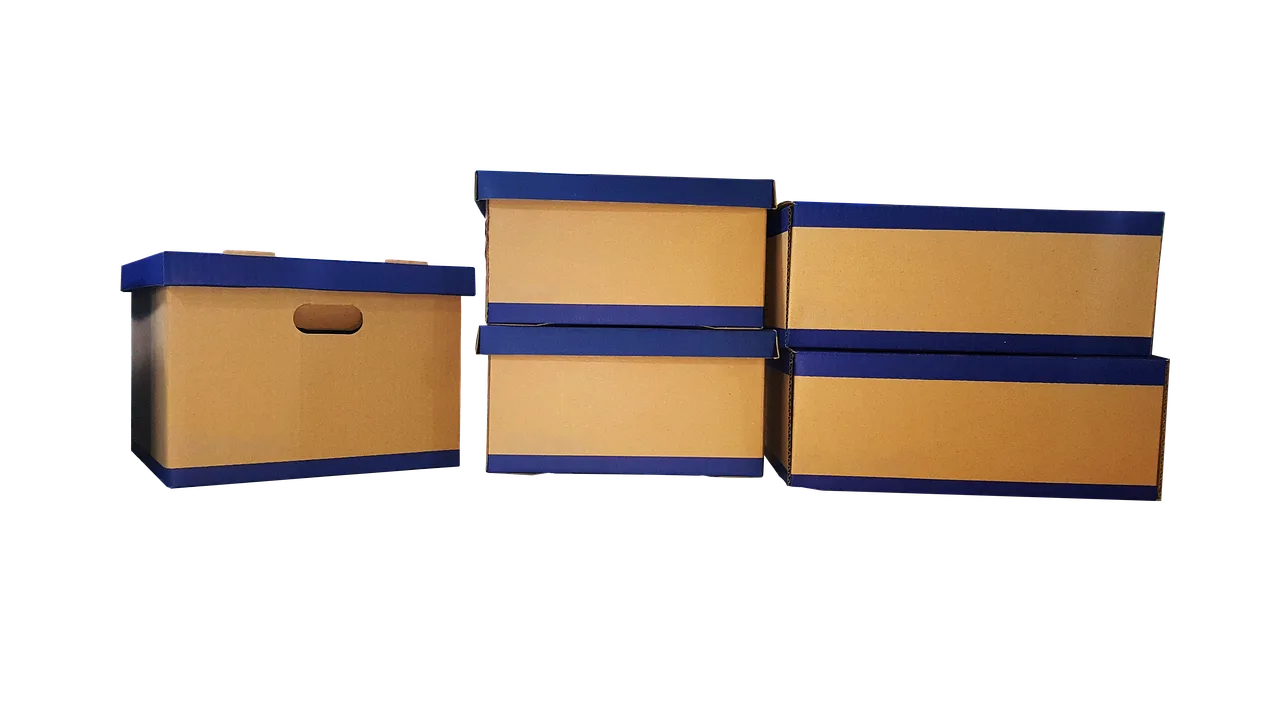
Medium boxes can handle some small furniture parts, but only when the pieces are light, flat, and easy to separate. They work best for shelves, stool parts, drawer inserts, and short legs that will not punch through the wall or scrape against each other.
Drawer inserts, shelf pieces, and stool parts
Use medium boxes for drawer inserts and shelf pieces when the parts are flat enough to stack with padding between them. A common footprint around 18 x 18 x 16 inches or 24 x 12 x 12 inches gives you room for odd lengths, but it also invites overpacking, so the box should stay well below its full visual capacity.
Stool parts fit better when the seat, legs, and screws are separated. If the stool base is heavy hardwood or metal, step up to a double-wall carton rather than forcing it into a standard medium box.
Packing hardware and brackets in labeled bags
Hardware should never float loose with books or wood pieces. Put screws, brackets, cam locks, and washers into labeled bags, then place those bags in a rigid pocket inside the carton so they do not scratch veneer or disappear under heavier items.
Use one bag per piece of furniture, not one bag for the entire move. That saves time later and keeps mixed hardware from becoming a sorting problem in the new place.
When medium boxes become too deep or wide
A medium box is too deep when the bottom layer is heavy enough to shift during a lift. It is too wide when the contents can slide sideways and hit each other, which is common with slim legs, loose brackets, and small shelf pieces.
A common first-timer mistake is using a roomy medium box because the parts “look small.” Then the box fills with unused space, the parts move, and the corners take the impact instead of the padding.
Do you need double-wall boxes?
Double-wall corrugated boxes are the better choice when the load is heavy, fragile, or both. They resist crush and puncture better than single-wall cartons, so they are worth it for dense books, wood panels, metal legs, or any carton that has to survive stacking.
Books plus hardware in the same carton
If you must pack books with hardware, double-wall is the safer call. The hard edges of brackets and screws can damage a lighter box from the inside, and the added weight increases the chance of seam failure during lifting.
Even then, keep the mix controlled. Books go on the bottom only if the hardware is bagged and cushioned; otherwise, separate the fasteners into their own protected compartment or second box.
Fragile or oddly shaped furniture parts
Odd shapes create point pressure. A stool foot, a table corner, or a shelf edge can press through a single-wall carton, especially if the load is shifted by a narrow stair turn or a stack in the truck.
Dishpack cartons make sense when the parts are fragile and need extra crush resistance, but they are not a default choice for every move. Use them when the load has breakable edges, glass-like finishes, or a shape that benefits from internal dividers.
What higher ECT ratings do for stacking strength
ECT, or Edge Crush Test, is the box strength metric that indicates how well a corrugated carton resists vertical pressure at the edges. Higher ECT ratings support more stacking strength, which matters when dense loads are placed under other cartons.
A 32 ECT carton is common for everyday moving boxes, but dense books and wood parts push that rating hard if the box is large or overfilled. Double-wall cartons usually give you more margin when the load must sit under other boxes in a stack.
How much weight can a moving box hold for books?
There is no universal weight cap that works for every carton, because box quality, contents, tape, and handling all matter. A practical rule is to keep book cartons in a lift range that one person can carry safely, then split the load before the box becomes awkward or crush-prone.
Practical lift thresholds, not exact limits
For books, think in terms of comfortable carry weight rather than a maximum printed number. Small book boxes often stay manageable in the 30 to 40 pound range; above that, the risk of bottom sag, handle tear, and stair fatigue rises quickly.
Heavy loads should not overfill large boxes. The larger the carton, the easier it is to exceed a safe lift while still leaving room at the top.
How to keep books from crushing boxes during a move
Keep the load flat, fill voids with packing paper, and stop before the top flaps have to be forced shut. A firm but not swollen box spreads weight better than a box that bulges at the center seam.
Use packing tape on the bottom seam and around weak points, but do not treat tape as a substitute for a smaller carton. If the box is already bending at the base, the cure is less weight, not more tape.
What packing supplies do I need for fragile small furniture parts?
Fragile furniture parts need a small set of supplies: packing paper, bubble wrap, packing tape, and labels. For pieces with sharp edges or finishes that scratch easily, add dividers or cardboard spacers so hard surfaces do not touch.
Core supplies for odd shapes
Packing paper is the main filler because it molds around uneven surfaces and stops movement. Bubble wrap is better for corners, feet, and metal ends, where you need a cushion against impact rather than just a void filler.
Dishpack cartons are worth considering when the parts are especially breakable or when you want dividers to keep objects from knocking together. They are a conditional upgrade, not a blanket requirement.
Labeling and separate bags for hardware
Label each bag with the furniture item, room, and orientation if needed. That matters because a bag of brackets can look identical to another bag of screws once everything is mixed in transit.
Put the bag in a side pocket or taped packet inside the box so it does not sink under heavier parts. Lost hardware slows reassembly and can scratch finished surfaces if it rattles loose.
Which one should you buy?
Buy the box that matches the heaviest item in the carton, not the item that just happens to be easiest to pack. For dense books, choose small book boxes first; for mixed loads under about 40 pounds, use medium boxes; for heavier or fragile parts, move up to double-wall cartons.
Best choice by budget
If you want the lowest-cost path for book-only packing, a small box pack is usually the best value because it keeps weight under control and avoids wasted space. For mixed loads, medium cartons cost less than specialty boxes and still handle flat parts well if you stop short of overfilling.
The U-Haul Small Moving Boxes pack is the clearest fit for dense books. Based on the published specs, it comes in a 12-5/8 x 16-3/8 x 12-5/8 inch size, includes handles and tape, and is rated at 32 ECT with a 65 lb capacity; the drawback is that the printed capacity does not mean you should pack books that heavy for comfort or stack safety.
Best choice by item mix
If your carton will hold books plus a few lightweight parts, start with a small box. If the parts are long, flat, or slightly bulky, a medium box gives you better layout options, but only if the total weight stays in a liftable range.
BOX USA’s medium 18 x 14 x 12 inch cartons are a practical middle ground for mixed-density loads. The published 32 ECT rating and 65 lb support claim make them useful for books, dishes, or light parts, but the drawback is the larger footprint, which can invite overpacking and a heavier carry.
Best choice when you have stairs or long carry distances
Choose the smallest box that fits the contents when the route includes stairs, long hallways, or repeated handoffs. The more times a carton has to be lifted, the more you should favor a smaller footprint and a stronger wall.
For heavy book loads on stairs, a compact reinforced box is easier to manage than a bigger carton filled to the top. Bankers Box’s small classic moving boxes use a 15 x 12 x 10 inch format, have reinforced handles, and do not require tape for assembly; the drawback is that the smaller interior can force more split loads and more boxes to label.
Picture a 24 x 12 x 12 inch medium box filled with textbooks, a bag of screws, and a pair of metal brackets. The box may close, but the mixed hard edges can bruise the books and press against the bottom seam. A second carton for the hardware often solves both the weight and the damage problem.
If the load includes fragile dishes, glass inserts, or small furniture parts with breakable edges, a taller reinforced carton can be the right special-case choice. BOX USA’s 18 x 18 x 24 inch double-wall box offers reinforced construction and more crush resistance, but the drawback is that its larger volume can tempt you to pack too much weight into a single carton.
Dishpack-style boxes make the most sense when fragile parts need dividers or when the same carton must hold several delicate components without contact. They are not a replacement for book boxes, and they should not be used just because the shape looks sturdy on paper. The extra structure is useful, but the bigger size can still create an overpacked box if you treat it like a general-purpose carton.
For closet items such as hanging clothes, wardrobe boxes are a specialty carton, not a book or parts box. They keep garments off the floor, but they are the wrong choice for dense cartons because the volume is intended for vertical hanging space, not heavy load control.
How to choose
- Start with density. Books and hardware belong in small cartons unless the load is very light.
- Check shape next. Long legs, shelves, and brackets often need a medium or double-wall carton so the parts do not poke through.
- Watch the top line. If the lid will not close without a bulge, split the load.
- Match the wall to the risk. Use double-wall when the item is heavy, sharp, fragile, or likely to be stacked.
- Protect every loose part. Bag hardware, wrap corners, and fill voids so nothing can move.
That decision tree keeps the choice simple. Small boxes for dense books, medium boxes for lighter bulky parts, and double-wall cartons when weight or fragility pushes past what a standard carton should carry.
Frequently asked questions
Can I use large boxes for books or small furniture?
Large boxes are a poor choice for books or dense parts because they invite overpacking and become hard to lift safely. They are better for lightweight bulky goods. If you need more volume, split the load into two smaller cartons instead of pushing weight into one oversized box.
Should small furniture go in moving boxes or specialty cartons?
Small furniture parts can go in moving boxes when they are flat, light, and well padded. Use specialty cartons such as dishpacks only when the parts are fragile, oddly shaped, or need dividers. Heavy wood or metal pieces usually need a stronger carton than a standard single-wall box.
Do I need double-wall boxes for heavy books?
Double-wall boxes are a better choice when the book load is very dense, the route includes stairs, or the carton will be stacked under other boxes. They give more crush resistance than single-wall cartons, but the main protection still comes from keeping the load small enough to carry safely.
How do I keep books from crushing boxes during a move?
Keep books in small cartons, fill empty space with paper, and stop before the box bulges. Use stronger cartons if the load is dense or stackable, and do not rely on tape to fix a box that is already bending. The cure for crush is less weight, not more tape.
What box size works for drawer inserts, stools, and side tables?
Medium boxes work for drawer inserts, stool parts, and side table components when the pieces are light and separated. If the parts are heavy, sharp-edged, or long enough to press against the wall, move up to a double-wall carton or split the parts across two boxes.
Products related to this article
Sponsored / affiliate links. As an Amazon Associate I earn from qualifying purchases. I may earn additional commission from eligible campaigns.