
Understanding the essential strengths of your home’s balcony and basement means knowing their structural limits for safety. We break down load capacities, inspection secrets, and simple maintenance to keep these vital areas strong and secure for years of worry-free use.
As someone who spends a lot of time looking under cars, I know that the hidden parts of any structure—whether it’s a vehicle frame or your house foundation—are the most important for safety. Your home has two areas that often cause concern: the basement and the balcony. Are they strong enough? What can you safely put on them? Don’t worry, these aren’t just for engineers! With a few simple checks, you can feel great about the strength hiding beneath your feet and outside your second-story window. We are going to pull back the curtain and show you exactly how to assess and maintain the hidden power of your basement and balcony. Let’s get started on making your home safer and stronger, one easy step at a time!
Understanding Structural Load: What “Strength” Really Means
When we talk about the strength of a basement or a balcony, we are talking about its ability to handle weight, which engineers call “load.” This isn’t just a complicated idea; it’s a simple measurement that keeps things from falling down.
The Basics of Load Capacity
Every part of your home is engineered to support a specific amount of weight, known as its load capacity. If you overload it, you strain the materials, leading to cracks, sagging, or worse.
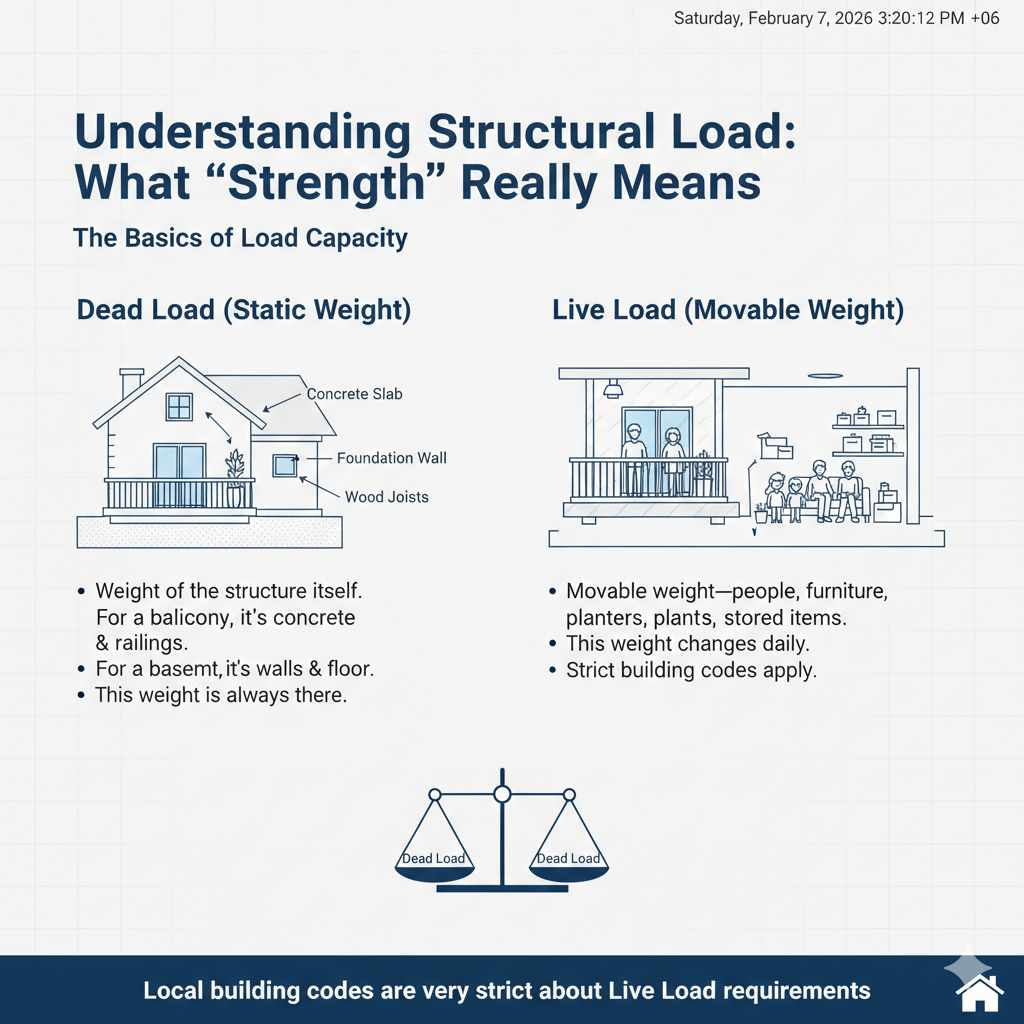
Dead Load vs Live Load
Think of it like a car:
Dead Load: This is the weight of the structure itself. For a balcony, it’s the weight of the concrete, wood, railings, and attached fixtures. For a basement, it’s the weight of the foundation walls, floor joists, and concrete slab. This weight is always there.
Live Load: This is the movable weight—you, your guests, furniture, planters, or stored items in the basement. This weight changes.
Local building codes are very strict about Live Load requirements because they can change daily depending on how you use the space.
Where to Find the Specs (It’s Easier Than You Think)
You don’t need blueprints for this! For general peace of mind, understand what standard building codes require. For residential US buildings, general guidelines for floors and balconies are:
Residential Floor Load (Basement/First Floor): Typically rated for 40 pounds per square foot (psf).
Balcony/Decks (Outdoor Areas): Often required to support 70 to 100 pounds per square foot (psf), as they need to handle snow, heavy rain, and crowds safely.
For anything permanent or added (like a hot tub on a balcony or heavy industrial shelving in a basement), you must check local regulations or consult a professional, as state and local codes govern construction safety standards (you can often find general guidelines on sites maintained by organizations like the International Code Council). Always defer to your local building department for specific requirements in your area.
The Basement: Foundation of Strength and Hidden Weaknesses
Your basement is the anchor of your home. Its strength lies in resisting pressure from the earth around it and supporting everything above it.
Inspecting Basement Walls for Load Bearing Integrity
Basement walls do a tough job: they hold back tons of soil and water pressure. Here is what you need to look for during a quick walk-through:
1. Vertical Cracks: Small, hairline cracks (less than 1/8 inch wide) are often simple shrinkage cracks from curing concrete and are usually not a structural threat.
2. Horizontal Cracks: These are a bigger red flag. They signal significant outward pressure from the soil or hydrostatic pressure (water pressure). If you see these, call a structural engineer.
3. Bowing Walls: If a wall bulges inward or outward more than an inch or two, especially near the middle, it compromises the entire structure’s ability to bear the load above it.
4. Water Penetration: Consistent dampness or active leaks show that the wall is failing to resist external hydrostatic pressure, weakening the concrete over time.
Safe Storage: Maxing Out Basement Load Without Danger
Basements are great for storage, but those heavy boxes of books or tools add up fast.
Tools for Assessing Basement Storage Safety
| Item Type | Typical Weight (Per Cubic Foot) | Safety Tip |
| :— | :— | :— |
| Paper Goods/Clothing | 10 – 20 lbs | Spread out evenly on shelving. |
| Books/Heavy Tools | 50 – 75 lbs+ | Store near load-bearing support columns. |
| Water Heaters/Appliances | Extremely heavy & fixed | Consult manual for required floor capacity. |
Rule of Thumb: Do not create towering, dense stacks directly against exterior basement walls. The weight should be centered over the main concrete floor slab, or near the interior support columns.
The Role of Support Columns (Piers)
If your basement has metal or wooden posts supporting overhead beams, these are critical load-bearing points.
Check Stability: Make sure they sit firmly on their footings (the small concrete pads beneath them). They should not wobble or shift.
Foundation Damage: If a footing sinks, the column will tilt, transferring uneven stress to the beam above, which affects the entire upper floor’s strength.
The Balcony: Elevated Engineering Secrets
Balconies take a beating—sun, snow, loading, and constant movement. Because they are cantilevered (sticking out without ground support underneath), their strength relies entirely on how they attach to the main structure.
Two Main Types of Balcony Construction
Knowing how your balcony is held up affects how you assess its strength:
1. Cantilevered Balconies: These are attached solely to the house structure, often sharing floor joists. They rely on the strength of the connection to the main frame. Sagging is a major concern here, indicating failure at the attachment point.
2. Supported Balconies: These use noticeable posts or columns that go all the way down to the ground or to a concrete footing. These are generally easier to inspect for adequate support.
The Critical Inspection Points for Balcony Strength
You don’t need to climb underneath (though that helps!), but a visual check from the top and sides is essential for long-term strength.
Essential Balcony Strength Checks:
Connection Points: where the balcony frame meets the house siding/rim joist. Are there large gaps? Is there visible rot on any wood flashing or mounting brackets?
Railing Stability: Grab the railing firmly and give it a good shake. A strong railing should not move. Loose railings indicate failing bolts or deteriorated wood posts connected to the ledger board (the board attaching it to the house).
Flashing Integrity: Water is the enemy of outdoor wood structures. Check the metal or plastic flashing (the protective shielding) where the balcony meets the house wall. If water gets behind this, it rots the main structural wood supports over time, severely reducing load capacity.
Signs of Sagging: Stand in the middle of the balcony. Does it feel bouncy, or does it noticeably dip in the middle compared to the edges near the house? A slight dip is common in older wood structures, but significant sagging is a serious load issue.
Calculating Balcony Load: A Simple Approach
While professional load calculations are complex, you can use common sense based on code requirements (70-100 psf).
Example Calculation: If your balcony is 8 feet deep by 10 feet wide (80 sq ft total), and the code requires 70 psf:
80 sq ft 70 psf = 5,600 pounds of weight capacity.
What that means practically: This capacity easily covers several people, patio furniture, and heavy snow loads. You would need an unusually dense feature, like a heavy stone hot tub, to exceed this safely without professional reinforcement.
Maintenance Secrets: Boosting Longevity and Strength
Strength isn’t just about the initial build; it’s about consistent care. Just like changing your car’s oil preserves the engine, regular maintenance keeps your home’s critical structures sound.
Basement Maintenance for Structural Longevity
The exterior grade around your foundation greatly influences basement strength by managing water.
Water Management for Basement Strength:
1. Slope the Grade Away:Soil should slope away from the foundation at a rate of about 6 inches over the first 10 feet. This directs rainwater away from the walls, reducing harmful hydrostatic pressure.
2. Check Downspouts:Ensure every gutter downspout extends at least 4–6 feet away from the foundation footing. Clogged or short downspouts dump water right next to the wall, inviting saturation and pressure.
3. Inspect Drainage Tiles:If you have perimeter drain tiles (weeping tiles) around older foundations, ensure the exterior exit points are clear and flowing correctly toward the street or yard drainage area.
For more in-depth guidance on maintaining your home’s exterior water barriers, resources from university extension programs often provide excellent landowner guides on soil management and moisture control.
Balcony Maintenance: Protecting the Connection Points
Since the connection to the house is the weakest link in a cantilevered balcony, focus your maintenance there.
Seal Gaps Annually: Use high-quality exterior caulk to seal any small gaps around the ledger board or where railing posts meet the deck surface. This stops water intrusion where it matters most.
Check Fasteners: If you have visible bolts or lag screws attaching ledger boards or support brackets, check them annually to ensure they haven’t loosened due to seasonal expansion and contraction.
Maintain Wood/Decking: Apply protective stains or sealants to wood decking every 1–3 years (depending on product and exposure). This prevents the wood from absorbing moisture, which leads to swelling, shrinking, and eventual splintering or weakening of the load-bearing surface.
When to Stop DIY and Call a Professional
Knowing your limits is the smartest part of maintaining strength. If you spot any of the following issues, it’s time to bring in a licensed contractor or structural engineer. Trying to patch serious structural issues yourself can put your home (and future occupants) at risk.
Warning Signs Requiring Immediate Expert Attention:
Basement:Any horizontal crack over 1/4 inch wide, significant stair-stepping cracks in the masonry above ground, or continuous dampness in dry weather.
Balcony:Any noticeable sagging (more than an inch over the span), railing movement under light pressure, or visible shifting where the balcony meets the house structure.
Floor Issues:Floors inside the house feel noticeably spongy, bouncy, or sloping near the basement or exterior walls.
A professional assessment provides peace of mind and an official path forward if repairs are needed. They use specialized tools to measure stress points far beyond simple visual inspection.
Comparing Basement and Balcony Load Management
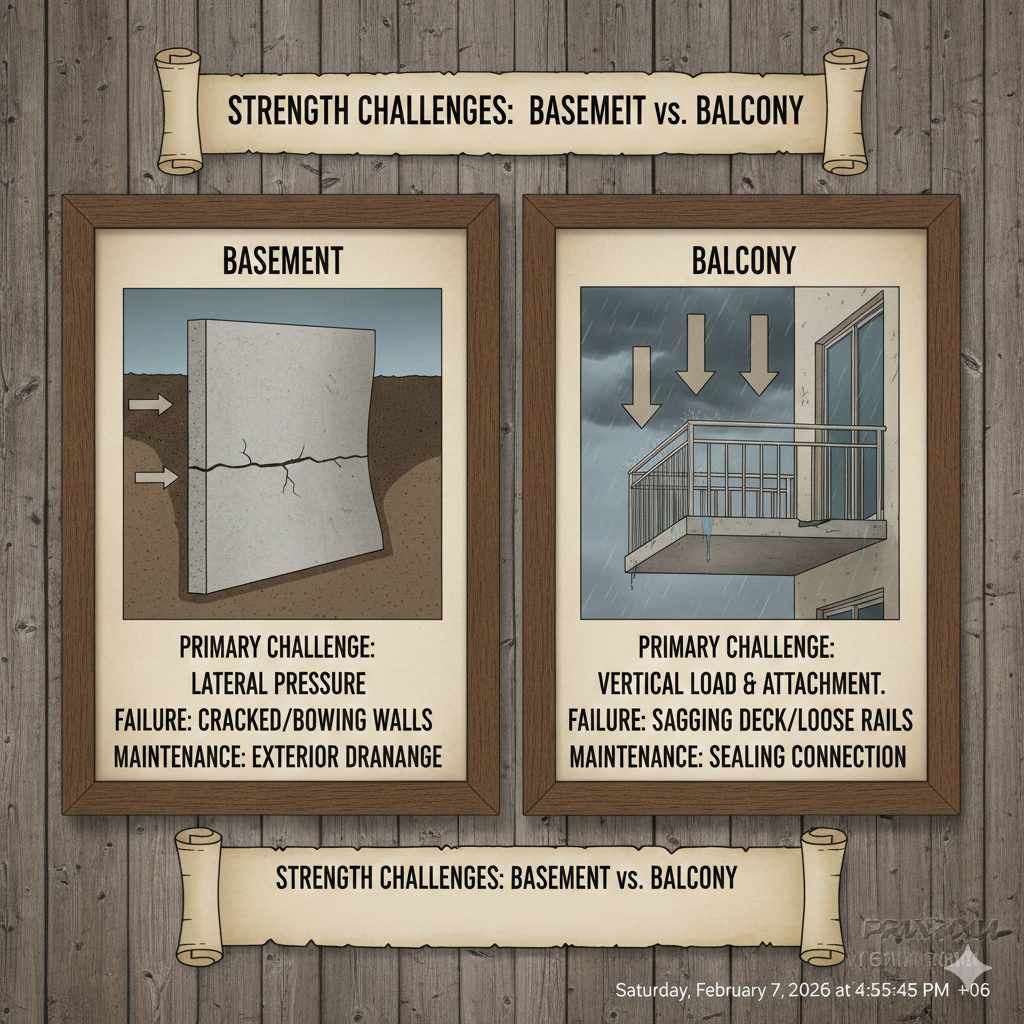
It helps to see how these two areas differ in the strength challenges they face. Basements fight primarily against ground pressure, while balconies fight gravity and weather while relying on a strong attachment.
Strength Challenge Comparison Table
| Feature | Primary Structural Challenge | Key Failure Indicator | Maintenance Priority |
| :— | :— | :— | :— |
| Basement| Lateral (sideways) pressure from soil and water. | Horizontal cracking or bowing walls. | Exterior grading and drainage. |
| Balcony | Direct vertical gravity load and attachment failure. | Sagging deck surface or loose railings. | Sealing connection points against water. |
FAQ Section: Simple Answers for Home Strength Confidence
1. Can I put a hot tub on my existing wooden balcony?
Answer: Probably not without checking. Hot tubs are extremely heavy (often exceeding 1,000 lbs when full). Standard balcony codes are based on patio furniture and people. You must have a structural engineer inspect the existing framing to see if it can handle the point load before adding one. Never guess with heavy items on a balcony.
2. If my basement walls have small vertical cracks, should I panic?
Answer: Not at all. Small, hairline vertical cracks (less than 1/8 inch) are extremely common as concrete cures and settles over time. They usually don’t indicate a major structural problem unless they widen rapidly or show water intrusion.
3. How often should I visually check my balcony railing?
Answer: Check your railings at least twice a year—once in the spring to see what winter damage occurred, and once in the fall before winter weather sets in. Give them a firm shake each time.
4. Does storing heavy concrete blocks in my basement weaken the foundation?
Answer: Storing a small amount near the center of the floor is usually fine, as the slab is designed for that load. However, piling very heavy materials directly against the exterior walls puts unnecessary lateral pressure where the wall is already fighting soil pressure, so store heavy items near interior support columns if possible.
5. What is the biggest threat to a balcony’s long-term strength?
Answer: Water intrusion. If water gets behind the ledger board (where the balcony attaches to the house) and rots the structural wood framing or connection bolts, the balcony can fail suddenly. Flashing and sealing are key!
6. If I see a horizontal crack in my basement wall, what simple first step should I take?
Answer: Mark the ends of the crack with a pencil and monitor it over a few months (especially after heavy rain or freeze/thaw cycles). If the crack expands, call a structural engineer immediately, as this indicates failing support against soil pressure.
Conclusion: Your Home’s Strength is Manageable
Taking charge of your home’s strength, from the deep anchor of the basement foundation to the elevated platform of the balcony, is a source of real confidence. You now know that “strength” is just easily measurable load capacity, and that key indicators like horizontal basement cracks or loose balcony railings are manageable issues if caught early. By focusing your maintenance efforts on water diversion around the basement and protecting the critical connection points of your porch, you are proactively preserving thousands of dollars in potential damage. Remember, you don’t need to be a master builder; you just need to look closely, listen to the structure (no strange creaks!), and know when a simple DIY fix ends and professional expertise begins. Keep checking those critical spots, and enjoy the security of knowing your home’s foundation and outdoor spaces are built to last.