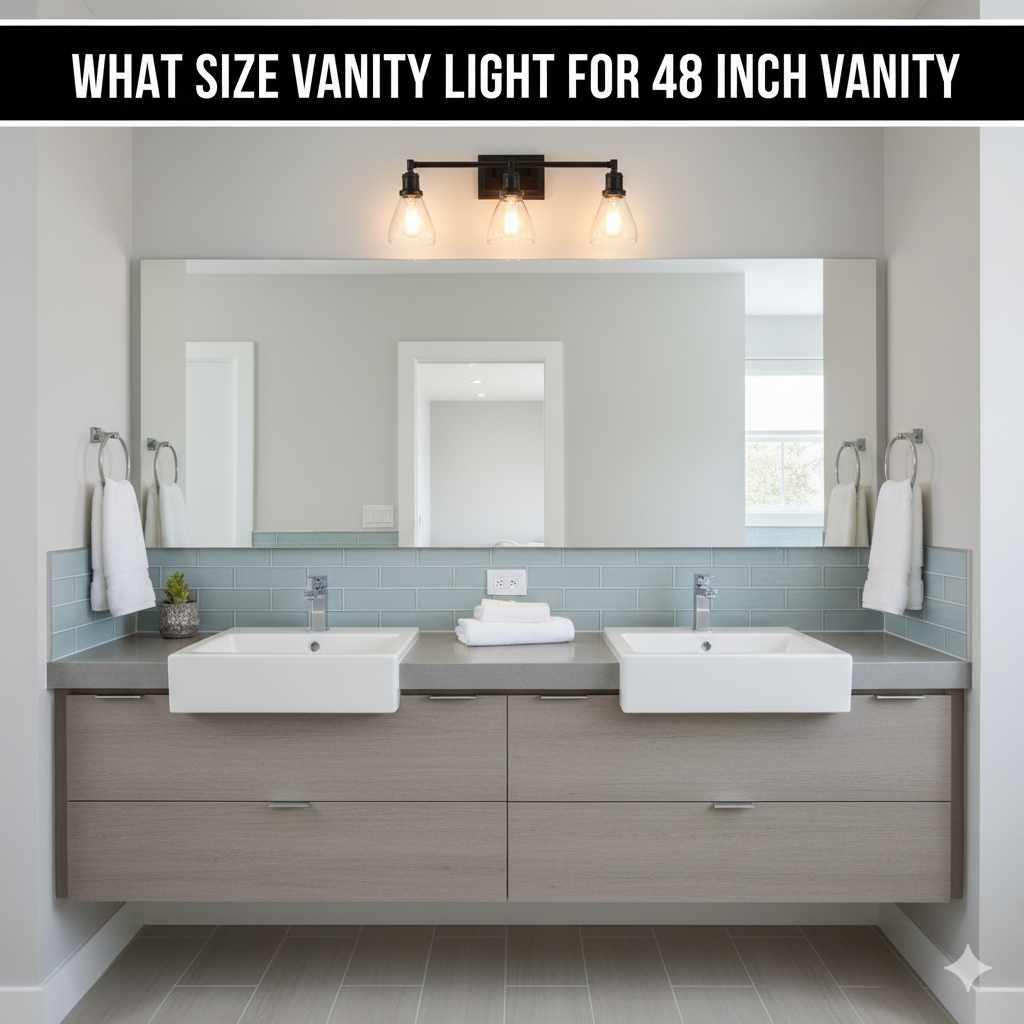
For a 48-inch vanity, the ideal total width for your vanity light fixture should be between 30 and 36 inches. This provides balanced, excellent lighting without looking too small or overwhelming the space. Always aim for the light fixture to cover about 75% of the total vanity width for the best look and function.
When you pick out a new bathroom vanity, everything seems straightforward until you get to the light fixture. You’ve got that perfect 48-inch vanity base, but now you face a wall of confusing lighting options. Choosing the wrong size can make your bathroom look unbalanced—too tiny, it disappears; too huge, and it overwhelms the mirror. It happens to everyone! Don’t worry; this isn’t rocket science. We’re going to walk through the simple math and design rules so you pick the perfect vanity light with total confidence. By the end of this guide, you’ll know exactly what size fixture looks great and works even better. Let’s get your bathroom shining correctly!
Understanding Vanity Lighting: More Than Just Looks
Picking a vanity light isn’t just about making it fit visually; it’s about making sure you can see yourself clearly when shaving, applying makeup, or just brushing your teeth. Bad lighting is frustrating because it casts shadows right where you don’t want them.
Why Sizing Matters So Much
Think of your vanity light like the tires on your car. If they are the wrong size, the car doesn’t perform right. Similarly, in the bathroom:
- Aesthetics: A light fixture that is too small looks lost over a wide 48-inch top. A fixture that is too large can crowd the mirror or feel visually heavy.
- Functionality: The light needs to spread evenly across your face. If the fixture is too narrow, you get harsh shadows on the sides of your face.
- Code and Placement: While local building codes rarely dictate the fixture size itself, proper placement (usually centered over the mirror) is crucial for optimal coverage. You can check local residential building standards for general electrical safety guidelines, but for sizing, design rules prevail.

The Golden Rule: Calculating the Ideal Light Fixture Width
When dealing with a 48-inch vanity, we use popular design ratios to ensure the light is proportionate to the furniture below it. This avoids guesswork and gives you a professional result every time.
The 75% Rule (The Go-To Formula)
The most widely accepted rule of thumb for vanity lighting is that the total width of the light fixture (or the combined width of separate sconces) should be approximately 75% of the width of the vanity cabinet or mirror beneath it.
Here is how that translates for your specific size:
Vanity Width: 48 inches
Calculation: 48 inches x 0.75 (75%) = 36 inches
This means your target total light fixture width should be 36 inches.
Breaking Down the Target Range for a 48-Inch Vanity
While 36 inches is the ideal target, lighting fixtures don’t always come in exact measurements. It’s helpful to know the acceptable range. Aiming for 70% to 80% of the vanity width gives you flexibility.
Minimum Acceptable Width (70%): 48 inches x 0.70 = 33.6 inches
Maximum Ideal Width (75%): 48 inches x 0.75 = 36 inches
Upper Limit (80%): 48 inches x 0.80 = 38.4 inches
For simplicity, when you are shopping, look for fixtures that are between 33 inches and 37 inches wide.
Comparing Light Fixture Types for a 48-Inch Vanity
How you achieve that total width depends on whether you choose a single long bar light or a pair of side sconces. Both options work well with a 48-inch vanity.
Option 1: Single Bar or Linear Fixture
This is the most common choice today. It’s a single fixture that sits above the mirror. For a 48-inch span, you should look for options that closely match that ideal 33 to 37-inch width.
Table 1: Recommended Light Widths for a 48-Inch Vanity
| Fixture Style | Recommended Width Range (Inches) | Why It Works |
|---|---|---|
| Single Bar Fixture | 33″ to 37″ | Provides even light distribution across the entire width. Highly balanced look. |
| Two Sconces (Paired) | Total Width: 30″ to 36″ (See detailed spacing below) | Offers side lighting, which is best for minimizing facial shadows. |
Option 2: Dual Sconces (Sconces on the Side)
Using two separate light fixtures—one mounted on either side of the mirror—is often considered the “best” lighting setup by makeup artists because it illuminates the face from both sides, eliminating shadows.
If you choose sconces, the calculation changes. You need to factor in the mirror size and the space between the fixture, the mirror edge, and the wall.
Sconce Placement Rules:
- Mirror Width: A common mirror size over a 48-inch vanity is 36 to 40 inches wide.
- Sconce Placement: The sconces should ideally flank the mirror, shining light directly onto your face, not just the backsplash or the ceiling.
- Spacing: You want about 6 to 10 inches of space between the edge of the mirror and the center of the sconce.
If you have a 36-inch mirror centered over your 48-inch vanity, you have about 6 inches of open wall space on either side (48 – 36 = 12 inches total space, divided by 2). Placing the center of your sconce about 3 to 5 inches away from the mirror edge works perfectly.
The sconce itself doesn’t need to be huge. A fixture that is 10 to 15 inches tall is usually plenty. The total light coverage is achieved by the pair working together.
Beyond Width: Height and Projection Matter Too
While width gets you 80% of the way there, height (vertical size) and projection (how far it sticks out from the wall) affect safety and functionality.
Vanity Light Height (Vertical Size)
The height of the fixture relates directly to the height of your mirror and ceiling.
General Rule for Height: The bottom of the light fixture should be mounted between 75 and 80 inches from the finished floor, or about 6 to 10 inches above the top of the mirror.
If your vanity has a short mirror and you have a high ceiling (9 feet or taller), you can choose a taller fixture (e.g., a vertical bar light that is 12 to 18 inches tall). If you have a standard 8-foot ceiling, stick to shorter fixtures (under 10 inches in height) to keep things proportional and avoid bumping your head.
Projection (How Far It Sticks Out)
Projection is how far the light sticks out from the wall toward you. This is important for two reasons:
- Lighting Efficiency: A fixture that sticks out too little won’t illuminate your face well.
- Safety: A fixture that sticks out too far might feel like you can bump into it easily when leaning over the sink.
Aim for a projection of 4 to 6 inches. Most standard vanity bars fall right into this range, which allows the light bulb’s light to disperse down and across your face effectively.
The Critical Role of Mirror Size
The mirror dictates the light. Since a 48-inch vanity can hold several different sizes of mirrors, you need to adjust your light sizing based on the mirror you selected, even if the vanity is 48 inches wide.
Scenario 1: Large, Single Mirror (Approx. 40″ – 46″ Wide)
If you have one large mirror nearly filling the space above your 48-inch vanity, stick rigidly to the 75% rule.
Light Width Target: 33″ to 36″
You need the light to cover the mirror width to prevent dark edges around your reflection.
Scenario 2: Two Smaller Mirrors (e.g., Two 20″ Mirrors)
If you opt for two separate mirrors, often placed over individual sinks (even if they share a 48″ top), you should use sconces rather than a single bar light.
Light Setup: Two 10″ to 12″ sconces, spaced evenly.
Why: Each mirror needs its own dedicated light source for shadow-free viewing.
Choosing the Right Color Temperature (Kelvin)
Once you nail the size, the next big decision is the light color itself. This is measured in Kelvin (K). Getting this wrong can make your bathroom feel clinical or dingy.
Understanding Kelvin Scale
Think of Kelvin like highway speed: lower numbers are warmer (like an old incandescent bulb), and higher numbers are cooler (like bright daylight).
2700K (Soft White/Warm White): Mimics traditional incandescent light. Very cozy and relaxing, but can sometimes cast a slight yellowish tint on skin tones.
3000K (Bright White/Neutral White): This is the “sweet spot” for most bathrooms. It’s crisp enough for detail work like makeup but still warm enough to feel welcoming.
4000K and Above (Daylight/Cool White): Very bright and stark, excellent for tasks where color accuracy is paramount (like a professional salon). Can feel harsh or sterile in a small residential bathroom.
Recommendation for a 48-inch Vanity: Aim for 3000K. It provides the best balance of clarity and comfort for daily grooming. If you have strong natural light in your bathroom, you might lean closer to 3500K.
Don’t Forget the Brightness: Lumens
While Kelvin tells you the color, Lumens tell you how bright the light is. Don’t look at the wattage (W) numbers on LED fixtures—look at the Lumens.
For task lighting over a vanity, you want bright light without glare.
Effective Lumens Range for a 48-inch Vanity: 2000 to 3500 total lumens.
If you use a single 34-inch bar fixture, it should produce roughly 2500 lumens. If you use two sconces, each should produce about 1200–1500 lumens. This ensures you have enough light bouncing around the space without relying on harsh overhead cans.
Installation Confidence: Where to Put the Box
Deciding on the light size is easier when you know where the electrical box needs to be. If you are replacing an old fixture, the box is already there. If you are doing new construction or a full gut renovation, placement is key.
Step-by-Step Placement Check
1. Locate the Center: Find the exact horizontal center point of your 48-inch vanity cabinet beneath where the light will go.
2. Center the Box: The electrical box should align perfectly with this center mark.
3. Height Check: Measure up from the finished floor. As mentioned above, aim for the box center to be 78 inches from the floor for an 8-foot ceiling, or adjust slightly higher (up to 82 inches) if you have tall ceilings or a very tall medicine cabinet.
A well-centered box makes mounting your perfectly sized fixture easy. If you are unsure about electrical work, remember that safety is always Job One. Always consult a licensed electrician for wiring and installation, especially when dealing with water sources near electricity.
Troubleshooting Common 48-Inch Vanity Lighting Mistakes
Even with the rules in hand, people still occasionally run into issues. Here are fixes for the most common sizing problems specific to the 48-inch size.
Mistake 1: Using a Standard 24-Inch Builder-Grade Light Bar
What happens: A 24-inch light looks tiny over a 48-inch vanity—it only covers half the space!
The Fixes:
- If you already bought it, use it over a smaller 24-inch guest bath vanity instead.
- If you must keep it, you must switch to a dual-sconce setup, centering the 24-inch fixture between the two sconces, but this rarely looks intentional.
Mistake 2: Fixture Width Equals Vanity Width (48 Inches)
What happens: Although it sounds balanced, a 48-inch fixture feels too heavy and blocks the visual space above the mirror. It violates the 75% rule.
The Fix: Downsize to a 36-inch fixture. Use the extra wall space for simple decorative elements or a small shelf, or ensure your mirror extends right to the edges of the light fixture.
Mistake 3: Using Tiny Aesthetic Sconces
What happens: You choose two very stylish but slim sconces (maybe 6 inches wide) and place them on either side of a large mirror. You get beautiful wall decor, but zero usable task lighting.
The Fix: Ensure each sconce produces at least 1200 lumens. If the decorative housing is small, prioritize finding a sleek, thin fixture that offers powerful, diffused light output (often found in modern LED integrated fixtures).
How to Handle Wide Mirrors Over a 48-Inch Vanity
Sometimes, DIYers purchase a huge 48-inch medicine cabinet or mirror to maximize reflection over the 48-inch base. This changes the lighting dynamic slightly.
If your mirror is exactly 48 inches wide, you have two excellent choices:
1. Symmetry with Sconces: Since the mirror covers the entire horizontal space, you must use sconces mounted on the wall outside the mirror edges. This pushes the light sources out slightly, which is actually great for facial illumination.
2. Minimalist Bar Light: Use a slim, modern bar light that is exactly 36 to 40 inches wide (75% to 83% of the vanity width). It will look sleek and modern, contrasting nicely with the large mirror surface.
Buyer’s Checklist for the 48-Inch Vanity Light
Keep this quick list handy when you head to the lighting store or browse online. This checklist ensures you cover all bases for your 48-inch setup.
Checklist for Optimal Light Sizing:
- Total Fixture Width: Target 33″ to 37″ wide.
- Vertical Height: Should fit comfortably above the mirror without hitting the ceiling line too hard (usually 8″ to 14″ tall).
- Projection: Between 4″ and 6″ depth from the wall.
- Color Temperature (Kelvin): Aim for 3000K (Bright White).
- Brightness (Lumens): Total output between 2000 and 3500 Lumens.
- Mounting Box Center: Must be centered horizontally over the 48-inch vanity cabinet.
Knowing these specific numbers takes all the stress out of shopping for lighting. You are no longer guessing; you are measuring and calculating for a perfect outcome, just like choosing the right oil weight for your engine!

Frequently Asked Questions (FAQ)
Q1: Can I use a 42-inch light fixture over my 48-inch vanity?
A: Yes, you absolutely can. A 42-inch fixture would cover 87.5% of the vanity width. While slightly larger than the 75% ideal, it still provides excellent coverage and looks very substantial and well-lit, especially if your mirror is also large.
Q2: If I use two pendant lights instead of a bar light, what size should they be?
A: If using pendants, the width rule applies to the horizontal distance between the center of each pendant. If your mirror is 36 inches wide, you still want the pendants positioned 6 to 10 inches away from the mirror edges. The pendants themselves should be relatively slim, perhaps 6 to 10 inches wide, focusing on height (12–18 inches is common).
Q3: Should the vanity light be wider than my mirror?
A: Generally, no. The light should ideally match the width of the mirror or be slightly narrower than the mirror, as the light is meant to illuminate the person standing in front of the mirror, not the cabinetry beside it. If the light is much wider than the mirror, it can look awkward, unless you are installing very wide, shallow sconces.
Q4: What if my ceiling is very low (7 feet)?
A: For low ceilings, stick to very shallow profile fixtures, often called flush-mount or slim integrated LED vanity bars. These fixtures usually have a height of 4 to 6 inches, which keeps the space from feeling crowded while still providing good illumination. Mount the light 6 to 8 inches above the mirror and make sure the fixture still falls within the recommended 33–37 inch width range for a 48-inch vanity. A low-profile design keeps the bathroom visually open while still delivering proper task lighting.
Q5: Can I install dimmable lights for a 48-inch vanity?
A: Yes, and it’s actually a great idea. Dimmable LED vanity lights allow you to adjust brightness depending on the time of day and the task you’re doing. For example, you can keep the light bright when shaving or applying makeup, then dim it in the evening for a softer, more relaxing atmosphere. Just make sure the fixture is labeled “dimmable” and pair it with a compatible LED dimmer switch for smooth brightness control.
Conclusion: Finding the Perfect Vanity Light for a 48-Inch Setup
Choosing the right vanity light for a 48-inch vanity might seem complicated at first, but once you understand the basic design rules, the decision becomes much easier. The key takeaway is simple: aim for a light fixture that is about 75% of the vanity width, which usually means a fixture between 33 and 37 inches wide. This proportion creates the perfect balance—large enough to provide even illumination, yet not so large that it overwhelms your mirror or wall space.
Beyond width, remember that placement, brightness, and color temperature also play an important role. Mount the light about 6–10 inches above the mirror, choose a 3000K color temperature for comfortable everyday lighting, and make sure the fixture produces around 2000–3500 lumens for clear task lighting. These details ensure that your bathroom lighting looks great while also making daily routines like shaving, skincare, or makeup much easier.
At the end of the day, the goal is to create a lighting setup that feels balanced, functional, and visually appealing. By following the simple sizing rules and installation tips outlined in this guide, you can confidently choose a vanity light that enhances your bathroom’s design while delivering the bright, comfortable lighting you need every day. With the right fixture in place, your 48-inch vanity will not only look better—it will also work better for years to come.