Peonies in a Vase with Roses: The Complete Guide to Timing, Ratios, and Care
You’ve seen the photos on Pinterest: lush, blowsy peonies tumbling over tightly furled garden roses, all in a simple glass vase. Then you try it at home, and by day two the peonies have ballooned into giant puffballs while the roses still look like tight little cabbages. The arrangement that looked so romantic on day one looks lopsided and chaotic by day three.
This is the single most common problem with pairing peonies and roses, and it’s almost never addressed in the usual flower-arranging advice. The fix isn’t more flowers or a fancier vase. It’s understanding the bloom stages of each flower and synchronizing them so the arrangement looks intentional from the moment you put it together through day five.

grtefhu
grtefhu Fake Peonies with Vase, Pink Real…
- 【Lifelike】The faux peonies flowers look real,they preserves the beauty of fresh flowers and could be kept for years.And the silk p…
- 【Handcrafted】Each silk peony flower arrangement in vase is handcrafted with unique design.The faux pink peonies are made of high-q…
- 【Size】Overall - 11*11 inches including the vase.The fake peony flowers may be squashed during transit,please use a hair dryer to l…
As an Amazon Associate I earn from qualifying purchases.
This guide covers the practical specifics: the ideal rose-to-peony ratio, the best vase shape for heavy heads, how to prep the different stem types, and how to force tight peony buds open faster when you need them to catch up to your roses. You’ll also learn how to manage the “mushrooming” effect where peonies overpower everything else in the vase.
If you’re working with faux flowers, the grtefhu Fake Peonies with Vase set solves the timing problem entirely. These handcrafted silk peonies come in a clear glass vase, they never wilt, and they skip the entire conditioning process. You can check the current price on Amazon here.
Why Roses and Peonies Are the Perfect Pair
The pairing works because of contrast. Peonies are round, soft, and almost cloud-like. Roses bring structure, pointed petals, and a tighter form. Together they create a silhouette that reads as both romantic and deliberate.
There’s also a practical reason this combination works: both flowers drink heavily and respond well to the same conditioning treatment. Warm water, flower food, and a cool room help both. You’re not fighting two different care regimes.
The catch is timing. Peonies open fast, sometimes going from a tight ball to a fully open bloom in 24 hours. Roses, especially garden roses, open slowly over several days. If you buy both at the same stage, your peonies will be past their prime while your roses are just getting interesting.
Choosing the Right Vase for Heavy Blooms
Peony heads are heavy. A single fully open peony can weigh down a thin stem, and when you add roses, the combined weight can tip a lightweight vase. You need something with a wide base and a low center of gravity.
Look for a vase that’s no more than 8 to 10 inches tall. Tall, narrow vases force the stems into a tight bunch, which compresses the peony heads and makes them look crowded. A shorter, wider vase lets each bloom sit at its own angle.
The opening of the vase matters too. A mouth that’s 4 to 5 inches across gives you room to arrange stems in a grid pattern. Anything narrower than 3 inches and you’ll struggle to get the stems to fan out naturally.
Heavy glass or ceramic works best. A clear glass vase shows off the stems, but it also exposes murky water, so you’ll need to change it more often. Opaque ceramic hides the water but makes it harder to see when the level drops.
For a deeper look at vase height and flower proportion, check this vase height guide for a related flower with similarly heavy heads.
The Ideal Ratio: How Many Roses to Peonies
Most guides say “use a mix” and leave it at that. Here’s a specific ratio that works: for every three peonies, use five to six roses. That’s roughly a 1:2 ratio of peonies to roses.
Why more roses? Because peonies are visually dominant. One open peony has the visual mass of two or three roses. If you use equal numbers, the arrangement looks like a peony centerpiece with a few roses stuck in as an afterthought. The extra roses fill the gaps and give the peonies something to lean against.
For a standard 6-inch-wide vase, that means 3 peonies and 6 roses. For a larger statement arrangement, go with 5 peonies and 10 roses. The ratio holds regardless of scale.
If you’re using a mix of bloom stages, adjust slightly. If your peonies are tight buds, you can get away with fewer roses because the peonies will expand. If your peonies are already half-open, add one or two extra roses to balance the visual weight.
Step-by-Step Prep: Conditioning Stems and Leaves
Peonies and roses have different stem structures, and they need slightly different handling.
Peony Stems
Peony stems are thick, woody, and sometimes hollow near the base. Cut them at a 45-degree angle with a sharp knife or pruners. A dull blade crushes the stem and reduces water uptake.
Strip all leaves that would sit below the waterline. Peony leaves are large and dense; submerged leaves rot quickly and feed bacteria. Remove about two-thirds of the foliage total, leaving just a few leaves near the top for visual balance.
Rose Stems
Rose stems are thinner, more flexible, and covered in thorns. Remove the thorns carefully with a thorn stripper or a paring knife, but don’t strip the bark. The outer layer helps the stem take up water.
Roses also have a tendency to form air bubbles in the stem after cutting. This blocks water uptake and causes drooping heads. To prevent this, cut the stem under running water, then immediately place it in the vase. This is a small step but it makes a measurable difference in vase life.
Both flowers benefit from a deep hydration period before arranging. Place them in a bucket of warm water (about 100°F) for two hours in a cool room. This plumps the stems and hydrates the heads before they go into the final vase.
The Arrangement Method: Building a Balanced Silhouette
Start with the peonies, not the roses. Peonies are the largest element, so they set the frame.
Creating a Focal Point with Peonies
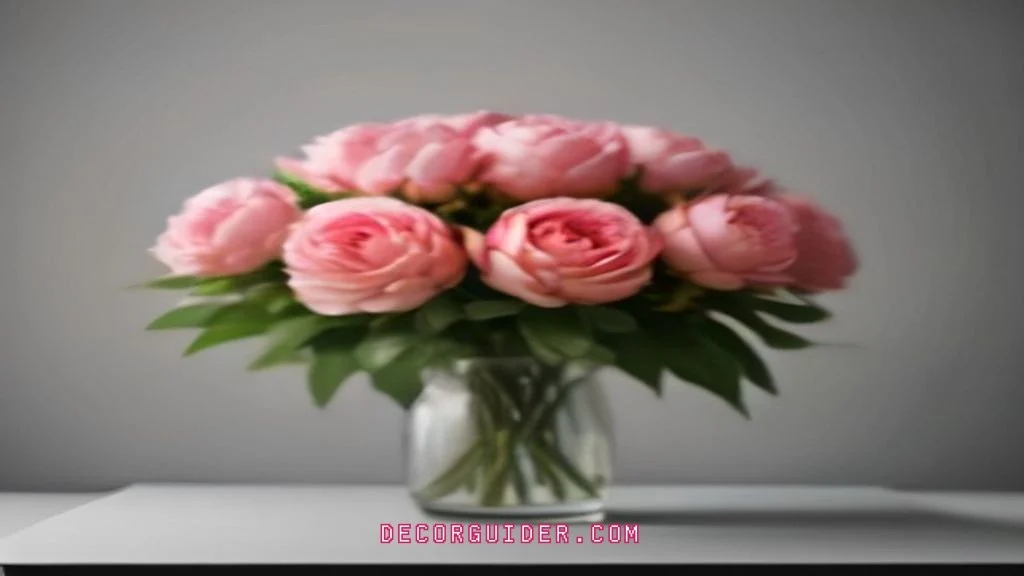
Place the first peony in the center of the vase, slightly lower than you think it should be. The second peony goes to the left and slightly higher. The third goes to the right and slightly lower. This creates a triangle, which is the most visually stable shape in floral design.
Turn each peony so its best side faces outward. Peonies are rarely perfectly round; they have a front and a back. Rotate the stem until you find the angle where the bloom looks fullest.
Weaving Roses for Texture and Support
Add roses in between the peonies, filling the spaces. Don’t cluster all the roses together. Distribute them evenly so each rose sits near a peony, creating a rhythm of round and pointed shapes.
The roses also serve a mechanical purpose. Their thinner, sturdier stems can act as supports for the heavier peony stems. If a peony stem is leaning, tuck a rose stem next to it to hold it upright.
Use a mix of rose bloom stages. Include one or two fully open roses for color, a few half-open for shape, and one or two tight buds for texture. This gives the arrangement depth and makes it look more natural.
The final silhouette should be roughly dome-shaped, with the highest point in the center. The entire arrangement should be about 1.5 times the height of the vase. Anything taller looks spindly; anything shorter looks squat.
How to Force Peony Buds to Open Faster
Sometimes your peonies are tight green balls and your roses are already opening. You need to speed up the peonies.
The fastest method is warm water. Fill the vase with water at 110°F, not boiling. Place the peonies in and put the whole arrangement in a warm room, around 70°F. The heat encourages the buds to swell.
You can also gently pry open the outer petals. Hold the bud in one hand and use your thumb to carefully push the outermost petals outward. Don’t force them; just loosen them. This mimics the natural opening process and can shave a day off the timeline.
Another trick: remove the green calyx, the leaf-like structure at the base of the bud. This is the outer shell that holds the bud closed. Snipping it off with scissors gives the petals room to expand. Do this only for buds that are already showing color; a completely green bud will not open if you remove the calyx too early.
One warning: peonies forced open this way won’t last as long. The natural opening process takes 2 to 3 days, and flowers that open slowly last longer. If you force them, expect the blooms to peak in about 24 hours and then start to decline.
Managing the Lifespan: When Peonies Outpace Roses
Here’s the real challenge: peonies open fast, look gorgeous for two days, then start shedding petals. Roses open slowly and can last a week. You have a few options to keep the arrangement looking good for the full five days.
Option one: buy peonies at different stages. Get one that’s already open, one that’s half-open, and one that’s still a tight bud. This staggers the bloom time so you have a peony at peak form for several days in a row.
Option two: accept the shift and rearrange mid-week. On day three, when the peonies are past their best, remove them and redistribute the roses. The arrangement becomes a rose centerpiece, which is still beautiful.
Option three: use fewer peonies. The 1:2 ratio already accounts for this, but you can push it further. A 1:3 ratio of peonies to roses means the roses carry the arrangement, and the peonies are accents rather than the main event.
If a peony starts to drop petals, remove it immediately. The fallen petals look pretty for about an hour, then they turn brown and make the water murky. Pull the whole stem out and let the roses fill the gap.
Final Care Tips for Maximum Vase Life
Change the water every two days, not every day. Both flowers are sensitive to bacteria, but daily changes stress the stems. Every 48 hours is the sweet spot.
Use flower food. The packet that comes with your flowers is formulated for mixed bouquets. It contains sugar for energy, acid to lower pH, and a biocide to kill bacteria. It works for both roses and peonies.
Keep the arrangement out of direct sunlight and away from fruit bowls. Ethylene gas from ripening fruit accelerates flower aging. A cool room, around 65°F, extends vase life by a day or two.
Re-cut the stems every time you change the water. A fresh cut opens up the vascular tissue and allows better water uptake. Cut at a 45-degree angle, and remove any leaves that have fallen into the water.
For more on keeping peonies healthy in a vase, this peony care guide covers the specifics in more detail.
Frequently Asked Questions
Can I use any rose variety with peonies?
Garden roses are the best choice because they have a similar bloom shape and a softer, more romantic look. Hybrid tea roses have a tighter, more formal spiral that can clash with the loose, ruffled peony form. If you only have hybrid teas, use them sparingly and let the peonies dominate.
How long do peonies and roses last together in a vase?
With proper conditioning and care, peonies last 4 to 5 days and roses last 5 to 7 days. The peonies will drop first. If you stagger the peony bloom stages, you can extend the overall arrangement to a full week.
Should I remove all the leaves from rose stems?
No. Remove leaves that would sit below the waterline, and thin out dense foliage, but leave a few leaves near the top. Roses need some leaves for photosynthesis, which keeps the stem strong and helps the flower stay hydrated.
Why do my peony stems bend and droop?
Peony stems are hollow near the base and can’t always support the weight of a fully open bloom. Cut the stems shorter, or use rose stems as supports. You can also insert a thin wire into the hollow stem to reinforce it, but this is fiddly and only worth it for special occasions.
Can I mix fresh peonies with faux roses, or vice versa?
You can, but it’s tricky. The texture difference is obvious up close. If you want to mix, choose faux roses with a matte finish rather than a glossy one, and place them near the back of the arrangement so they’re not the first thing people inspect.
What Actually Matters
- Use a 1:2 ratio of peonies to roses for a balanced arrangement that doesn’t get overwhelmed.
- Pick a short, wide vase with a 4-5 inch opening to support heavy peony heads.
- Cut peony stems at 45 degrees and strip most leaves; cut rose stems under running water to prevent air bubbles.
- Force peony buds open with 110°F water and gentle petal loosening, but accept a shorter vase life.
- Stagger peony bloom stages so you have fresh blooms for several days, not just one.
- Change water every 48 hours, re-cut stems, and keep the arrangement out of direct sun.
- When peonies start to fade, pull them and let the roses carry the arrangement.
Products related to this article
Sponsored / affiliate links. As an Amazon Associate I earn from qualifying purchases. I may earn additional commission from eligible campaigns.