
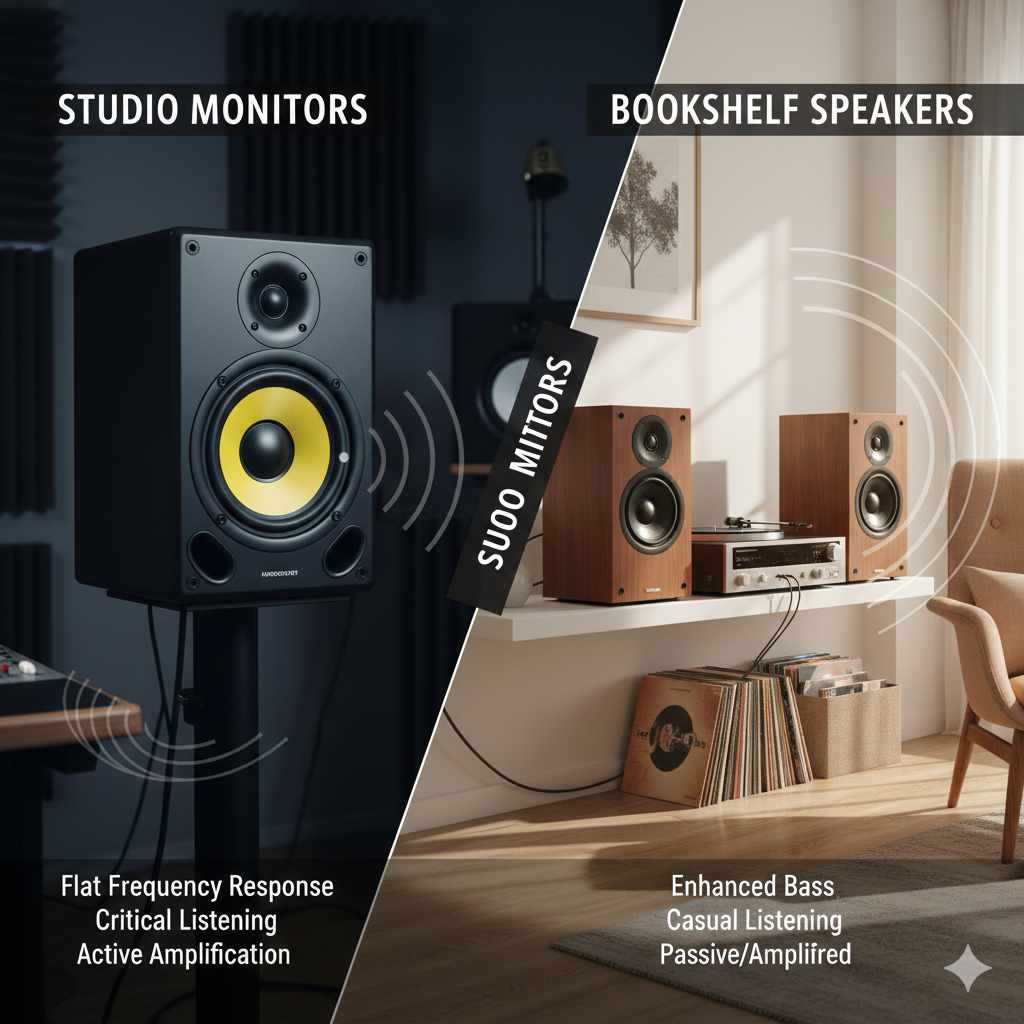
The debate between studio monitors and bookshelf speakers usually gets framed as work versus play. You buy monitors to mix audio. You buy bookshelf speakers to enjoy music. But the lines blur fast when you start shopping.
| Our Pick | Runner Up |

|

|
| Edifier Edifier MR3 Powered Studio Monitor, Speaker Hi-Res… | Ortizan Ortizan C7 Powered Studio Monitors Pair with… |
| See on Amazon | See on Amazon |
As an Amazon Associate I earn from qualifying purchases.
I spent a week with the Edifier MR3 powered monitors and the Ortizan C7 powered speakers. Both are compact, both sit on a desk, and both cost less than a night out in some cities. Yet they serve completely different masters. The Edifier is a tool with a flat frequency response. The Ortizan is a toy that flatters everything you throw at it.
If you only buy one, the Edifier MR3 wins for most people. It does more, sounds more honest, and won’t tire your ears after an hour. But the Ortizan has a place. Let me show you where.
The Short Answer: Which One Do You Actually Need?
Ask yourself one question: what will you do with these speakers more than half the time?
If you edit video, record guitar, produce beats, or do any critical listening, get the Edifier MR3. The flat response means what you hear is what your file actually contains. No sugar coating. No fake bass. Just truth.
If you mostly stream Spotify, watch YouTube, and play casual games, the Ortizan C7 might be enough. It has a fun sound signature that makes everything feel alive. But it won’t tell you when your mix has a problem. It will hide it.
Neither speaker is perfect. The Edifier lacks deep bass punch. The Ortizan lacks detail in the mids. But the Edifier gets closer to accurate, and accuracy is harder to fix later.
Defining the Contenders: Studio Monitors vs. Bookshelf Speakers
People use the terms interchangeably, but they are not the same thing.
The “Flat” Promise of Studio Monitors
Studio monitors aim for a flat frequency response. That means no frequency range is boosted or cut to make music sound better. The Edifier MR3 is certified Hi-Res Audio and covers 52Hz to 40kHz. That range is wider than your ears can perceive at the top end, but the point is precision.
The MR3 has three listening modes: Music, Monitor, and Custom. In Monitor mode, the speakers strip away any coloration. You hear the raw signal. This is what you want when you’re mixing vocals or balancing a drum track. The 3.5-inch mid-low drivers and 1-inch tweeters deliver a soundstage that feels focused, not wide and dreamy.
The “Pleasure” Curve of Bookshelf Speakers
Bookshelf speakers are designed to please. They often have a slight V-shaped EQ—boosted bass and treble, scooped mids. The Ortizan C7 follows this recipe with its 3.5-inch carbon fiber mid-bass driver and 0.75-inch silk dome tweeter.
The result is a lively sound. Pop music sounds punchy. Movie explosions sound bigger than they should. But the midrange—where vocals and guitars live—gets pushed back. That’s fine for casual listening. It’s a problem if you’re trying to judge a vocal take.
The Ortizan also has a flat response claim in its marketing, but the components and tuning tell a different story. A 0.75-inch tweeter simply cannot deliver the same clarity as a larger, better-engineered driver.
The Technical Divide: Crossover, Amplification, and Drivers
The crossover is the brain that splits the audio signal between the tweeter and the woofer. In the Edifier MR3, the crossover point is set higher than typical consumer speakers. This matters because the midrange driver handles more of the vocal frequencies.
That higher crossover point is why the MR3 sounds clearer in the mids. Vocals sit forward, and you can hear the texture of a guitar string. The Ortizan uses an electronic 2-way crossover, but the smaller tweeter forces the crossover lower. That means more of the midrange gets handed to the tweeter, which can sound harsh at higher volumes.
Active vs. Passive: The Hidden Cost of Bookshelf Speakers
Both of these speakers are powered, meaning they have amplifiers built in. But this is where the studio monitors vs bookshelf speakers conversation gets tricky.
If you buy passive bookshelf speakers, you also need to buy an amplifier. That adds $100 to $300 to your total cost. A powered speaker like the Ortizan C7 includes the amp, but it’s a cheap one. The Edifier MR3 also has built-in amps—18W per channel—but they are tuned with more care.
The MR3’s amp delivers a peak SPL of 92.5dB. That’s loud enough for near-field listening on a desk. The Ortizan doesn’t publish SPL numbers, which tells you something. It gets loud, but it distorts sooner than the Edifier when you push it.
For the money, the Edifier is the better deal because you get accurate sound without buying extra gear. The Ortizan is cheaper upfront, but you might outgrow it in six months.
The Real-World Test: Mixing Music vs. Watching Movies
I mixed a short track on the Edifier MR3. The first thing I noticed was how honest the bass was. It didn’t boom. It just sat there. I could hear the kick drum and the bass guitar as separate elements, not a muddy blend. That’s the flat response doing its job.
Then I switched to the Ortizan C7. The same track sounded more exciting. The bass was thumpier, the highs sparkled. But I couldn’t tell if the levels were right. The speakers were adding their own flavor. I made two EQ changes that sounded good on the Ortizan, then checked them on the Edifier. They were wrong. That is the danger of mixing on bookshelf speakers.
For movies, the tables turn. The Ortizan’s boosted bass makes action scenes more fun. Explosions rumble, and the soundstage feels wider. The Edifier is more reserved. It’s accurate, but it won’t shake your desk. If you want movie magic, the Ortizan is the better pick.
The Acoustic Trap: Why Your Room Matters More Than the Speaker
Here is the uncomfortable truth: your room affects the sound more than any speaker choice.
Put either of these speakers on a desk against a wall, and the bass will bounce off the wall and get boomy. Put them in a large open room, and the bass will disappear. This is room acoustics, and it applies to both products.
The Edifier MR3 handles this better because it has a flatter response to start with. The Ortizan’s boosted bass gets worse in a bad room. You can fix this with speaker placement—pull them away from walls, angle them toward your ears—but you cannot fix what the speaker itself is doing wrong.
If you are serious about sound, you need to treat your room. Cheap foam panels on the walls make a bigger difference than upgrading from a $100 speaker to a $500 one. The Edifier MR3 is a better foundation for that journey because it shows you the truth of your room, not the speaker’s coloration.
The Hybrid Solution: Powered Bookshelf Speakers with DSP
Some people want both accuracy and fun. That is where DSP (digital signal processing) comes in.
The Edifier MR3 has a Custom mode that lets you adjust the EQ through the EDIFIER ConneX app. You can dial in a flattering curve for movies, then switch back to Monitor mode for mixing. This makes the MR3 a true hybrid.
The Ortizan C7 has no app and no DSP controls. What you get is what you get. There is a headphone output and multiple inputs, but no way to tune the sound to your room.
This is the hidden advantage of the Edifier. Room correction software can make a $200 speaker sound like a $500 monitor. The MR3 gives you the tools to do that. The Ortizan leaves you stuck with its default tuning.
If you are willing to learn how to use EQ, the Edifier is the smarter investment. It grows with you.
The Final Verdict: A Decision Matrix for Your Budget and Goals
Here is how I would decide between these two, based on your situation.
You are a beginner producer or content creator. Get the Edifier MR3. You need to hear accurate sound to learn what good mixing sounds like. The flat response will teach you more than any YouTube tutorial.
You only listen to music and watch movies. The Ortizan C7 is fine. It’s cheaper, it’s fun, and it has Bluetooth 5.3 for easy pairing. Just don’t expect it to be accurate.
You have a small desk and limited space. Both work, but the Edifier’s front-panel headphone output and balanced TRS inputs make it more flexible. You can connect a mixer or an instrument without buying adapters.
You care about long-term value. The Edifier MR3 wins. It has Hi-Res Audio certification, better drivers, and app-based EQ. The Ortizan is a starter speaker, not a keeper.
| Feature | Edifier MR3 | Ortizan C7 |
|---|---|---|
| Amplifier Power | 18W x 2 RMS | Not specified |
| Tweeter Size | 1 inch | 0.75 inch |
| Mid-Low Driver | 3.5 inch | 3.5 inch carbon fiber |
| Frequency Response | 52Hz – 40kHz | Not specified |
| Bluetooth Version | 5.4 | 5.3 |
| Inputs | Balanced TRS, RCA, AUX | RCA, AUX, USB, Balanced TRS |
| EQ Control | Music, Monitor, Custom via app | None |
| Hi-Res Certification | Yes | No |
| Headphone Output | Yes | Yes |
The table shows the real gap. The Edifier gives you more control and better specs where it counts. The Ortizan throws in a USB input, which is nice, but it lacks the tuning tools.
Frequently Asked Questions (FAQ)
Can I use studio monitors for casual listening?
Yes, but you might not like them at first. The flat frequency response can sound boring compared to a consumer speaker. You hear all the flaws in a bad recording. That said, the Edifier MR3 has a Music mode that adds a bit of life. You can switch between modes depending on your mood.
Do I need an audio interface for the Edifier MR3?
No. The MR3 has RCA and AUX inputs that connect directly to your computer or phone. But if you want to use the balanced TRS inputs, you will need an interface or a mixer. The balanced connection reduces noise over longer cable runs, which is useful in a studio setup.
Are the Ortizan C7 speakers good for near-field listening?
They are acceptable, but not great. The boosted bass can overwhelm a small desk setup. The sweet spot is narrow, so you need to sit directly in front of them. The Edifier MR3 has a wider sweet spot, which makes it easier to move around while you work.
Which speaker is better for a home theater setup?
The Ortizan C7, honestly. Its fun sound signature adds excitement to movies. But if you want accurate dialogue and sound effects, the Edifier MR3 is better. It depends on whether you want to feel the explosion or hear the exact direction of the sound. For a deeper look at how these compare to larger options, check my bookshelf vs floor standing guide.
If you are still torn, remember this: studio monitors vs bookshelf speakers is not a battle of good versus bad. It is a battle of purpose. The Edifier MR3 is a tool. The Ortizan C7 is a toy. Both are valid. But you should know which one you are buying before you click the button.
For a broader comparison of these two categories, read my bookshelf speakers vs monitors article. And if you are considering floor-standing alternatives, this floorstanding vs bookshelf with subwoofer breakdown might help.