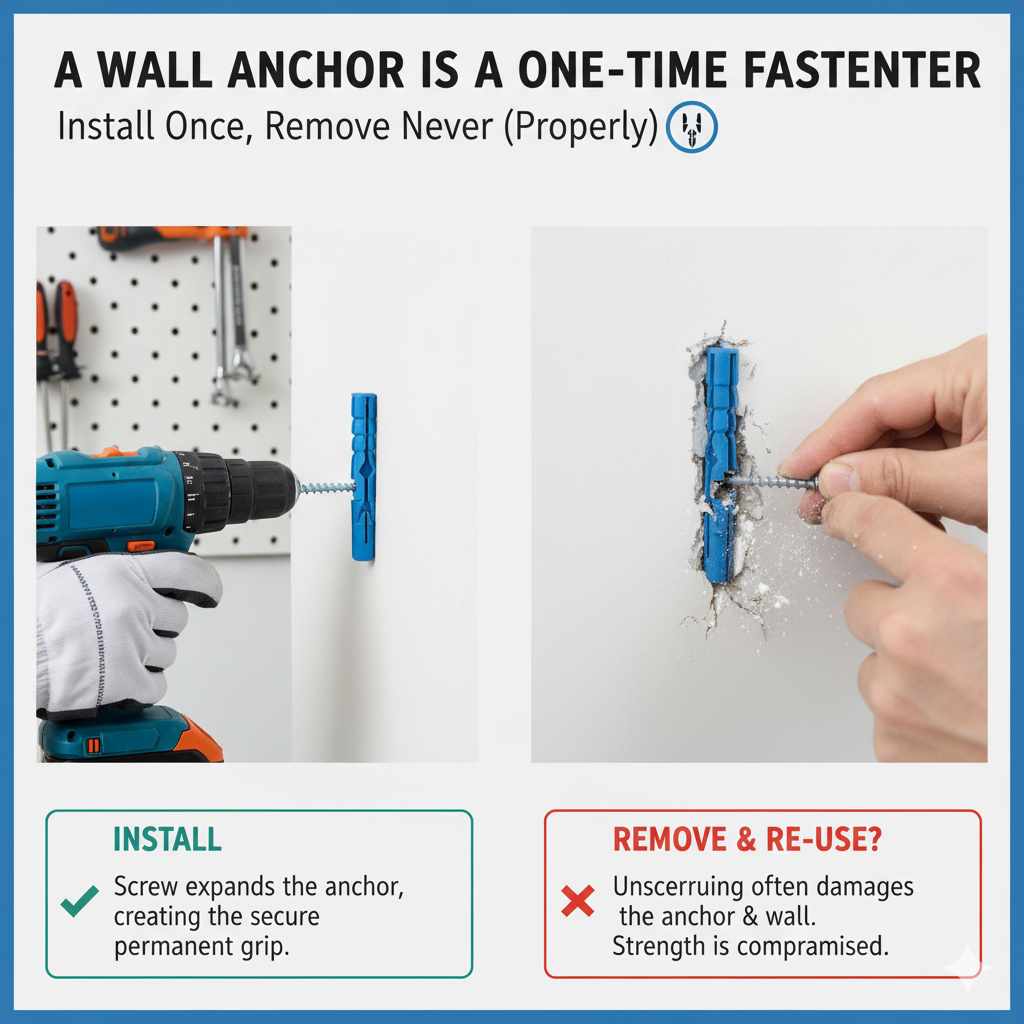
A wall anchor is a one-time fastener; once set or fully engaged in drywall or masonry, it should not be removed and reinstalled, as this almost always damages the anchor or the surrounding material, compromising its holding power for safety and reliability.
We’ve all been there: you need to hang a shelf, a mirror, or maybe that new coat rack, and the drywall just won’t hold a regular screw. You reach for a wall anchor, hoping it will magically solve your problem. But there’s one very important, often overlooked rule in the world of home improvement: a wall anchor is usually a one-time use item. Trying to pull it out and stick it back in later is a recipe for disaster, leaving you with a wobbly object and a hole that seems too big to fix. If you’re feeling frustrated, take a deep breath! I’m Dustin Hall, and I’m here to walk you through exactly why these anchors are single-use heroes and how to use them correctly the first time so your heavy items stay safely on the wall. We’ll look at the different types, the right installation steps, and preventative tips so you have total confidence next time you tackle that hanging project.
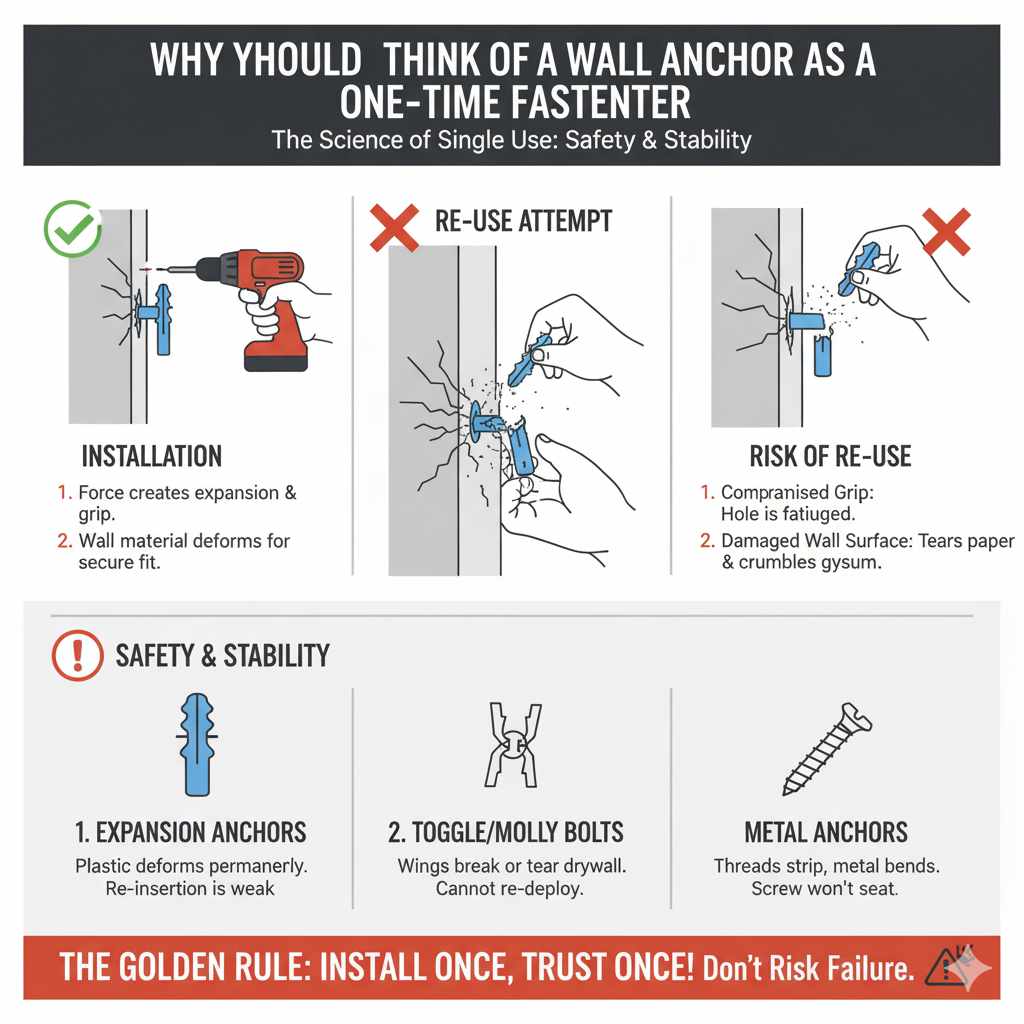
Why You Should Think of a Wall Anchor as a One-Time Fastener
It might seem like a waste, but understanding why a wall anchor is a one-time fastener is the secret to preventing frustration and ensuring safety. These little devices rely on creating a specific shape, expansion, or grip behind your wall surface. Changing that shape once breaks the spell.
The Science Behind the Single Use
When you install an anchor—especially the plastic expansion type common in drywall—you force it into a tight hole.
Expansion Anchors: These plastic sleeves are designed to slightly deform and press against the backside of the drywall when you drive the screw in. This crushing action creates grip. If you remove the screw, the plastic might shrink back slightly, but the wall material around the hole is already fatigued. Removing the screw again lets the anchor pull out, or you’ll find the hole is now too wide to create the necessary friction the second time.
Toggle Bolts and Molly Bolts: These anchors work by deploying “wings” or barbs behind the wall surface. Once those wings spread out, they are locked in place by the pressure of the screw head. Trying to unroll them usually damages the locking mechanism or tears the surrounding drywall paper, making them useless for re-installation.
Risk of Re-Use: Safety and Stability
The main reason we stick to the “one-time” rule is safety. You are relying on that anchor to support weight—sometimes quite a bit of weight.
1. Compromised Grip: The original friction fit is gone. The second attempt will never achieve the same level of tight compression against the wall material.
2. Damaged Mounting Surface: Drywall is essentially gypsum held between two layers of heavy paper. Drilling or forcing an anchor repeatedly tears this paper and crumbles the gypsum core, turning a solid anchor point into soft dust.
3. Anchor Wear: Metal anchors can bend or strip their threads during removal, meaning the screw won’t seat properly the next time, leading to wobble or eventual failure.
Understanding Anchor Types: Which Ones Are Strictly One-Time?
Not all anchors are created equal. Some tolerate removal better than others, but for any load-bearing application, assume they are single-use. Here is a breakdown based on common household materials.
Plastic Expansion Anchors (The White, Brown, or Gray Sleeves)
These are the workhorses for lightweight items (picture frames, small decorations) but should not be trusted for mid-to-heavy loads (over 10 lbs in standard 1/2-inch drywall).
One-Time Use Verdict: Strictly one-time. If you pull the screw out, the anchor usually pulls right out with it, especially if the load was heavy.
Nylon Self-Drilling Screws (The Ones That Look Like Plastic Screws)
These screw directly into the drywall without a pre-drilled hole. They create their own threads in the gypsum.
One-Time Use Verdict: Highly sensitive. Removing the screw often causes the threads in the wall to strip immediately, making re-insertion unreliable.
Metal Drywall Anchors (Molly Bolts)
These are the ones that expand behind the wall when tightened. They are much stronger than basic plastic anchors.
One-Time Use Verdict: One-time. They must be expanded correctly. If you loosen the screw too much, the metal barbs or wings may flatten against the wall structure and won’t re-engage properly later.
Toggle Bolts (The Strongest Drywall Option)
These use a spring-loaded metal mechanism that snaps open behind the wall. They are excellent for heavy items like large shelves or TV mounts where studs are unavailable.
One-Time Use Verdict: Absolutely one-time. Once the wings have snapped open, they rely on the screw tension to hold them in place. Removing the screw releases the tension, causing the wings to collapse, and they cannot be reliably re-deployed.
For a detailed look at how much weight different materials can safely hold, you can consult guidelines from building material standards organizations, like those often referenced in residential construction guides, which emphasize proper fastening for structural integrity.
Step-by-Step: Installing an Anchor Correctly the First Time
Since we know a wall anchor is a one-time fastener, the goal is to get the installation perfect so you never have to think about removing it again. Follow these steps to ensure maximum holding power.
Tools You Will Likely Need
Before you start, grab your gear. Having everything ready prevents stopping mid-job, which can compromise the installation.
| Tool | Purpose |
|---|---|
| Stud Finder | To check for wooden studs first (always the best option!). |
| Drill and Bits | To create a pilot hole of the correct diameter. |
| Level | To make sure your item hangs straight. |
| Pencil | For marking the exact drill spot. |
| Screwdriver or Screw Gun | To drive the final mounting screw. |
The Installation Process (Using a Standard Plastic Expansion Anchor as Example)
This general process applies to most standard anchors used in drywall.
1. Locate the Spot: Use your stud finder. If you hit wood (a stud), stop! You don’t need an anchor; use a simple long wood screw directly into the stud. If you hit an empty space, proceed with the anchor. Mark the exact center point with your pencil.
2. Determine the Correct Anchor Size: This is crucial! Check the packaging of your anchor kit. It will specify the required drill bit size (usually in millimeters or 1/64ths of an inch) and the depth to drill. Using a bit that is too small will crack the wall; one that is too large will result in a loose fit.
3. Drill the Pilot Hole: Attach the correct size bit to your drill. Drill straight into your mark to the depth specified on the anchor package. Hold the drill steady! If you drill at an angle, the anchor won’t sit flush.
4. Clean the Hole: Use a quick blast of air (like a can of compressed air if you have one, or just blow gently) to remove all the gypsum dust from the hole. Dust prevents the anchor from friction-fitting correctly.
5. Insert the Anchor: Gently push the plastic anchor into the hole until it sits perfectly flush or slightly recessed with the wall surface. If it feels extremely tight, you may need to gently tap it once with a hammer, but usually, finger pressure is enough for friction anchors.
6. Attach Your Item: Hold your shelf bracket or hanging hardware over the anchor hole.
7. Drive the Screw: Insert the screw provided in the kit (or the correct size specified by the anchor manufacturer) into the anchor and through your hardware. Drive the screw slowly. You will feel resistance build up. Stop driving when the screw is snug and the anchor is fully engaged and tight against your item. Do not overtighten, or you risk crushing the anchor or the screw head!
When You Must Remove an Anchor: The Repair Dilemma
Sometimes, mistakes happen, or you need to move a heavy item. Since a wall anchor is a one-time fastener, removal needs to be done carefully so you can patch the area effectively.
How to Safely Extract a Stuck Anchor
Most anchors will come out, but they often bring plaster or drywall paper with them.
1. Remove the Mounting Screw: Use the correct screwdriver/bit and carefully back out the screw until it is completely free of the anchor.
2. Extracting Friction Anchors: If the anchor is plastic and sits flush, try gripping the edge with needle-nose pliers and gently twisting and pulling it straight out. If it breaks apart, you’ll be left with debris inside the wall cavity.
3. Extracting Self-Drilling Anchors: These often have a slot or Phillips head pattern. Use a screw extractor tool if it’s stripped, or try backing it out slowly following the original thread path.
4. Handling Toggle Bolts/Molly Bolts: If you remove the screw, you must push the metal toggle wings back through the hole into the wall cavity. Wiggle it until it falls freely inside the wall.
Repairing the Damage
Once the anchor is out, you have a hole that is likely too big for spackle alone. For a successful repair that lasts, follow these guidelines:
Small Holes (1/4 inch or less): Use lightweight spackle. Push it firmly into the hole and smooth it over.
Medium Holes (Up to 1 inch or the size of a quarter): This is where the anchor damage usually lives. You need mesh reinforcement. Use a fiberglass mesh tape patch, affix it over the hole, and then cover the entire patch with setting-type joint compound. Sand smooth once dry.
Large Holes (Over 1 inch or major crumbling): You need a proper drywall patch kit. This often involves cutting out the damaged section and replacing it with a corresponding piece of new drywall bonded to wood backing strips anchored to the existing wall studs. For an in-depth tutorial on structural drywall repair, resources from organizations like the Department of Housing and Urban Development (HUD) often provide excellent foundational guidance on proper patching techniques to maintain wall integrity, although for simple home repairs, a mesh patch is usually sufficient.
Proactive Planning: Avoiding the Anchor Removal Trap
The best way to handle the fact that a wall anchor is a one-time fastener is to never have to question it. This means planning your placement ahead of time.
The Importance of Pre-Installation Measurement
Think about your furniture layout, shelving needs, and sightlines beforeyou drill a single hole.
Layout Templates: For items like curtain rods or picture gallery walls, use painter’s tape laid out on the wall to represent the final shape. If you aren’t happy with the placement, you can adjust the tape without damaging the wall.
Spacing for Multi-point Mounts: If you are hanging something heavy that requires three or four anchors (common for tall bookcases), make sure those points are perfectly spaced and level according to the manufacturer’s template. If one anchor fails later, the sheer weight distribution means the others are likely to fail too.
When to Upgrade Your Fastener Strategy
If you find yourself constantly relying on heavy-duty anchors, it might be time to rethink your approach.
| Load Weight | Recommended Fastening Strategy | Why It Matters |
| :— | :— | :— |
| Under 10 lbs (Small Art, Light Frames) | Standard nail or small plastic expansion anchor. | Easiest to repair if moved later. |
| 10–30 lbs (Medium Shelves, Mirrors) | Self-drilling nylon or metal molly anchor. | Requires careful, one-time installation. |
| 30–75 lbs (TVs, Heavy Bookcases) | Toggle bolts, or ideally, drilling into a wooden wall stud. | Must hit a stud if possible for long-term safety. |
| Over 75 lbs (Very Large Cabinets) | Must secure into wall studs using structural wood screws. | Anchors are not suitable for sustained heavy structural loads. |
Remember, even the best anchor is only rated for its specific load in specific drywall thickness (usually 1/2 inch). Always check the manufacturer’s specifics for safety!
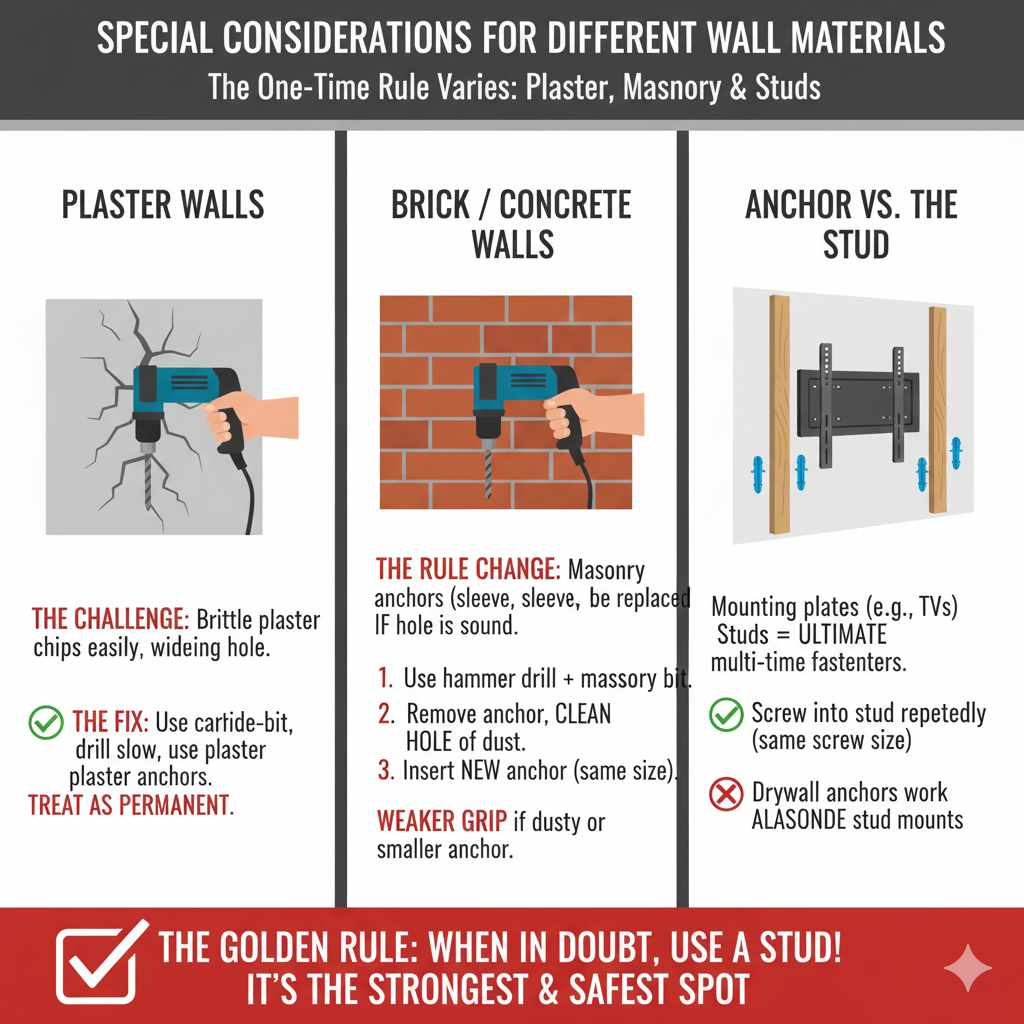
Special Considerations for Different Wall Materials
While most DIYers deal with drywall, some homes have older plaster, brick, or concrete walls. These materials change how the “one-time” rule applies.
When Dealing with Plaster Walls
Older homes often have plaster over lath (thin wooden strips). Plaster is brittle, making it even less forgiving than drywall.
The Challenge: When you drill, the brittle outer layer of plaster can easily chip away, widening the hole instantly.
The Fix: Use a carbide-tipped masonry bit, drill slowly, and use anchors specifically designed for plaster/masonry. Because plaster crumbles easily, treat these installations as absolutely permanent.
Mounting into Brick or Concrete
If you are mounting something near a fireplace or on an exterior basement wall, you might be hitting solid masonry.
The Rule Change: Masonry anchors (like drive pins or sleeve anchors) can sometimes be removed and replaced, but only if the hole is sound.
The Process: You must use a hammer drill and a masonry bit. If you remove the anchor, you must thoroughly clean the hole of all concrete dust before inserting a new, similar-sized anchor. If the hole dust is compacted or you use a significantly smaller anchor, the grip will be much weaker than the original installation.
The Anchor vs The Stud: A Final Word on Prefabrication
If you are using a specialized mounting plate (like for a flat-screen TV) that spans multiple wall studs, you may only need the center holes to hit studs—the outer holes might need anchors. This is where precise measurement is vital, ensuring the anchor holes are not an afterthought but perfectly spaced to work alongside the stud mounts. Studs are the ultimate multi-time fasteners—you can screw into a stud, remove the screw, and re-screw into the same spot repeatedly, provided you use the same size hole.
Frequently Asked Questions (FAQ) About Wall Anchors
Here are some common questions beginner DIYers have when learning that a wall anchor is a one-time fastener.
Q1: Can I just leave the anchor in the wall if I remove the screw?
A: Yes, you can, but it’s often better to push it in slightly if you plan to patch the area. If it’s a plastic expansion anchor, leaving it in the wall means you have a small debris piece there, but it won’t interfere with regular patching spackle over the area. For toggle bolts, you must push the wings into the wall cavity.
Q2: What size screw should I use if I lost the screws that came with my anchor kit?
A: Always try to find the original screws first! If you can’t, the replacement screw must match the diameter specified on the anchor packaging exactly. If the new screw is too thick, it will strip the anchor threads or crack the wall instead of expanding the anchor properly. If you are using a self-drilling screw, the thread pitch must also match.
Q3: How can I tell if an anchor I installed last year is still good?
A: Gently push on the item it is holding. If there is any wobble, clicking sound, or movement, the anchor is failing. If it feels rock solid and doesn’t move at all when you apply firm pressure, it is likely still holding its original tension. Never assume an old anchor is safe for a heavier load!
Q4: If I drill a new hole right next to the old anchor hole, will it work?
A: It might work for very light objects, but it is highly risky for anything moderately heavy. The repeated drilling and expansion activity weakens the gypsum between the two holes, creating a soft spot. It’s safer to cut out the damaged area and patch it first, or move your mounting point significantly farther away.
Q5: Are there any anchors that are truly reusable?
A: Most hardware stores do not stock “reusable” drywall anchors for load-bearing uses because reliability drops too much. The closest you get are heavy-duty threaded anchors designed to screw deeply and securely into wood studs (which are reusable) or specific, high-tolerance masonry anchors designed for repeated adjustment in hard materials like poured concrete.
Conclusion: Install Wall Anchors Right the First Time
Understanding that a wall anchor is a one-time fastener can save you a lot of frustration and prevent unsafe installations. These anchors are designed to expand, grip, or lock behind the wall material during their first installation, which gives them their holding strength. Once removed, the anchor and the surrounding drywall usually lose that precise fit, making reinstallation unreliable and potentially dangerous for anything holding weight.
The key to success is careful planning before drilling. Always measure accurately, check for wall studs, choose the correct anchor type, and follow the recommended installation steps. Using the right tools and anchor size ensures that shelves, mirrors, and other mounted items stay secure without damaging your wall.
If you ever need to remove an anchor, treat the hole as a repair project rather than trying to reuse the same fastener. Proper patching and installing a new anchor in a fresh location will give you much better long-term results. By approaching the job with the right knowledge and preparation, you can hang items safely, protect your walls, and complete your DIY projects with confidence every time.