Why Is My Enchantment Table Not Working? Easy Fixes
You might be wondering what went wrong. Did you miss a step? Is there a secret rule you didn’t know?
For another table or room-layout decision, How to Make a Craft Table: Minecraft gives readers a useful follow-up.
For another table or room-layout decision, How To Craft An Enchantment Table In Minecraft Fast gives readers a useful follow-up.
Don’t worry, you’re not alone. Many players run into this. We’ll break down why your enchantment table might not be working.
We’ll cover the most common reasons and give you clear, easy steps to fix them.
Your enchantment table isn’t working because of missing bookshelves, incorrect placement, insufficient experience levels, or an unsupported enchant combination. Ensuring you have 15 bookshelves correctly placed, that you have enough experience, and that you aren’t trying to enchant an already enchanted item are key to successful enchanting.
Understanding How Enchantment Tables Work
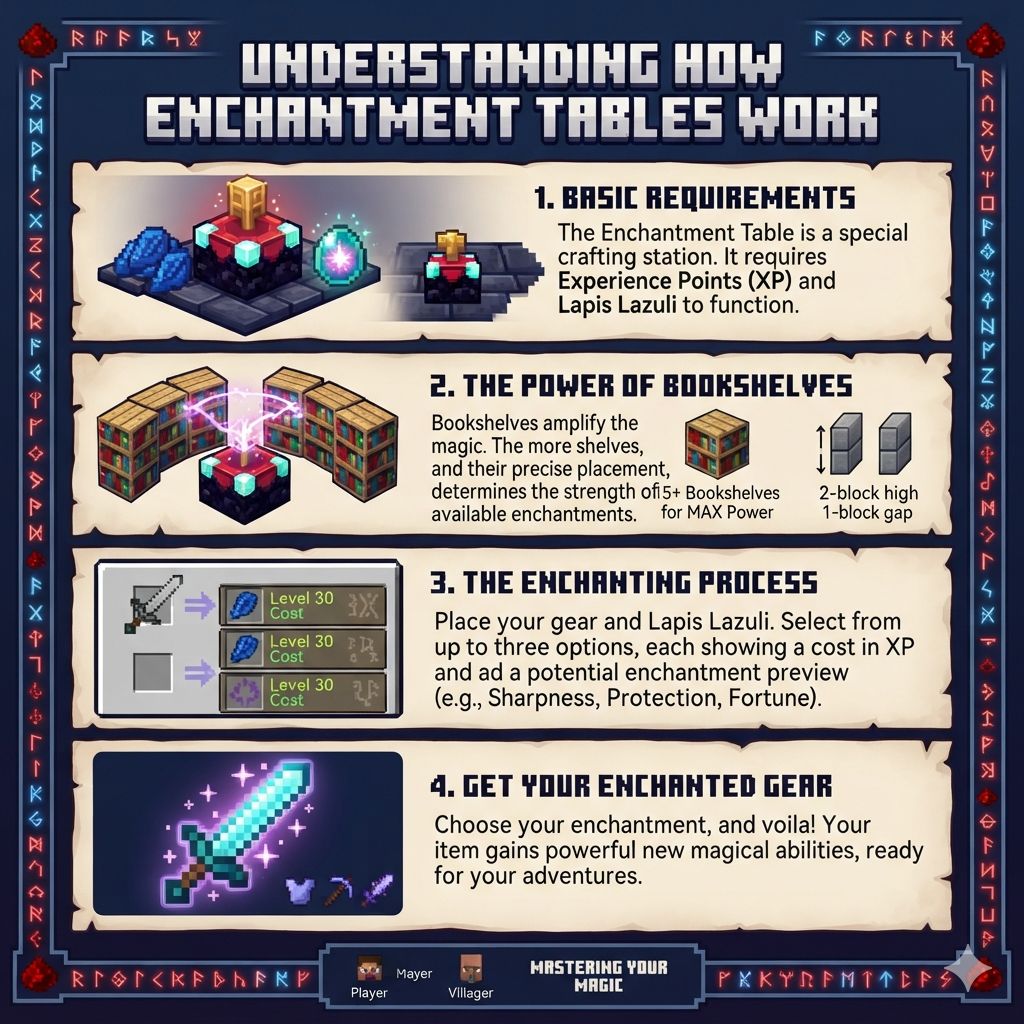
First, let’s talk about how your enchantment table is supposed to work. Think of it like a special crafting station. It uses experience points (XP) and lapis lazuli.
These items let you add magical abilities to your gear. The goal is to get powerful enchantments like Sharpness, Protection, or Fortune.
The table itself needs certain things around it. The most important are bookshelves. These shelves hold the magic.
The more shelves you have, and the better they are placed, the stronger the enchantments can be. It’s not just about having shelves, though. How you place them matters a lot.
When you use the table, you’ll see a few options. Each option shows a number. This number is the cost in XP.
It also shows how powerful the potential enchantment is. You pick an option, use the lapis, and boom! You get your enchanted item.
My Personal Enchantment Table Story
I remember the first time I tried to build a proper enchantment setup. I was playing on a new survival world. I’d found diamonds for the first time.
I crafted a diamond sword. I was so excited to get Sharpness V on it. I dug out a nice room underground.
I placed my enchantment table.
Then, I started placing bookshelves. I put them all around the walls. I figured more was better.
I filled every single spot. I stood back, feeling proud. I opened the table.
I put in my sword and some lapis. I looked at the available enchantments. They were all low numbers.
Like, level 1 or 2. I was so confused. My sword was still just a normal sword.
I spent what felt like hours trying different things. I moved the bookshelves. I added more.
I even tried placing them on the ceiling! Nothing worked right. I started to feel that familiar sinking feeling.
That “what am I doing wrong?” panic. I almost gave up and just kept playing with my basic sword. It was a moment of pure Minecraft frustration.
Enchantment Table Essentials Checklist
Item: Enchantment Table
Required: Yes, obviously!
Item: Lapis Lazuli
Required: Yes, for each enchantment.
Item: Experience Levels
Required: Yes, you need enough levels to pay for the enchant.
Item: Bookshelves
Required: Yes, at least 15 are needed for the best enchants.
Common Problems and Simple Fixes
Let’s get to the heart of it. Why isn’t your table working like it should? There are a few main culprits.
We’ll go through them one by one. This will help you pinpoint the issue in your game.
The Missing Bookshelf Mystery
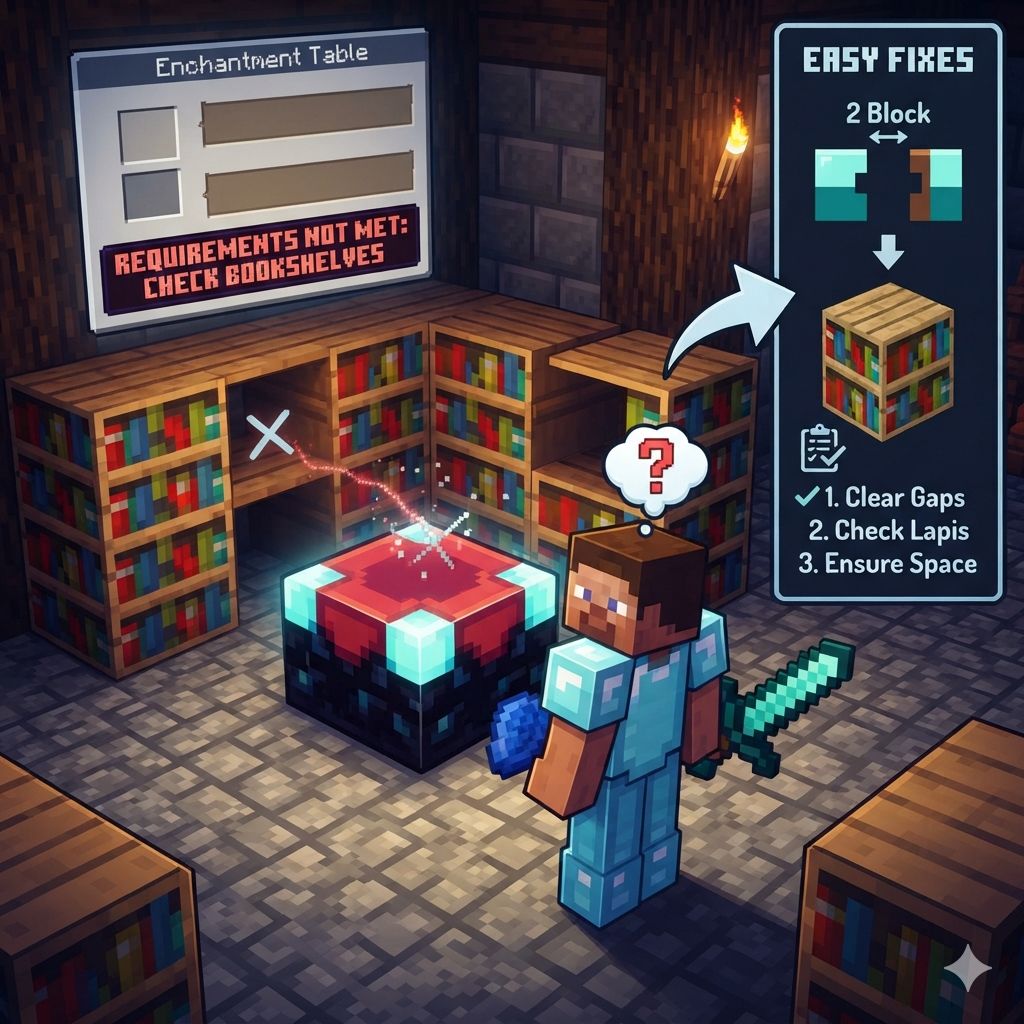
This is the biggest one. Your enchantment table needs bookshelves to work well. Specifically, it needs a good number of them.
You need at least 15 bookshelves. These need to be placed correctly around the table.
What does “correctly” mean? Well, each bookshelf should be one block away from the table. You also need to leave a one-block air gap between the table and the shelves.
So, you can’t just stack them right next to the table. They need a little breathing room.
If you don’t have 15 bookshelves, you won’t see the highest-level enchantments. You might only see very basic ones. Or, you might get a message that says you need more bookshelves.
Bookshelf Placement Guide
Goal: 15 Bookshelves for maximum power.
Spacing: One block away from the enchantment table.
Air Gap: Always leave one block of air between the table and the shelves.
Layout: Two rows of bookshelves on three sides of the table works well.
Example: 3 blocks on the left, 3 on the right, 5 behind, and 4 above (if possible).
To get the best enchantments, you need 15 bookshelves. You can arrange them in a few ways. A common setup is a 5×5 square with the table in the middle.
But you can’t place shelves directly on the corners. You need that one block of air. Think of it like the shelves “feeding” the table magic from a short distance.
If you only have, say, 5 bookshelves, you’ll only see enchantments up to level 5. If you have 10, you’ll see up to level 10. The full 15 allow for enchantments up to level 30.
This is a huge difference in power!
Are You Leveling Up Enough?
Experience points are your currency for enchantments. When you use the enchantment table, you’ll see a cost in levels. This is the number of XP levels you need to spend.
If you don’t have enough XP, you simply can’t perform the enchantment.
Many players make the mistake of only collecting a few XP levels. Then they try to enchant. The table might show options, but when they click, nothing happens.
The game tells them they don’t have enough levels. Make sure you have at least the number of XP levels shown next to the enchantment option.
For example, if an enchantment costs 10 XP levels, you need to be at least level 10. It’s often good to have a few extra levels. This is just in case you want to enchant another item or try a different option.
Quick XP Check
Look at the number next to the enchantment. This is your XP cost.
Check your XP bar. It’s the green bar at the bottom of your screen.
Do you have enough XP levels? If not, you need to find more.
Farming XP: Mine ores, kill mobs, use furnaces, or fish.
Farming XP can be a game in itself. Killing hostile mobs like zombies or skeletons is a good start. Smelting ores in a furnace also gives a little XP.
Even mining stone provides a tiny bit. Once you have enough, head back to your table and try again. It’s a simple but crucial step.
The Wrong Item Problem
Not all items can be enchanted. You can enchant tools (pickaxes, axes, shovels, hoes), weapons (swords, bows, crossbows), armor (helmets, chestplates, leggings, boots), and some other specific items like fishing rods or shields. You cannot, for instance, enchant a dirt block or a crafting table.
Also, you can only enchant items that are not already enchanted. If you try to put a new enchantment on an item that already has one, it won’t work. You’ll need to use an anvil to combine enchantments or remove them.
Sometimes, players try to enchant items that are made of materials that can’t be enchanted. For example, you can’t enchant leather armor directly. You’d need to use diamond or iron armor to get the best enchantments.
Enchantment Combinations and Conflicts
This is a bit more advanced. Some enchantments just don’t play well together. For example, you can’t have both Silk Touch and Fortune on the same pickaxe.
They are conflicting enchantments. The game knows this.
When you use the enchantment table, it shows you the enchantments it can apply. If you’re seeing weird or very low-level enchantments, it might be that your available books are offering incompatible enchants. The table tries to offer what it can based on what it “sees” in the nearby books.
You can’t force two conflicting enchantments onto an item using the table alone. You would need to use an anvil with enchanted books. But for the table itself, it’s about the base enchantments.
The table’s selection is already limited by what’s available in the game’s enchantment pool and your XP level.
Item Compatibility Quick Facts
Can be Enchanted: Tools, Weapons, Armor, Fishing Rods, Shields, Books.
Cannot be Enchanted: Blocks, Food, Raw Materials, etc.
Conflict Example: Silk Touch and Fortune on pickaxes.
Combining: Use an anvil with enchanted books to add or combine enchants.
It’s important to remember that the enchantment table offers random enchantments. You don’t get to pick the exact enchantment you want every time. You pick a level, and the game gives you a selection of what’s possible at that level.
This randomness is part of the fun for many players.
Real-World Enchantment Setup Scenarios
Let’s look at how players actually set up their enchantment areas. It’s not always a fancy room. Sometimes it’s a simple corner.
Other times, it’s a dedicated building.
The “Just the Basics” Setup
Some players just need the bare minimum. They might put the enchantment table in their starter base. They’ll place bookshelves along the walls.
They might only get about 5 or 6 shelves. This is enough to get some basic enchantments. Things like Protection I or Efficiency I.
This is perfectly fine for early game. You don’t always need Sharpness V on day one. This kind of setup often happens when players are still exploring.
They haven’t settled on a permanent base yet. It’s quick to build and doesn’t require a lot of resources.
The Dedicated Enchanting Room
As players progress, they often build a dedicated room. This room is specifically for enchanting. It’s usually in their main base.
They’ll make sure to have 15 bookshelves. Sometimes they’ll even go for more, just to be safe. They might use different block types for decoration.
These rooms often have good lighting. They might have chests nearby for storing enchanted items and books. Some players even make them look really cool.
Think themed rooms or areas with special lighting effects. The goal here is efficiency and power.
Enchanting Room Styles
Minimalist: Table + 15 shelves, no extra decoration. Quick and functional.
Functional: Table + 15+ shelves, storage chests, lighting. Practical for regular use.
Aesthetic: Elaborate designs, themed builds, special lighting. Looks great, still functional.
Underground Bunker: Secure, out of the way, often well-lit. Safe from mobs.
The environment matters too. Mobs can sometimes wander into your base. Having a secure room helps.
You don’t want a creeper blowing up your hard-earned enchanted gear. That would be a disaster!
Using Enchanted Books
Players who are more experienced often use enchanted books. They get these from fishing, trading with librarians, or finding them in generated structures. They then use an anvil to combine these books with their items.
This method gives you more control. You can choose the exact enchantment you want. You can even combine books to get multiple enchantments on one item.
This bypasses the randomness of the enchantment table for specific goals.
However, the table is still essential. It’s how you get the initial enchanted books. It’s also how you get enchantments that you can’t find in book form easily.
Think of them as two different but related ways to power up your gear.
What This Means For Your Enchanting Success
So, what’s the takeaway? If your enchantment table isn’t working, it’s usually one of a few simple things. Don’t panic.
Most of the time, the fix is straightforward.
When Is It Normal?
It’s normal for your enchantment table to offer only basic enchantments if you don’t have enough bookshelves. It’s also normal for it to show high-level options that you can’t afford yet if you’re low on XP.
It’s normal to see different sets of enchantments each time you open the table. The game chooses them randomly from the available pool based on your setup. You won’t always get the perfect enchantment right away.
That’s part of the challenge and fun.
When Should You Worry?
You should worry if you have 15 perfectly placed bookshelves, plenty of XP, and you’re still only seeing enchantments like “Aqua Affinity” or “Feather Falling I” on a diamond sword. This might indicate a bug or a misunderstanding of how certain items work.
If you’re trying to enchant an item that simply cannot be enchanted, like a stone pickaxe when you only have basic options available, that’s also something to note. Make sure you’re trying to enchant the right kind of item.
Common Issues vs. Game Mechanics
Issue: Low-level enchants available.
Reason: Usually not enough bookshelves or low XP.
Issue: Can’t afford enchants.
Reason: Need more XP levels.
Issue: Enchantment doesn’t appear when clicking.
Reason: Insufficient XP levels.
Issue: Specific enchantments are missing.
Reason: Random selection or conflicting enchantments.
Another thing to check is the version of Minecraft you are playing. Older versions might have slightly different mechanics or bugs. However, the core principles of bookshelves and XP remain the same across most modern versions.
Simple Checks You Can Do
1. Count your bookshelves. Make sure you have exactly 15. More is okay, but 15 is the magic number for the best possible enchants.
2. Check the spacing. Each shelf must be one block away from the table. There must be one block of air between them.
3. Verify your XP level. Ensure you have enough levels to pay for the enchantment you want.
4. Confirm the item. Make sure you are trying to enchant a valid item.
5. Check for conflicts. Are you trying to put an incompatible enchantment on an item that already has one?
These simple checks cover about 95% of all enchantment table problems. It’s easy to overlook one little detail. Especially when you’re excited about getting that perfect enchantment.
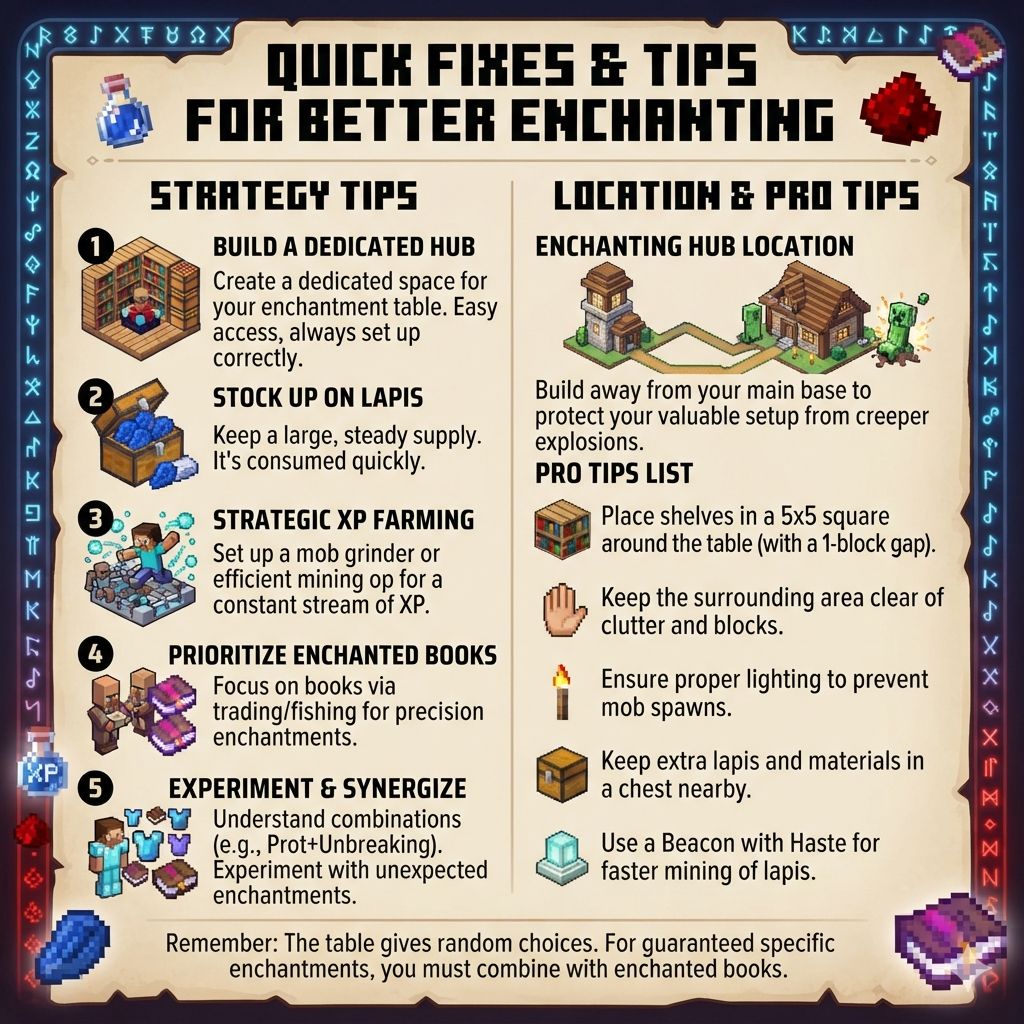
Quick Fixes and Tips for Better Enchanting
Here are some tips to make your enchanting process smoother and more successful. These are things I’ve learned over years of playing.
- Build an Enchanting Hub: Create a dedicated space for your enchantment table. This makes it easy to access and ensure your setup is always correct.
- Always Stock Up on Lapis: Lapis is easy to find in caves, but it’s also consumed quickly. Keep a good supply.
- Farm XP Strategically: Set up a mob grinder or a good mining operation. Having a steady stream of XP makes enchanting much less of a chore.
- Use Enchanted Books for Precision: Once you have your basic setup, focus on getting enchanted books via trading or fishing. They offer more control over your enchantments.
- Understand Enchantment Synergy: Learn which enchantments work well together. For example, Protection IV and Unbreaking III make for amazing armor.
- Don’t Be Afraid to Experiment: Sometimes, you’ll get an unexpected but useful enchantment. Try to make the best of it.
One of my favorite tips is to build your enchanting area slightly away from your main house. This way, any accidental explosions from creepers are less likely to destroy your valuable setup. It also helps keep your base tidy!
Pro Enchanting Tips
Tip: Place shelves in a square or rectangle around the table.
Tip: Leave the area around the table clear for easy access.
Tip: Consider lighting to prevent mob spawns near your table.
Tip: Keep extra lapis and materials handy.
Tip: Use a beacon with Haste for faster mining of lapis.
Remember, the goal of the enchantment table is to offer a random selection. If you want guaranteed specific enchantments, you’ll need to rely on anvils and enchanted books. The table is the first step in that process for many players.
Frequently Asked Questions
Why does my enchantment table only show level 1 enchantments?
This almost always means you don’t have enough bookshelves placed correctly around the table. You need 15 bookshelves. Each should be one block away from the table, with one block of air in between.
If you have fewer, you’ll see lower-level enchantments.
Why does my enchantment table only show level 1 enchantments?
This almost always means you don’t have enough bookshelves placed correctly around the table. You need 15 bookshelves. Each should be one block away from the table, with one block of air in between.
If you have fewer, you’ll see lower-level enchantments.
Can I enchant anything with an enchantment table?
No, you can only enchant specific items like tools, weapons, armor, fishing rods, and books. Blocks, food, and raw materials cannot be enchanted directly through the table.
Can I enchant anything with an enchantment table?
No, you can only enchant specific items like tools, weapons, armor, fishing rods, and books. Blocks, food, and raw materials cannot be enchanted directly through the table.
I have 15 bookshelves, but I still don’t see good enchantments. What else could it be?
Make sure there’s a one-block air gap between the enchantment table and the bookshelves. Also, ensure you have enough experience levels to afford the higher-level enchantments shown. The game randomly selects available enchantments, so sometimes it takes a few tries.
I have 15 bookshelves, but I still don’t see good enchantments. What else could it be?
Make sure there’s a one-block air gap between the enchantment table and the bookshelves. Also, ensure you have enough experience levels to afford the higher-level enchantments shown. The game randomly selects available enchantments, so sometimes it takes a few tries.
What is the best way to get experience points for enchanting?
The most common ways are killing hostile mobs (like zombies and skeletons), mining ores, smelting items in a furnace, and fishing. Setting up a mob grinder is a very effective method for a constant supply of XP.
What is the best way to get experience points for enchanting?
The most common ways are killing hostile mobs (like zombies and skeletons), mining ores, smelting items in a furnace, and fishing. Setting up a mob grinder is a very effective method for a constant supply of XP.
Can I enchant an item that is already enchanted?
No, you cannot use the enchantment table to add a new enchantment to an item that already has one. You would need to use an anvil to combine enchanted books or repair the item.
Can I enchant an item that is already enchanted?
No, you cannot use the enchantment table to add a new enchantment to an item that already has one. You would need to use an anvil to combine enchanted books or repair the item.
How do I get the best enchantments like Sharpness V or Protection IV?
To get the highest level enchantments from the table, you need 15 perfectly placed bookshelves and sufficient experience levels. However, the table offers a random selection. For guaranteed top-tier enchantments, it’s often best to find enchanted books from trading or fishing, and then combine them using an anvil.
How do I get the best enchantments like Sharpness V or Protection IV?
To get the highest level enchantments from the table, you need 15 perfectly placed bookshelves and sufficient experience levels. However, the table offers a random selection. For guaranteed top-tier enchantments, it’s often best to find enchanted books from trading or fishing, and then combine them using an anvil.
What if I want to remove an enchantment?
You can remove enchantments by using a grindstone. This will remove all enchantments from an item and give you some experience back, but it will also remove any durability. An anvil can be used to repair items and combine enchantments.
What if I want to remove an enchantment?
You can remove enchantments by using a grindstone. This will remove all enchantments from an item and give you some experience back, but it will also remove any durability. An anvil can be used to repair items and combine enchantments.
Conclusion
Getting your enchantment table working is a key part of advancing in Minecraft. It can feel confusing at first. But once you understand the role of bookshelves, XP, and item types, it becomes much simpler.
Don’t get discouraged if your first few attempts don’t yield the perfect enchantments.
Keep experimenting with your setup. Always check your XP levels and bookshelf placement. Soon, you’ll be equipping your gear with the most powerful magic the game has to offer.
Happy enchanting!
Products related to this article
Sponsored / affiliate links. As an Amazon Associate I earn from qualifying purchases. I may earn additional commission from eligible campaigns.