Pouf vs Cube Ottoman: Which One Fits Your Space?
By the DecorGuider editorial team
How we compared them: This guide compares poufs and cube ottomans using manufacturer-reported size ranges, upholstery and furniture-care guidance, basic seating ergonomics, and common real-room use cases. The score matrix favors everyday function: a higher score means a better fit for that specific task, not a more expensive or more decorative piece.
Choose a pouf if you want a softer, lighter seat that moves with little effort; choose a cube ottoman if you need a flatter, steadier surface for trays, books, or extra seating. Pick the wrong one and you waste floor space on furniture that wobbles, slumps, or cannot do the job you need. This guide compares shape, firmness, height, storage, and room fit so you can choose the right fit for your space.
Quick selector: If your room is under about 120 square feet, has narrow walkways, or needs furniture that can shift between footrest and seat, start with a pouf. If you need a steadier landing spot for a tray, a more formal look, or storage built into the body, start with a cube ottoman. In higher-traffic family rooms, the firmer cube shape usually wins; in casual bedrooms, reading corners, and low-traffic lounge areas, the pouf usually feels easier to live with.
| Decision factor | Pouf | Cube Ottoman | Winner |
|---|---|---|---|
| Footprint | Usually smaller-looking and easier to tuck into a gap; common pouf sizes include 18 by 18 by 14 inches and a 60CM by 33CM round pouf. | Often closer to an 18-inch cube, so it reads as a fuller block of furniture. | Pouf |
| Stability | Softer top; more likely to sink or shift under a tray or uneven load. | Flatter, firmer top; holds shape better under daily use. | Cube Ottoman |
| Tray-friendliness | Works only with a rigid tray and careful use. | More reliable for books, mugs, and snacks. | Cube Ottoman |
| Comfort | Plusher under bare feet and softer as a casual seat. | Firmer feel, less sink, more support. | Pouf |
| Portability | Usually lighter and easier to move around the room. | Still movable, but often feels more furniture-like and less easy to shift often. | Pouf |
| Kid and pet safety | Soft edges help in tight family rooms, but sagging tops can tip or slip when used hard. | More stable for climbing, perching, or quick landings; harder corners can still matter in tight rooms. | Cube Ottoman |
| Storage potential | Available with or without storage, but many models are non-storage pieces. | Also available with or without storage, and the boxy shape often suits hidden compartments well. | Cube Ottoman |
| Style formality | Reads softer and more casual. | Reads more structured and polished. | Cube Ottoman |
Pouf vs cube ottoman: the core trade-off
What makes a pouf feel softer
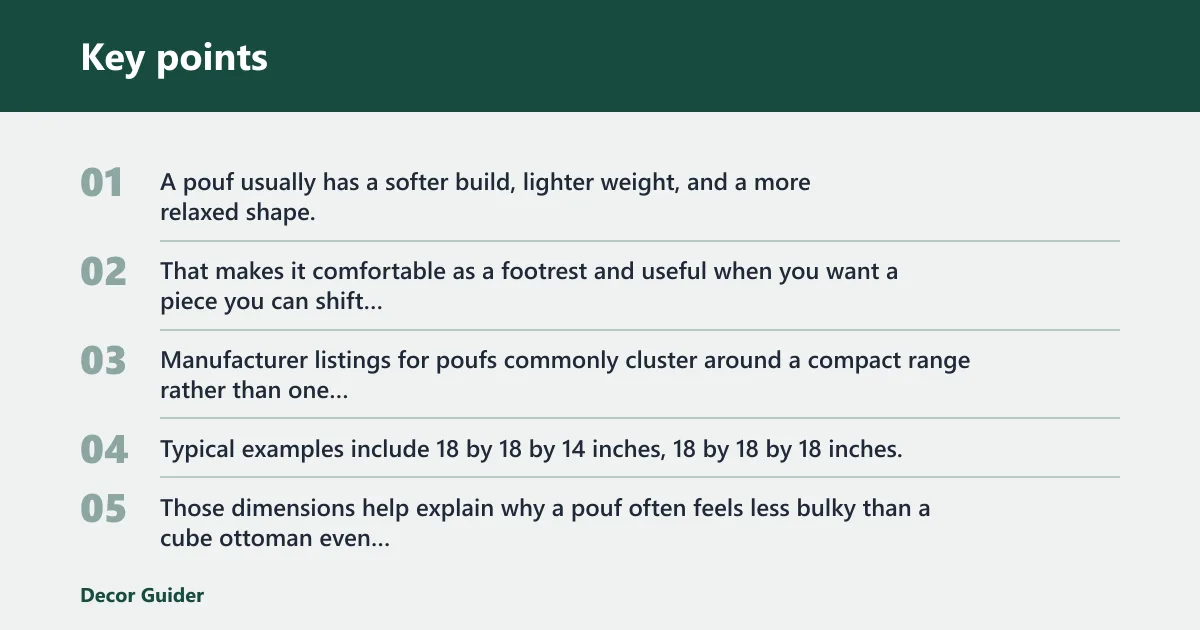
A pouf usually has a softer build, lighter weight, and a more relaxed shape. That makes it comfortable as a footrest and useful when you want a piece you can shift across the room without much effort.
Manufacturer listings for poufs commonly cluster around a compact range rather than one standard size. Typical examples include 18 by 18 by 14 inches, 18 by 18 by 18 inches, and round silhouettes around 60CM by 33CM. Those dimensions help explain why a pouf often feels less bulky than a cube ottoman even when the overall footprint is similar.
What makes a cube ottoman feel steadier
A cube ottoman is more structured. The top is flatter, the sides hold shape better, and the piece behaves more like a small upholstered furniture block than a soft seat cushion.
That difference matters when you want a surface that can take a tray, support a firmer footrest position, or act as a steadier extra seat. In manufacturer descriptions, cube ottomans are often positioned as seating, footrests, or decor, which matches the role most buyers want from a cube-shaped ottoman.
Real-world room examples
Example 1: In a 10-foot by 12-foot living room, an 18-inch cube ottoman placed 14 to 18 inches in front of a sofa gives a more reliable snack-and-book surface than a soft pouf, especially if the room has a narrow pass-through along one side.
Example 2: In a bedroom reading corner, an 18-by-18-by-14-inch pouf with a woven cover works well beside a lounge chair because it can be pulled out for foot support and pushed back under a console when the room needs to feel open.
Example 3: In a family room with low pile rug, a storage cube ottoman can keep toys or throws hidden, but the lid and internal frame add bulk; a non-storage pouf feels lighter if the room already has enough storage elsewhere.
Example 4: In a studio apartment living area, a firmer cube ottoman is the safer pick if it must serve as both guest seat and coffee-table substitute. A rigid tray is still recommended, and the top should remain level when someone leans to one side.
Example 5: In a nursery or playroom, a soft pouf with rounded edges can be easier to live with than a hard-edged block, but only if the fill is dense enough to resist tipping during quick climbs or rough play.
Pouf ottoman matrix
| Criterion | Pouf | Cube Ottoman | Pick |
|---|---|---|---|
| Footprint | 4/5 | 3/5 | Pouf |
| Stability | 2/5 | 5/5 | Cube Ottoman |
| Tray-friendliness | 2/5 | 5/5 | Cube Ottoman |
| Comfort | 5/5 | 3/5 | Pouf |
| Portability | 5/5 | 3/5 | Pouf |
| Kid and pet safety | 3/5 | 4/5 | Cube Ottoman |
| Storage potential | 3/5 | 4/5 | Cube Ottoman |
| Style formality | 2/5 | 4/5 | Cube Ottoman |
How the scores were assigned
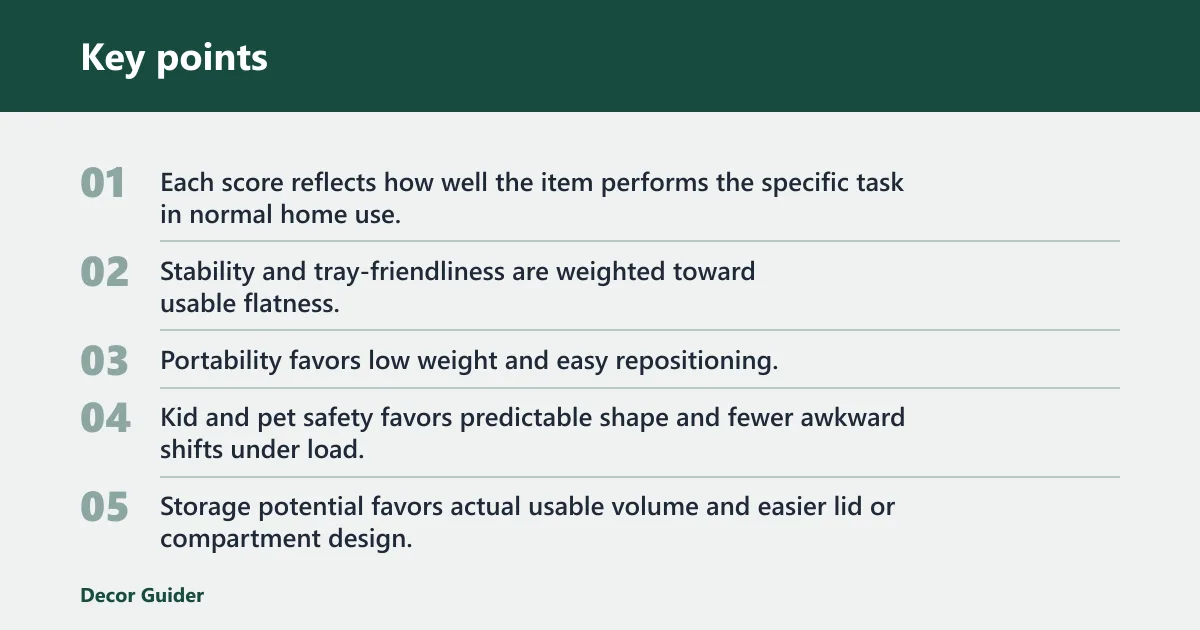
Each score reflects how well the item performs the specific task in normal home use. Stability and tray-friendliness are weighted toward usable flatness, not just surface area. Comfort favors soft contact and leg rest. Portability favors low weight and easy repositioning. Kid and pet safety favors predictable shape and fewer awkward shifts under load. Storage potential favors actual usable volume and easier lid or compartment design. Style formality favors cleaner lines and a more furniture-like profile.
Footprint
A pouf often wins on visual footprint because it can feel softer and less blocky, even when its actual size is similar to a cube ottoman. Common forms include round and square, which means you can choose a shape that fits a tighter gap beside a sofa or chair.
The key detail is clearance. An 18-inch-wide pouf can still need walking room around it, but a rounded profile may feel less obtrusive than a boxy one in a narrow layout.
Stability
Cube ottomans win here because the top is more likely to stay level under pressure. That matters if you place your feet, a serving tray, or a stack of books on it.
A pouf can compress or tilt when weight lands off-center. That is fine for light use, but it is a real drawback when the surface needs to behave like furniture, not a cushion.
Tray-friendliness
If you want a coffee table alternative, the cube ottoman is the safer pick. A flatter top gives a tray a better chance of staying level, which lowers the chance of cups sliding or tipping.
A pouf can work with a rigid tray, but the tray has to carry the stability that the top does not provide. Without that rigid base, the surface can dip and drinks can feel unstable.
Comfort
Poufs usually feel softer under your legs and feet. That makes them appealing when the main job is a footrest or a casual extra seat for short use.
Cube ottomans are comfortable too, but in a firmer way. If you want a little less sink and a more grounded feel, that structure may be the better match.
Portability
Poufs are usually lightweight and easy to move around, which is exactly why they work well in rooms that change often. That portability helps in small rooms where the same piece may serve different spots during the week.
Cube ottomans can still move, but they usually feel more fixed in place. If you shift furniture often, a pouf is the easier object to lift, slide, or stash.
Kid and pet safety
In homes with kids or pets, the choice comes down to wobble versus structure. A pouf is softer on contact, but it can squish, slip, or tilt when someone climbs on it or lands unevenly.
A cube ottoman is steadier for quick sit-downs and more predictable under load. The tradeoff is that its sharper lines can feel less forgiving in tight circulation paths, so placement still matters.
Say your living room is about 10 feet by 12 feet and you want a seat near the sofa for a toddler to use as a perch. A cube ottoman is the safer pick if the child will sit upright often, because the flatter top gives more predictable support than a soft pouf.
Storage potential
Not every ottoman stores anything. Some products are built with storage and some without, so you need to check the construction rather than assume a hidden compartment is included.
Storage versions are useful when floor space is tight and you want a place to tuck throws, toys, or remotes. The tradeoff is that the inside cavity and lid structure can add bulk, which matters in a very small room.
Storage and price variants to compare
If your main goal is hidden storage, compare the lower-cost, non-storage versions against pricier storage models before you decide. A square pouf around $159 can make sense if it solves both seating and clutter, while a much less expensive filled pouf around $28.70 may be the better value if you only need a movable footrest. The right answer depends on whether storage bulk is helping you or simply taking up room.
Storage pouf cost becomes easier to judge when you think in terms of task and volume: if the compartment replaces a basket or side bin, the larger footprint may be worth it; if not, a slimmer non-storage pouf may keep the room feeling lighter.
Which works better as a footrest?
Height match to a sofa seat
Both can work as footrests, but height match matters more than the name on the tag. Ergonomics guidance generally favors a footrest that lets the hips and knees stay comfortable without forcing the thighs into an awkward angle, so the ottoman should sit close enough to seat height to support relaxed legs.
Pouf dimensions often fall around 18 inches wide and roughly 10 to 18 inches high, while cube ottomans are often closer to roughly 18-inch cube sizing. If your sofa sits higher, the firmer cube shape is often easier to pair with a consistent foot position.
Soft top versus firm top
A pouf feels better if you want the top to mold under your feet. That softness can be more comfortable for long lounging sessions on the sofa.
A cube ottoman feels better if you want less sink and a steadier surface under the heels. The firmer top is not always the softer choice, but it is often the more predictable one.
When cushioning matters most
If the ottoman will mainly support bare feet after long days, choose the softer pouf. If it will also hold a laptop tray, a book, or a mug, the cube ottoman is the more useful hybrid.
Can you use either one as extra seating?
Guest seating limits
Yes, both can serve as extra seating, but only for occasional use. They are not substitutes for a real chair when someone needs to sit for a long time.
Weight and balance matter here. A pouf can work for a light, brief seat, but its softer body may feel unstable if the sitter shifts around. A cube ottoman usually feels more controlled under load.
Why weight and balance matter
The more a piece compresses, the more it changes shape under a person’s weight. That is why a pouf can feel cozy and casual while still being the weaker choice for repeated guest use.
A cube ottoman keeps a flatter profile, so it behaves more like a small bench substitute. That does not make it ideal for long sitting, but it does make it more dependable for quick visits.
Best use cases for occasional seating
Choose a pouf if the seat will mostly be used by children, short visits, or as a flexible spot you can move out of the way fast. Choose a cube ottoman if guests will set down bags, sit to change shoes, or need a firmer perch.
Suppose an apartment living room only has room for one extra seat beside a loveseat. A cube ottoman is usually the better pick if that seat also has to hold a tray between uses, because the surface stays flatter when it is not serving as a chair.
Does a cube ottoman work better as a coffee table alternative?
Tray stability on a flat top
Yes. A cube ottoman is usually the better coffee table alternative because the top is flatter and steadier. That gives you a better platform for trays, books, and a lamp base if the piece is sturdy enough.
The advantage is not just shape. It is the way the piece resists wobble. That matters every time a glass is set down or someone nudges the tray while reaching across the room.
Soft-top spill risk
A pouf can double as a table only if you add a rigid tray or a stiff board. Even then, the soft fill underneath can shift, which increases spill risk compared with a cube ottoman.
That is the failure case many shoppers miss. A soft top can look close enough to a table surface, yet still let a drink lean as soon as someone presses on the edge. In a higher-traffic room, that risk is reason enough to prefer the firmer block.
When a pouf needs a rigid base
If you insist on using a pouf as a table stand-in, use it only for light, low-risk items and keep the tray wide and rigid. That works best in low-traffic rooms where nobody is constantly setting down hot drinks.
For everyday living rooms, the cube ottoman is the cleaner choice. It gives you the same versatility with less dependence on accessories.
How size and shape affect your layout
Round, square, rectangular, and oval forms
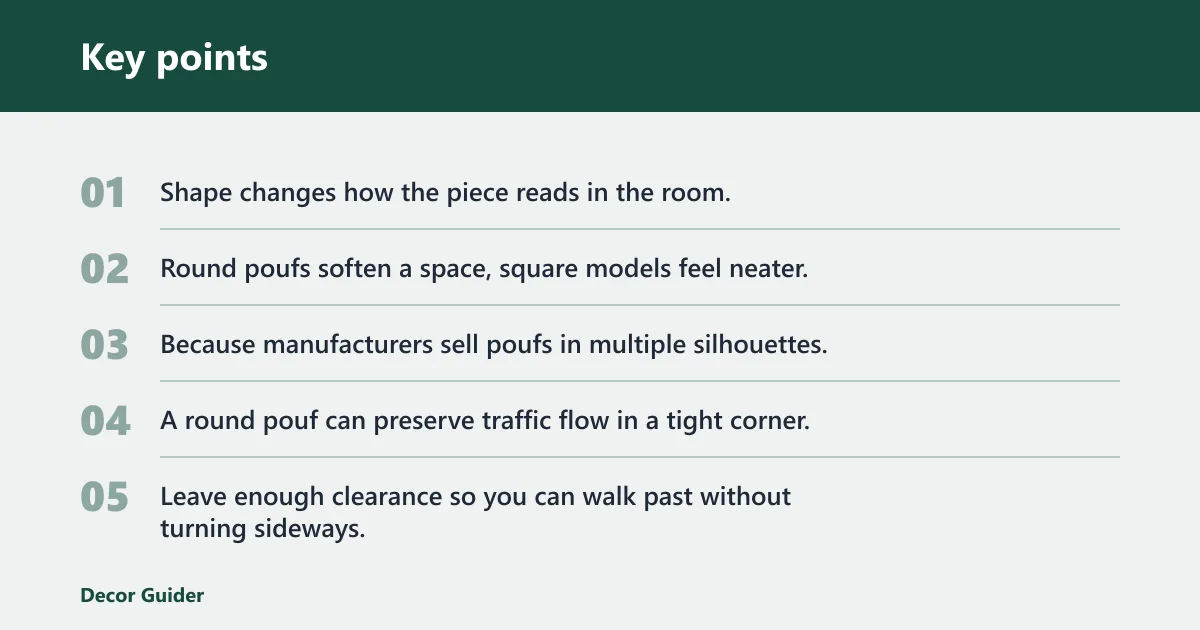
Shape changes how the piece reads in the room. Round poufs soften a space, square models feel neater, and oval or rectangular forms can fit along a sofa edge or at the foot of a bed.
Because manufacturers sell poufs in multiple silhouettes, the shape is often as important as the dimensions. A round pouf can preserve traffic flow in a tight corner, while a square or cube-shaped ottoman can line up more cleanly with a sofa or armchair.
Clearance around chairs and sofas
Leave enough clearance so you can walk past without turning sideways. In a cramped room, even a small ottoman can interrupt traffic if it sits too close to a chair or coffee table.
This is where the shape matters as much as the width. A round pouf may feel less visually heavy in a narrow path, while a cube ottoman can look more fixed and deliberate.
Why 18-inch sizing shows up often
Many examples sit near 18 inches because that size often works as a middle ground between footrest and seat. It is large enough to be useful, but not so large that it overwhelms a small room.
Common pouf dimensions around 18 inches wide and 10-18 inches high fit many small spaces without reading as bulky. For price comparison, a square pouf priced at $159.00 sits in a different value band than a filled pouf at $28.70, so it helps to compare dimension, fill, and storage before comparing price alone.
Pouf dimensions matter most when you are trying to decide whether the piece will act like decor, seating, or a table substitute. A compact profile can work in a bedroom or reading nook, while a larger cube may be more appropriate in a family room that needs multiple roles from one item.
Choose Pouf if… / Choose Cube Ottoman if…
Choose Pouf if you want the softest footrest, the easiest piece to move, or a casual seat that can slide around a bedroom or small living room without much effort. It is also the better pick if you care more about a relaxed look than a polished one.
Choose Cube Ottoman if you need a flatter top for trays, a steadier extra seat, or a more structured piece that reads like furniture rather than a cushion. It is the better match for apartment seating, small living rooms that need coffee-table duty, and rooms where storage or visual order matters.
- Small living room: pick a cube ottoman if it must hold drinks or books; pick a pouf only if the main job is soft foot support.
- Bedroom: pick a pouf if you want a lightweight landing spot you can move often; pick a cube ottoman if you want a neater perch at the foot of the bed.
- Apartment seating: pick a cube ottoman if the same piece must also act as a table; pick a pouf if flexibility matters more than surface use.


Frequently asked questions
Which is better for a small living room, a pouf or a cube ottoman?
A small living room usually benefits from the piece that solves the most problems. Choose a pouf if you mainly need softness and easy moving. Choose a cube ottoman if you need one object to act as a footrest, extra seat, and stable tray base.
Is a cube ottoman more comfortable than a pouf?
Not in the soft sense. A cube ottoman is usually more comfortable for support and stability, while a pouf feels more cushioned and relaxed. If comfort means less sink and a firmer perch, the cube ottoman wins. If it means softness under your feet, the pouf does.
Can I use a pouf as a footrest or extra seat?
Yes, and that is one of the main reasons people buy them. A pouf works well as a footrest and can handle occasional extra seating, especially in casual rooms. Just expect more give and less stability than you get from a cube ottoman.
How do size and shape affect how much space each one takes?
Size and shape control both floor use and visual weight. A round pouf can feel lighter in a room, while a cube ottoman looks more solid. Common pouf dimensions around 18 inches wide and 10-18 inches high fit many small spaces without reading as bulky.
Should I choose a pouf or cube ottoman for storage?
Choose the one that actually has storage if hidden space matters. Some models are built with storage and some without, so the feature is optional, not guaranteed. A cube ottoman often suits storage well because the boxy shape supports a compartment more naturally, but that added capacity can make the piece visually and physically bulkier.
What style looks more polished in a living room: pouf or cube ottoman?
A cube ottoman usually looks more polished because it has cleaner lines and a more structured profile. A pouf reads softer and more casual, which can be attractive in relaxed rooms. If you want the space to feel more composed, the cube ottoman is the stronger choice.
Sources
- Manufacturer product specifications for pouf and ottoman dimensions, fill types, and storage/no-storage variants.
- Furniture care guidance from upholstery manufacturers for fabric, woven, and upholstered surfaces.
- Basic seating ergonomics guidance used to compare footrest height, seat support, and comfort for short-duration seating.
- Household safety guidance used to evaluate stability, tipping risk, and circulation clearance in family rooms and small spaces.
Products related to this article
Sponsored / affiliate links. As an Amazon Associate I earn from qualifying purchases. I may earn additional commission from eligible campaigns.