

Adjustable bases are absolutely worth it if you value better relaxation, easier breathing, and relief from aches and pains. They offer customizable support that improves sleep quality, reading comfort, and even circulation immediately.
Are you tired of propping up five pillows just to read a book in bed? Maybe waking up with a stiff back makes you dread getting out of the cozy covers. Sleep shouldn’t be a daily battle against discomfort! Many drivers, just like you, constantly look for ways to improve their rest after a long day on the road. Adjustable bases seem like a big upgrade, but you wonder if they are truly worth the money. Don’t worry! We are going to break down exactly what these bases do, who benefits most, and the secrets to picking the right one so you can make a smart choice with total confidence. Let’s get you sleeping better!
Deciding if an adjustable base is “worth it” depends entirely on what you want from your sleep setup. It’s not just about luxury; for many people, it’s a health and comfort necessity. We’ll cover the real-world perks, the potential downsides, and the hidden features that make one base better than another.
The Top 5 Reasons an Adjustable Base is Worth the Investment
For many, the cost is the main hesitation. But when you look at the long-term benefits for your comfort and potential health, the value becomes clear. Here are the biggest wins owners report:
1. Superior Comfort for Reading, Watching TV, and Working
How often have you struggled to hold a heavy book or crane your neck to see the TV while lying down? An adjustable base lets you find the perfect angle instantly. It moves your spine into a natural, supported position, eliminating pressure points under your shoulders and neck. Think of it as the ideal lounge chair, but for your bed!
- Zero-Gravity Position: Many bases mimic the feeling of floating weightlessly, which relieves pressure on your lower back instantly.
- Easy Adjustments: Switching from fully flat to a sitting position takes seconds, making midnight snacks or early morning coffee in bed much more enjoyable.
2. Relief for Common Aches and Pains
If you often wake up feeling stiff, an adjustable base can be truly transformative. Elevating key areas helps manage pain related to specific conditions.
- Back Pain Relief: Slightly raising the head can take strain off the lower back muscles that tighten up overnight.
- Swelling (Edema): Elevating your feet above your heart helps gravity work with you, encouraging fluid to move back toward the core, reducing swelling in the legs and ankles.
3. Improved Breathing and Reduced Snoring
This is a game-changer for couples! When you sleep completely flat, gravity can pull tissue in your throat backward, causing or worsening snoring and sometimes contributing to issues like sleep apnea. By slightly elevating the head (just 10 to 15 degrees is often enough), you open up your airways. This can lead to quieter nights for your partner and deeper, more restorative sleep for you.
For more information on how sleep position affects breathing, reputable health sources like the National Center for Biotechnology Information (NCBI) have researched the impact of inclining the upper body during sleep.
4. Better Circulation for Long-Term Health
We talk a lot about circulation when driving long distances—and the same principles apply when we’re still for hours in bed. Elevating the legs promotes better blood flow back to the heart, which is not only comfortable but can be helpful for overall vascular health over time.
5. Great for Lifestyle Use (Beyond Just Sleeping)
A quality adjustable base turns your bed into a multi-purpose piece of furniture. It’s perfect for:
- Working from home on your laptop.
- Recovering from minor medical procedures or injuries.
- Easier entry and exit from the bed, especially for those with mobility concerns.

Understanding the Different Types of Adjustable Bases
Not all adjustable bases are created equal. When you start shopping, you’ll quickly notice different levels of features. Think of these like trims on a new vehicle—Basic, Mid-Range, and Fully Loaded.
Basic (Entry-Level) Bases
These offer the core functionality. They usually only allow you to raise the head and feet sections independently. They function well and are a great starting point if your main goal is just to elevate your head for snoring or acid reflux.
Mid-Range Bases (The Sweet Spot)
This is where most people find the best value. These bases add massage features, memory presets (like a saved “Zero Gravity” button), and perhaps USB charging ports for your devices.
Premium (High-End) Bases
These are the fully loaded models. They often include advanced features like underbed lighting, full body massage programming, automatic adjustments based on sleep tracking, and even adjustable leg and lumbar support—offering customized support exactly where you need it, similar to a high-end driver’s seat.
| Feature | Basic Base | Mid-Range Base | Premium Base |
|---|---|---|---|
| Head/Foot Articulation | Yes | Yes | Yes |
| Memory Presets | No | Yes (1-2) | Yes (Multiple/Programmable) |
| Massage Function | No | Often Included | Advanced, Wave/Pulsing |
| USB Charging Ports | Rarely | Usually | Yes (Multiple) |
| Lumbar Support | No | Sometimes | Most Always |
Must-Have Secrets: What to Check Before You Buy
If you’re ready to pull the trigger, don’t just grab the first one you see! Experienced buyers know these crucial details make all the difference in long-term satisfaction.
Secret 1: Check Mattress Compatibility
This is the most common mistake beginners make. Not all mattresses work on an adjustable base! You need a flexible material that can bend without damage. If you have a very old, heavily sprung innerspring mattress or a very firm, non-flexible foam, it might crack or fail prematurely when bent.
Mattresses That Work Best:
- Memory Foam
- Latex
- Hybrid Mattresses (where the coils are pocketed and designed to flex)
Tip: Always check the manufacturer’s warranty. Many warranties are voided if the mattress is used on an adjustable base that isn’t explicitly approved for it.
Secret 2: Understand the “Wall Hugger” Feature
This is essential if you want to keep your bedside table close! When you raise the head of a standard adjustable base, the entire unit slides backward, leaving a gap between your bed and the wall or headboard. A “Wall Hugger” (or “Head-Up Retention”) design keeps the base stationary, sliding only the mattress platform forward slightly as it elevates.
If you plan on using a headboard or keeping nightstands right next to your bed, prioritizing a wall hugger model saves you space and keeps your setup looking neat. This feature is standard on mid-range and premium models.
Secret 3: Focus on Noise Level (The Motor Matters)
If you live with a light sleeper or plan to use the adjustments frequently during the night, the motor noise is a huge factor. Cheaper, entry-level bases might have louder, grinding motors. Higher-quality bases use quieter lifting mechanisms.
Look for terms like “Whisper-Quiet Motor” or “Low-Decibel Operation.” Test it out in the store if possible, or check user reviews specifically mentioning motor sound.
Secret 4: Weight Capacity and Durability
Just like checking the towing and payload capacity on a truck, you must know how much weight your base can safely handle. Weight capacity includes the weight of the mattress plus the weight of the people using it.
Most standard adjustable bases handle 650 to 850 lbs. If you and your partner are heavier, or plan to spend significant time sitting up with kids or pets on the bed, aim for a model rated for 1,000 lbs or more. Higher weight capacity usually means stronger steel framing and more robust motors.
Secret 5: Remote Control Functionality
The remote control dictates your daily experience. Avoid clunky wired remotes if possible. Wireless remotes are the standard now, but look closely at the interface:
- Simplicity: Does it have intuitive up/down buttons, or too many tiny, confusing icons?
- Backlight: Essential for finding the remote in the dark!
- Programmable Buttons: Can you save your perfect reading angle so you only press one button?
Installation: Keeping It Simple (Just Like Changing Your Oil)
Setting up an adjustable base isn’t like rebuilding an engine—it’s usually straightforward, much like installing a new set of tires. Most modern bases are shipped disassembled in a box (often called “Boxed Bases”) and require minimal tools.
Here is the general workflow. Always follow the manual for your specific model, but this gives you a good roadmap:
Tools You Might Need:
- The included Allen wrench (usually provided).
- A Phillips head screwdriver (for attaching legs sometimes).
- A helper (most queen/king bases require two people to lift the mattress platform).
Step-by-Step Assembly Overview:
- Unbox and Inventory: Lay out all the pieces and compare them against the parts list in your manual.
- Assemble the Frame: Connect the main side rails and foot/head sections using the provided bolts. This usually forms a sturdy rectangular frame.
- Attach the Legs: Screw the legs into the designated corner brackets. Make sure they are tight so the base doesn’t wobble.
- Install the Decking: Attach the flat platform (the slats or solid board that the mattress rests on) to the frame mechanism.
- Plug In and Test: Find the control box (usually attached underneath) and plug it into the wall. Connect the remote signal. Move the head and foot sections all the way up and down once to ensure everything is working smoothly before proceeding.
- Place Mattress: Slowly place your compatible mattress on top. There are sometimes retainer bars at the foot of the bed—use these to stop the mattress from sliding off when you elevate the foot section.
Safety First: Never plug in the unit until the entire structure is assembled and stable. Keep fingers clear of the moving joints when testing the remote.
Adjustable Bases vs Traditional Frames: The Weight Difference
One thing to consider, especially if you live upstairs or have an older home, is the weight. A standard metal bed frame is light. An adjustable base, with its motors, steel frame, and heavy-duty electronics, is significantly heavier.
For example, a Queen size standard foundation might weigh 40 lbs. A comparable Queen adjustable base can easily weigh 150 to 200 lbs, even when disassembled into a box. This means delivery and moving it around the house require more planning. Be sure to check the shipping weight if you need to move it up or down stairs later on.
Keeping Your Adjustable Base Reliable: Maintenance Tips
Adjustable bases are surprisingly low-maintenance, much like modern automatic transmissions—they mostly just work! However, simple care ensures they last for years, avoiding costly repairs. Think of this as preventative maintenance for your sleep system.
1. Keep an Eye on the Cords
The power cords and control cables run along the underside of the base. Make sure that when the bed articulates, the cords don’t get pinched between the frame and the floor, or tangled in the moving parts. Most modern bases have built-in cord management, but a visual check every few months is smart.
2. Limit Debris Near the Motors
The motors and moving joints should be kept generally clean. Dust and pet hair attract grime. If you use a vacuum, use the brush attachment to clean around the base frame regularly. You don’t need to lubricate anything; they are designed to run dry.
3. Don’t Exceed Weight Limits
As mentioned above, overloading the base puts extreme strain on the motors and the internal gear mechanisms. Running the base at or under its rated capacity is the single best thing you can do for its longevity. If you notice slow movement or struggling sounds, stop immediately and check the load.
4. Know Your Warranty Details
Most quality brands offer warranties that cover the motors, electronics, and frame separately. Typically, the motors have a shorter warranty (1 to 5 years) than the main frame (10 to 20 years). Keep your user manual and proof of purchase in a safe place. If a part fails within the warranty period, you want to be ready to activate that coverage.
Is Adjustable Base Worth It for Specific Needs?
While everyone benefits from comfort, certain groups see a return on investment much faster than others.
For Acid Reflux (GERD) Sufferers
If your doctor recommends elevating your upper body to prevent stomach acid from creeping up at night, an adjustable base offers far superior, consistent support compared to stacking pillows, which often leads to a bent neck and poor alignment.
For Partners with Different Sleep Preferences
If one person sleeps hot and needs to sit up to read while the other sleeps flat, a split king or queen base is the answer. These models have two independent motors, allowing each side to move separately without disturbing the other sleeper. This feature alone often makes the investment “worth it” for peace in the bedroom!
For Seniors or Those with Limited Mobility
The ability to raise the head to a sitting position aids greatly in getting in and out of bed safely. This reduces the physical strain required to get vertical in the morning. Furthermore, the gentle massage feature can help soothe tired muscles before sleep.
| User Group | Primary Benefit | Why It’s Worth It |
|---|---|---|
| Snoring Partners | Airway Opening | Immediate improvement in sleep quality for both people. |
| Individuals with Sciatica/Back Pain | Spinal Decompression | Reduces pressure on lower back by finding the ideal angle. |
| Remote Workers/Readers | Perfect Viewing Angle | Turns the bed into an ergonomic workstation or lounge area. |
| Leg Swelling Sufferers | Improved Circulation | Natural gravity assistance for fluid return. |
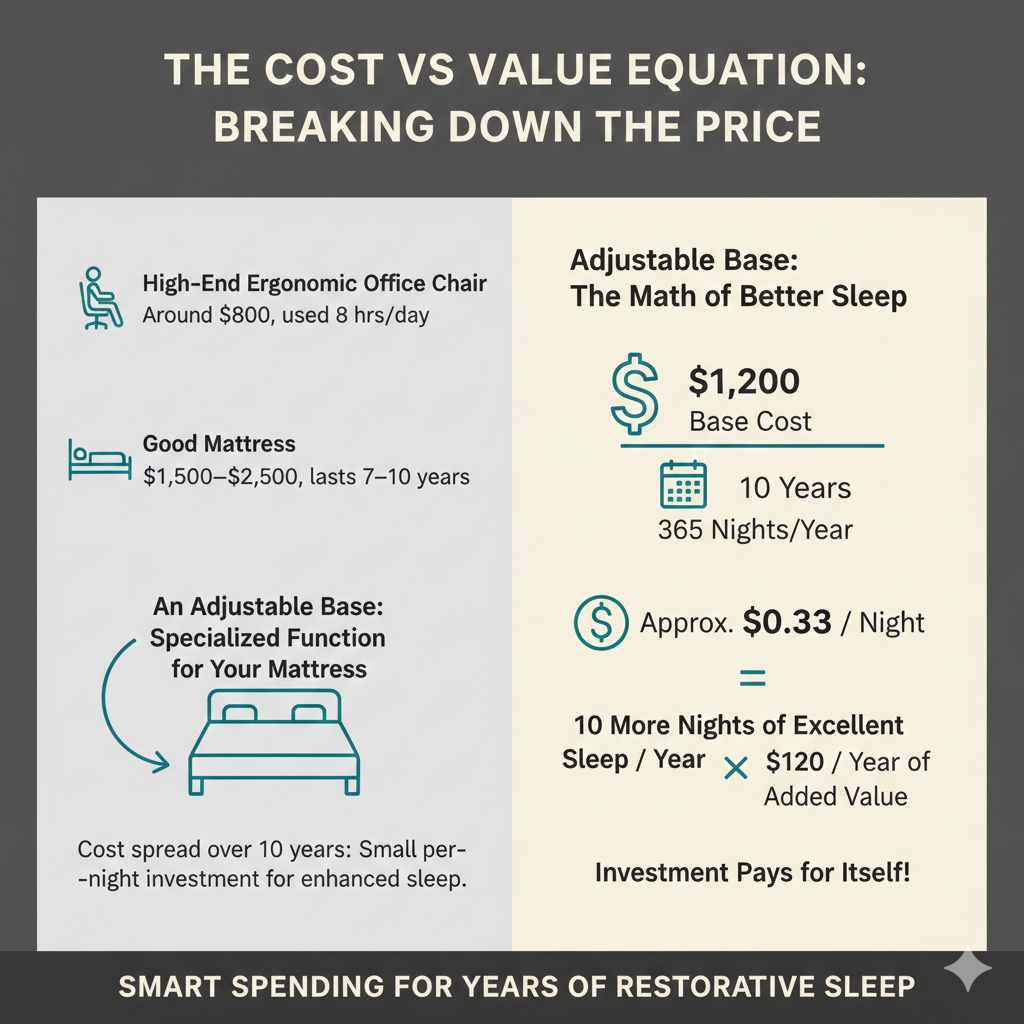
The Cost vs Value Equation: Breaking Down the Price
The price range for adjustable bases is wide, from maybe around $500 for a basic twin model up to $3,000+ for a premium king size with all the extras. How do you decide if the price tag matches the benefit?
Think about what you spend money on for comfort and health:
- A high-end ergonomic office chair might cost $800 and you use it 8 hours a day.
- A good mattress usually costs $1,500–$2,500 and lasts 7–10 years.
An adjustable base adds specialized function to your mattress investment. If you spend 8 hours sleeping in it, and it significantly improves those 8 hours by reducing stiffness or snoring, its cost, spread over a decade, becomes quite small on a per-night basis. If a $1,200 base gives you 10 more nights of excellent sleep per year, it’s paid for itself in comfort alone.
Frequently Asked Questions (FAQ) for Beginners
Q1: Do I need a special mattress for an adjustable base?
A: Not necessarily — but your mattress must be flexible. Memory foam, latex, and most hybrid mattresses (with pocketed coils) work perfectly. Traditional innerspring mattresses with rigid coils may not bend properly and could become damaged. Always check your mattress manufacturer’s warranty to confirm compatibility before using it on an adjustable base.
2. Can an adjustable base really help with snoring?
A: Yes, for many people it can. Slightly elevating the head (around 10–15 degrees) helps keep airways open by reducing gravity’s effect on throat tissues. This often reduces snoring significantly and may also help those with mild sleep apnea symptoms. However, it is not a replacement for medical treatment if you have diagnosed sleep apnea.
3. Are adjustable bases noisy when adjusting positions?
A: Most modern adjustable bases are designed with quiet, low-decibel motors. Entry-level models may produce more noticeable sound, but mid-range and premium bases typically operate very smoothly. When shopping, look for terms like “whisper-quiet motor” and check customer reviews regarding noise levels.
4. How difficult is it to assemble an adjustable base?
A: Assembly is usually straightforward. Most bases come partially assembled and require attaching the legs and securing a few bolts. Basic tools like an Allen wrench (often included) and a screwdriver are typically all you need. However, due to the weight (often 150–200 lbs for queen size), having a second person to help is strongly recommended.
5. Is an adjustable base worth the cost long-term?
If you value improved comfort, pain relief, better breathing, and enhanced circulation, many users find the investment worthwhile. When spread over 7–10 years of nightly use, the cost per night becomes relatively small. For people with back pain, acid reflux, snoring issues, or mobility challenges, the health and lifestyle benefits often outweigh the initial price.
Final Verdict: Is an Adjustable Base Really Worth It?
At the end of the day, an adjustable base isn’t just a luxury upgrade — it’s a comfort and wellness investment. If you’re tired of stacking pillows, waking up stiff, dealing with snoring complaints, or struggling to get comfortable after a long day, an adjustable base can completely transform how you rest.
The real value comes down to this: better support equals better sleep — and better sleep impacts everything. From improved breathing and circulation to reduced back pressure and enhanced relaxation, the benefits go far beyond convenience. It turns your bed into a personalized comfort zone built around your body’s needs.
Of course, it’s not for everyone. If you’re perfectly comfortable sleeping flat and never experience discomfort, a traditional frame may be just fine. But if even one of the benefits we discussed speaks to your daily experience, the upgrade can pay for itself in comfort night after night.
Sleep shouldn’t feel like recovery from discomfort — it should be the solution to it.
Choose wisely, check compatibility, prioritize quality features, and invest in a base that fits your lifestyle. Your back, your breathing, and your future well-rested self will thank you.