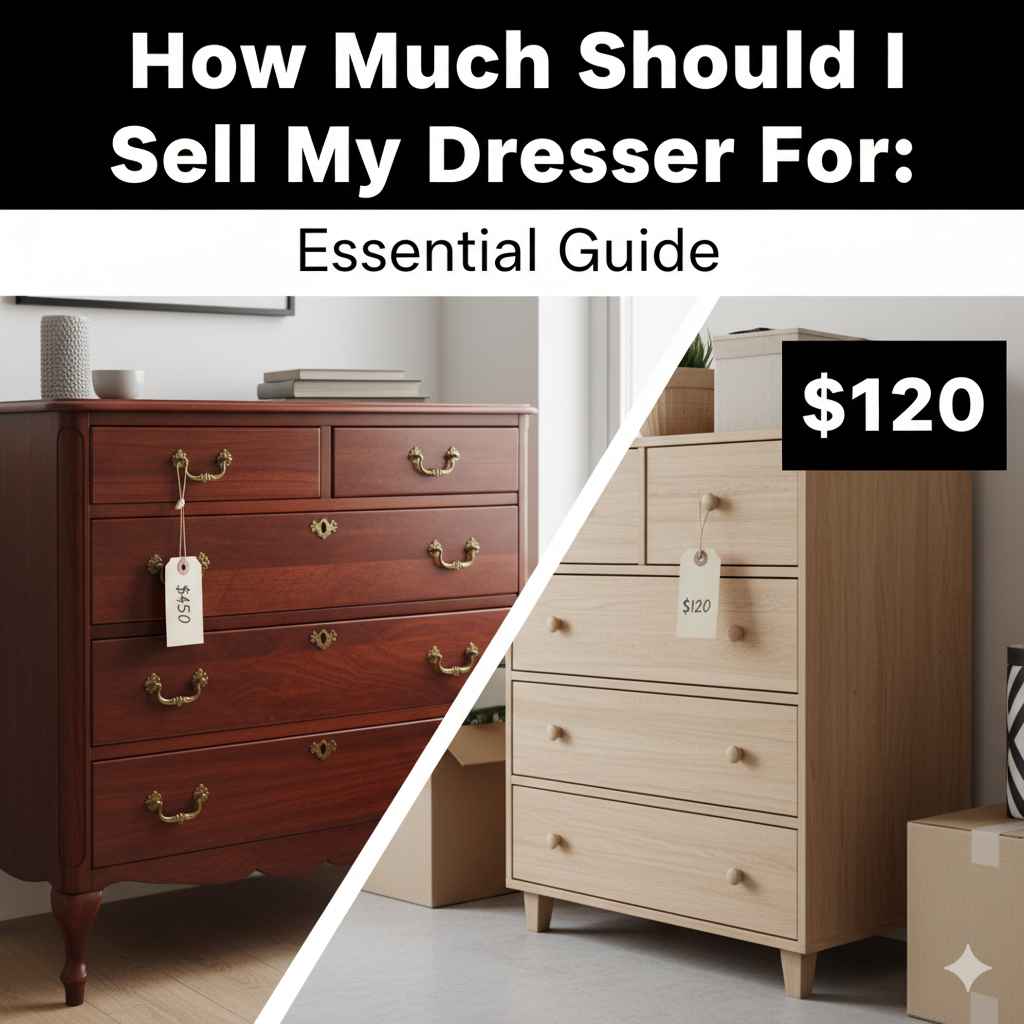
You should price your used dresser based on its condition, age, brand, and material. Generally, expect to sell a good quality, used dresser for 30% to 60% of its original retail price. Always check local market listings for similar pieces to set a competitive, fair price.
Selling furniture can feel tricky. You want a fair price without waiting forever. How much should I sell my dresser for? That is the million-dollar question! It’s frustrating when good furniture just sits there taking up space. You might think it’s worth a lot, or maybe you are just happy to see it go. Don’t worry. We will break down the price tag step-by-step. By looking at a few simple factors, you can set a price that gets you paid fairly and moves that dresser fast. Let’s figure out the perfect price tag together!
The First Step: Understanding Value vs. Price
Before we talk numbers, let’s clear up something important: value versus price. The value is what the dresser is inherently worth—its quality, materials, and brand recognition. The price is what someone is actually willing to pay for it right now in your local market. Our goal is to land the price close to that true value, making it appealing to buyers.
Think about buying a used car. A classic car has high value, but if no one is currently looking for that model, the selling price might be lower. Dressers work the same way. Buyers are looking for solutions to their immediate needs, like furnishing a spare room or apartment quickly. We need to match your dresser’s quality with what those buyers are ready to spend.
Condition is King: Grading Your Dresser’s Health
The single biggest factor affecting your selling price is how good the dresser looks and functions. Buyers are generally looking for something that requires zero immediate work. We can grade the condition easily, just like checking the tires on a car.
Condition Tiers Explained
- Excellent (Near New): This dresser looks brand new. No visible scratches, dents, or stains. All drawers slide perfectly, and the hardware is tight. You might still have the original manual or receipt.
- Good (Usable & Attractive): This is the most common tier. It has minor, barely noticeable signs of use—a small scratch on the side, perhaps. Functionality is perfect. It’s solid and ready to use immediately.
- Fair (Needs Minor TLC): This piece is structurally sound but might have cosmetic issues. Think of a few deep scratches, a wobbly leg that needs tightening, or slightly sticky drawers. Buyers expect a lower price here.
- Poor (As-Is/Repair Project): Significant damage, like broken hardware, deep veneer peeling, water damage, or major structural issues. Unless it’s a rare antique, these should be priced very low or given away.
If your dresser is in “Good” condition, you can comfortably aim for the middle of the suggested pricing range. If it’s “Excellent,” push towards the higher end!

Four Pillars That Determine Your Dresser’s Price
Once you know the condition, you need to consider the four main pillars that hold up the pricing structure. These factors separate a $50 dresser from a $500 dresser.
Pillar 1: Original Quality and Brand Name
Did you buy this dresser from a big-box store (like IKEA or Target), or did you invest in solid wood furniture from a dedicated retailer? High-quality brands hold their value much better. Furniture made from solid hardwood (like oak, maple, or cherry) is always worth more than particleboard or veneer furniture.
Look for identifying marks:
- Check the back panel or inside a drawer for a manufacturer’s stamp or sticker.
- Search the brand name online along with “dresser” to see what similar new items sell for. This gives you the baseline for calculating depreciation.
- If it’s an antique or high-end vintage piece, look for dovetail joints (a sign of quality craftsmanship) inside the drawers.
Pillar 2: Age and Style Relevance
Style is huge in furniture sales. A modern, clean-lined dresser might sell fast in a trendy area. However, a very heavy, dark oak 1980s style might be harder to move unless you are in an area known for vintage buyers.
Keep this in mind:
- Modern/Mid-Century: Often sells quickly at a higher percentage of the original cost because these styles are currently popular.
- Rustic/Farmhouse: Very popular right now; price these competitively if they are in good shape.
- Dated Styles (Heavy traditional, dark cherry): You may need to price these lower to attract buyers who are willing to refinish or paint them.
Pillar 3: Size and Functionality
Is this a standard 6-drawer dresser or a small 3-drawer chest? Larger pieces take up more space, which means buyers might be willing to pay slightly more for the storage, but they also have a smaller audience because they require more room. Always measure carefully! Oversized furniture can sometimes be tougher to sell unless the price is very attractive.
Pillar 4: The “Effort Factor”
Buyers want convenience. If you are selling a piece that is already assembled, clean, and ready to go, you can charge more. If the buyer has to disassemble it or clean off layers of dust, you need to lower the price to compensate for their effort.
For example, if you are selling IKEA furniture that is currently assembled, you can charge more than if you are selling the exact same piece disassembled in the box, because the buyer saves the assembly time. This concept is true across all furniture selling platforms.
Calculating Your Selling Price: The Percentage Method
Most experts agree that for typical, modern used furniture, you should aim to recoup between 30% and 60% of the original retail price, depending heavily on condition.
To use this method, you must know (or accurately estimate) what the dresser cost new. If you don’t have the receipt, search online for the item or a very similar replacement.
| Dresser Condition | Recommended Price Range (As % of New Cost) | Example: If New Cost $500 |
|---|---|---|
| Excellent (Like New) | 50% – 65% | $250 – $325 |
| Good (Minor Wear) | 35% – 50% | $175 – $250 |
| Fair (Needs Minor Fixes) | 20% – 35% | $100 – $175 |
| Poor (Project Piece) | 5% – 20% | $25 – $100 (or free) |
This table gives you a great starting point. If your dresser is a well-known, sought-after brand, like Ethan Allen or Restoration Hardware, you might be able to push the percentage higher, even up to 70% if the condition is truly flawless.
The Local Market Check: The Secret to Fast Sales
The absolute best way to know how much to charge is to look at what others are charging right now. This is where you go from guessing to being market-smart. Think of this as checking local road conditions before you take a long drive; you need to know the current traffic!
Visit popular local selling sites like Facebook Marketplace, Craigslist, OfferUp, or local buy/sell/trade groups. Search for:
- “6-drawer dresser”
- “Wood dresser”
- “Double dresser”
How to Compare Listings Effectively
When comparing listings, don’t just look at the price. Match the criteria as closely as possible:
- Condition Match: Find dressers listed as “Good” or “Excellent.” Ignore the ones that look wrecked unless you are aiming for the lowest end of the market.
- Style Match: Do they have similar hardware? Is it a tall chest or a long dresser? Match style and size closely.
- Review Sold Listings (If Possible): Some platforms show what similar items actually sold for, which is gold. If you can’t find sold listings, look at how long the current listings have been posted. If a comparable dresser has been listed for three weeks at $300, maybe try pricing yours at $275.
Pro Tip: If you find three similar dressers priced at $250, $275, and $300, pricing yours at $260 puts you right in the sweet spot—slightly better value than the median price.
Pricing for Different Sales Venues
Where you sell your dresser matters just as much as its condition. Different venues attract different types of buyers and support different price points.
Facebook Marketplace & Craigslist (Best for Highest Returns)
These platforms connect you directly with local buyers. You have the most control over pricing here, but you also handle all the logistics (photos, messaging, pickup).
- Pricing Strategy: Aim for the higher end of your calculated range (45%–60% of new cost) because buyers expect to pay private-party prices. Be prepared to negotiate down by about 10%–15%.
Online Consignment Stores (Good for High-End Pieces)
If you have a designer or high-quality piece (like those from Pottery Barn or Crate & Barrel), local furniture consignment shops can be an option. They do the selling, but they take a large cut.
- Pricing Strategy: Consignment shops usually take 40% to 60% of the final sale price. If you want to walk away with $300, you need to price it around $500–$750 so the shop can make their cut.
Garage/Yard Sales (Best for Quick Disposal)
Garage sales are for moving items fast, often for less than their true value. Buyers at yard sales expect rock-bottom prices.
- Pricing Strategy: Use the low end of your calculated range (20%–35% of new cost). Clearly price everything to avoid haggling over pennies.
Donating (If You Need a Tax Break)
If you need the space immediately or the dresser needs too much work to sell, donating is an option. Check with local charities. You may be able to deduct the fair market value of the item on your taxes. For tax deduction purposes, you generally use the value you could have sold it for in “Good” condition, according to the IRS guidelines on non-cash donations. Always get a receipt!
Essential Preparation: Boosting Perceived Value
Great photos and a detailed listing can often justify a slightly higher price point. A messy photo of a dusty dresser sitting in a dark corner suggests low value. Clean, well-lit photos suggest high value.
The Photography Checklist (Your Sales Magnet)
- Clean It Up: Wipe down every surface. Polish the hardware.
- Stage It: Remove clutter from the room. Use natural light. If possible, place a nice lamp or a decorative tray on top to show scale.
- Get All Angles: Take at least 5–8 clear photos: front, both sides, top, and a close-up of the hardware.
- Show the Functionality: Open every drawer halfway to prove they work smoothly. If it has a secret compartment, show that off!
- Disclose Flaws: If there’s a noticeable scratch, take a clear picture of only the scratch. This builds trust and prevents wasted time later.
Writing a Killer Description
Your description needs to answer every question a buyer might have before they even ask. Use clear, straightforward language.
What to Include:
- Measurements (Crucial!): Height (H), Width (W), Depth (D), all in inches.
- Material: Solid Wood, Veneer, Particle Board.
- Brand/Style: E.g., “Mid-Century Modern Style Dresser.”
- Condition Summary: Be honest (e.g., “Excellent condition overall, one small, faint scuff on the bottom right corner”).
- Why You Are Selling: (Optional, but helpful) “Upgrading to a larger set,” or “Moving out of state.”
- Pickup Details: “Must be picked up by buyer. Located on the first floor. Cash only.”
Pricing Strategies for Faster Sales
If you need the dresser gone by the weekend, you need a strategy to attract immediate attention. Think about this like pricing adjustments when a car dealership needs to clear inventory.
The “Anchor Price” Strategy
List the dresser at the top of your acceptable range (e.g., $300). Then, immediately state: “Priced to sell quickly! Firmly priced at $275,” or “Or Best Offer (OBO).” This makes the buyer feel like they are getting a deal right away, even if $275 was your target all along.
The “Too Good to Pass Up” Strategy
If you need it gone today, price it about 15% below the average going rate for comparable items. If the average is $250, list it at $215. This listing will likely get multiple inquiries within minutes. Be ready to respond instantly!
Bundling for Value
Do you have matching nightstands or a tall chest? Selling the whole bedroom set together allows you to charge a higher total price, and buyers often feel they are getting a better deal per item.
For example, if one dresser sells for $250, and a nightstand sells for $80, don’t list the set for $330. List the set for $299. You save the buyer money, and you move three items at once.
Understanding Depreciation and Furniture Lifespan
Furniture depreciates differently than electronics or cars. A well-made dresser, if cared for, can last decades. However, market taste changes rapidly.
A $1,000 dresser bought new in 2018 might fetch $400 today (40% retention). If you try to get $600, it might sit unsold for months. Why? Because the market perceives the “new normal” value for that style and age to be closer to 40%. Respecting depreciation is key to a fast sale.
You can learn more about the lifespan and sustainable use of household goods through resources focused on home economics and consumer goods, which often detail the expected durability of different material types, helping you gauge how much life is left in your piece.

FAQ: Beginner Questions About Selling Furniture
Q1: Should I take down the price if no one contacts me in three days?
Yes, if you haven’t gotten any reasonable offers after 3–4 days, it means your price is slightly too high for the current market interest. Drop the price by about 10% and see what happens over the next few days. If that doesn’t work, revisit your photos and description.
Q2: Is it okay to charge extra if the buyer needs me to help them lift it?
It is generally recommended to price your item for self-pickup, meaning the buyer handles all loading and transport. If you are willing to provide assistance (especially for heavy solid wood pieces), you can state in the listing, “Help available for loading small fee ($20).” This keeps the base price fair but acknowledges your extra effort.
Q3: What is the absolute minimum price I should accept for a good quality dresser?
For a dresser in “Good” condition, you should aim to keep the price above 30% of its original cost. If you go below that, you are probably selling it too cheaply unless you absolutely must get rid of it today.
Q4: Do I need to measure the inside of the drawers?
It is not essential unless you are selling a specialty item (like a blanket chest or very high-end antique). For standard dressers, measure the exterior and state the number of drawers clearly. Buyers looking for a specific fit will ask if they are serious.
Q5: How should I handle payment?
For local pickups, cash is always the safest and simplest option. If you must accept digital payment (like Venmo or PayPal), ensure the payment is completed and visible in your account before the buyer touches or moves the dresser. Avoid checks or money orders.
Q6: How do I price very old, unbranded dressers?
If you cannot identify the brand or age, treat it as a “Good Condition, Solid Wood” piece, but style might limit the price. If it is structurally sound and has nice hardware, price it based on local, unbranded solid wood sales in the $150–$250 range, then adjust based on your market research.
Conclusion: Confidence in Your Price Tag
Figuring out how much to sell your dresser for doesn’t have to be a mystery. By taking a systematic approach—assessing the condition honestly, understanding the impact of brand and style, calculating a percentage based on the original cost, and, most importantly, checking what similar items are selling for locally—you set yourself up for success.
Remember, the goal is a win-win: you clear space and get a fair return, and the buyer gets a useful piece of furniture without paying retail markup. Price it confidently, take fantastic photos, and be ready to negotiate politely. With these steps, your dresser won’t sit on the curb for long; it will be on its way to its next home, and you’ll have a little extra cash in your pocket. You’ve got this!