

How much do bakers make a year? On average, entry-level bakers earn around $30,000 to $35,000 annually, while experienced, specialized, or bakery owners can see salaries range from $50,000 up to $75,000 or more, depending on location, skill, and type of establishment.
Ever wondered what it really takes to turn flour and sugar into a paycheck? If you love the smell of fresh bread and dreaming about turning that passion into a full-time job, you’re not alone. Figuring out the pay is a big first step. It can feel confusing because baking jobs cover everything from small local shops to huge hotel kitchens. Don’t worry; we are going to break down exactly what bakers earn. We will look at the different types of jobs and what affects those yearly totals. You will walk away knowing exactly what you can expect to make. Let’s dive in and see how sweet a baking career can be!
Understanding Baker Salaries: What Does the Data Say?
When we talk about “bakers,” we are talking about a wide range of roles. Just like a car mechanic might earn differently than an automotive engineer, a pastry chef earns differently than someone mixing dough in a factory. To get a clear picture of how much bakers make a year, we need to look at the main sources of job data. We are looking for reliable numbers that reflect the reality of the market right now.
The most common way to get reliable salary data in the United States comes from the Bureau of Labor Statistics (BLS). These figures give us a great baseline. Remember, these are national averages, and your specific location or employer can change the numbers a lot.
Here is a snapshot of what the data generally shows for the category of “Bakers” (often grouped with food production workers):
| Salary Metric | Approximate Annual Earning | What This Means |
|---|---|---|
| Median Annual Wage | $31,900 – $35,000 | This is the midpoint—half earn more, half earn less. |
| Entry-Level (10th Percentile) | $24,000 – $28,000 | Starting out, perhaps in basic production or cleanup. |
| Highly Experienced (90th Percentile) | $55,000 – $65,000+ | Senior bakers, specialized roles, or high-end bakery work. |
This table shows that while the average base salary is modest, there is serious potential to earn more with experience and specific skills. Think of it like buying a used car: the base model is one price, but adding a turbocharger (skills!) increases the value significantly.
Factors That Heavily Influence Baker Pay
Your salary isn’t just a fixed number; it’s affected by several key things you can often control. If you want to reach the higher end of the scale, focusing on these areas helps tremendously. Think of these as the maintenance schedule for your career progression.
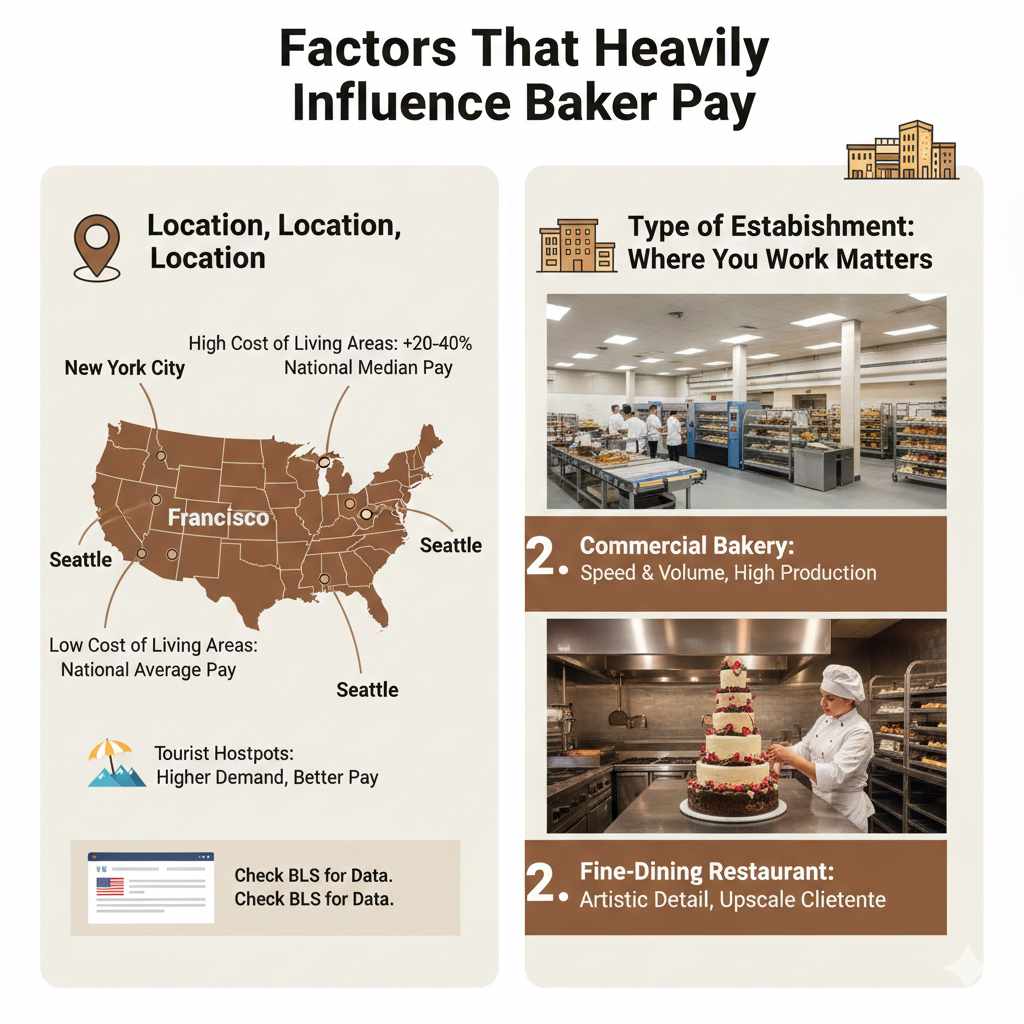
1. Location, Location, Location
Just like the cost of living affects everything, location heavily dictates what an employer can afford to pay. Bakers working in major metropolitan areas with a high cost of living—such as New York City, San Francisco, or Seattle—will almost always earn more than those in smaller towns. This extra pay helps offset the higher rent and daily costs.
- High Cost of Living Areas: Salaries are often 20% to 40% higher than the national median.
- Rural/Low Cost of Living Areas: Pay tends to stick closer to the lower end of the national average.
- Tourist Hotspots: Bakeries in busy tourist destinations often have higher demand, leading to better earning potential, especially if they cater to upscale visitors.
For the most detailed, up-to-date geographical breakdowns, regularly checking official resources like the U.S. Bureau of Labor Statistics Occupational Employment Statistics for “Bakers” is a smart move. They keep track of state-by-state variances.
2. Type of Establishment: Where You Work Matters
The environment provides the biggest immediate salary shift for bakers. A large-scale commercial bakery operation where speed and volume are key will pay differently than a fine-dining restaurant demanding artistic detail.
Commercial vs Retail vs Hospitality
- Wholesale/Commercial Bakeries: These facilities produce bread, frozen dough, or baked goods for grocery stores or large chains. The work is often shift-based (sometimes graveyard shifts) but can offer regular hours and predictable, slightly higher hourly wages for production efficiency.
- Retail Bakeries/Donut Shops: These are your local, neighborhood spots. Pay can vary widely based on the owner’s success. Tips can occasionally boost income here, but base pay is often standard.
- Hotels and Fine Dining Restaurants: This is often where the highest specialized wages are found. A “Pastry Chef” in a high-end hotel kitchen demands high skill, long hours, and offers excellent salary potential, often exceeding $60,000 annually for experienced individuals due to the complexity of the menu.
- In-Store Grocery Bakers: These bakers usually fall under the general grocery store wage structure, which may be lower than specialized roles but often includes stronger benefits packages.
3. Experience and Skill Specialization
Experience is the turbocharger for your baking career! Someone who has just completed culinary school starts at one level, while someone who has spent five years mastering sourdough fermentation or intricate wedding cake design sits much higher on the pay scale.
Specialized Skills That Boost Pay:
- Pastry Arts: Advanced skills in chocolate tempering, sugar work, and elaborate cake decorating significantly increase earning power.
- Artisan Bread Making: Deep knowledge of long-fermentation, regional styles (like baguette vs. rye), and different flours command more respect and better pay rates.
- Management/Supervision: If you can manage inventory, schedule staff, and ensure quality control across a team, you move into a supervisory role, which always carries a higher salary.
Think about it: if your vehicle needs an oil change, you can pay less for someone who does it quickly every day, or you can pay a specialist mechanic who can diagnose a complex engine failure. Specialized skills fetch specialist prices.
The Path to Higher Earnings: Moving Beyond Entry-Level Pay
If your eyes are set on a comfortable annual income, you need a plan to move beyond that initial starting wage. This involves targeted education, professional movement, and maybe even taking the leap into self-employment. Here is a roadmap for boosting your earning potential in the baking world.
Step 1: Formal Education vs. On-the-Job Training
Many successful bakers start by learning directly on the job. However, formal education can often shorten the time it takes to reach a higher skill bracket.
Formal Training (Culinary School/Baking Programs):
- Pros: Provides a structured understanding of food science, which is crucial for consistency. Often leads to a higher starting salary because employers recognize the foundational knowledge.
- Cons: Involves tuition costs and time investment.
Apprenticeship/On-the-Job Training:
- Pros: You are paid while you learn, building real-world speed and efficiency immediately.
- Cons: Learning might be less structured; sometimes, only one style of baking is taught.
My Take: For practical, achievable results, look for programs accredited by local community colleges. They offer the academic rigor without the massive expense of some four-year private schools. Check resources from educational bodies like the American Culinary Federation for recognized standards.
Step 2: Mastering Specific, High-Value Techniques
To get paid more, you need to offer something others can’t easily replicate. Invest your time in mastering techniques that are difficult to learn quickly:
- Lamination: Knowing how to perfectly create croissants, puff pastry, and danishes. This is high-skill and high-reward in upscale bakeries.
- Gluten-Free & Vegan Baking: As dietary needs grow, bakers who can consistently produce high-quality gluten-free or vegan items are extremely valuable.
- Large-Scale Production Planning: If you can manage the logistics of producing hundreds of items efficiently while maintaining quality, you are invaluable to a business owner.
Step 3: Considering Roles Outside Traditional Kitchens
Not all high-earning baking jobs involve working in a hot kitchen at 4 AM. Consider these alternative routes that often pay better due to the need for business acumen or specialized technical skill:
| Alternative Role | Typical Setting | Why Pay is Often Higher |
|---|---|---|
| Food Scientist (R&D Baker) | Large Food Corporations | Involves product development, stability testing, and intellectual property—requiring advanced chemical/baking knowledge. |
| Bakery Manager/Owner | Self-Employment or Corporate Chain | Earning potential is unlimited, tied directly to business success, marketing, and financial management skills. |
| Instructor/Consultant | Culinary Schools or Private Consulting | Leverages years of experience to train others or troubleshoot production issues for struggling businesses. |
Moving into management or ownership is a significant jump. Owners must handle everything—from ordering commercial ovens to securing loans—but their income potential far surpasses that of a salaried employee.
The Financial Reality: Weighing Salary Against Work Hours and Benefits
When you look at “how much do bakers make a year,” the dollar amount is only half the story. A high salary that requires 70 hours of grueling physical labor might not feel as good as a slightly lower salary with excellent benefits and a manageable 40-hour week. It is crucial to look at the total compensation package.
Understanding the Schedule Trade-Off
The baking industry often demands non-traditional hours. If you are working in a retail bakery, your prime time might be 3 AM to 11 AM so that bread is fresh for morning customers. This impacts your personal life significantly.
- Early Starts: Prepare for pre-dawn shifts, especially in wholesale environments.
- Holiday and Weekend Work: Bakers are always in demand before major holidays (Thanksgiving, Christmas) and on weekends when people buy special treats.
If you are working shifts that require you to be up extremely early, you might qualify for overtime pay if your employer is not structured appropriately, or you might negotiate a slightly higher base rate to compensate for the inconvenient schedule.
The Value of Benefits
For a beginner thinking about their first job, benefits might seem less important than the hourly rate, but they add serious value over a year. A job paying $32,000 with full health, dental, and retirement matching is financially much stronger than a $34,000 gig that offers nothing.
When interviewing for positions, always ask about:
- Health Insurance contribution levels.
- Paid Time Off (PTO) policies.
- Retirement plans (like a 401(k) with company match).
- Uniform allowances or daily meal/product discounts.
The Entrepreneurial Route: Owning Your Own Bakery
For many passionate bakers, the ultimate financial goal is opening their own shop. This path carries the highest financial risk but offers the highest potential reward. It’s like tuning your own engine for peak performance—you control every variable.
Startup Costs and Early Earnings
It is important to understand that for the first year or two, the owner often pays themselves the least. You are reinvesting everything back into the business.
Initial costs can be high, involving commercial leases, specialized equipment (mixers, deck ovens, retarders), and inventory. Experts often suggest that food-based startups require significant working capital just to survive the first 12–18 months.
The Ceiling on Owner Income
Once established and profitable, the income ceiling for a bakery owner is extremely high. Highly successful, well-managed independent bakeries in busy areas can generate significant revenue, allowing the owner to draw a consistent salary well over $100,000, potentially much more if they expand to multiple locations or franchise. This income reflects not just the baking skill, but the business management skill applied.
If you are considering this route, start by researching small business resources. The Small Business Administration (SBA) offers fantastic guides on developing a solid business plan, which is non-negotiable for securing startup funding.
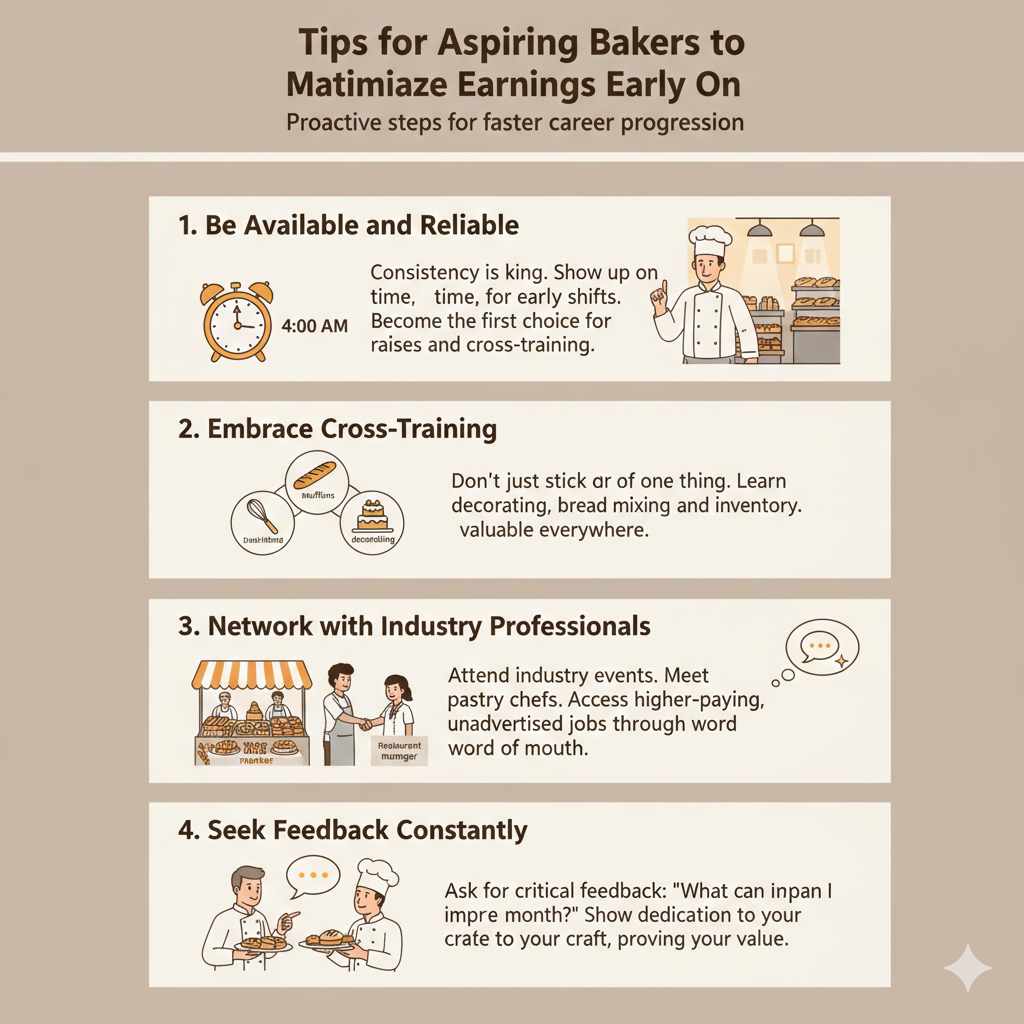
Tips for Aspiring Bakers to Maximize Earnings Early On
If you are just starting out and eager to move up the pay ladder faster than the average, adopt a proactive mindset. Treat your career development like routine, high-priority maintenance on a reliable vehicle.
Be Available and Reliable
Consistency is king in baking. Employers pay a premium for staff they never have to worry about. If you show up on time, every time, ready to work that early shift, you become the first person considered for cross-training or raises.
Embrace Cross-Training
Don’t just stick to making muffins. Ask to spend time with the decorator, the bread mixer, and the inventory manager. The baker who can step in anywhere without missing a beat is significantly more valuable than the specialist who can only do one thing.
Network with Industry Professionals
The best jobs often aren’t posted online; they come through word of mouth. Attend local food industry events or farmers’ markets. Getting to know successful pastry chefs or restaurant managers can open doors to higher-paying opportunities before they are ever publicly advertised.
Seek Feedback Constantly
Ask your head chef or manager: “What is one thing about my work that you think I could improve upon this month?” Showing a desire for critical feedback proves you are serious about your craft, a trait highly valued by owners who want a return on their investment in you.
Frequently Asked Questions (FAQ) for Aspiring Bakers
Q1: Is a culinary degree necessary to become a baker?
A: No, a degree is not strictly necessary. Many excellent bakers learn through apprenticeships or on-the-job training. However, a degree from a respected school can speed up learning and potentially increase your starting salary offer.
Q2: Do bakers get paid overtime?
A: It depends on whether they are classified as non-exempt or exempt employees, and the laws of their specific state. Most production bakers are non-exempt and are entitled to overtime pay for hours logged over 40 in a standard work week, but this must be verified with the employer.
Q3: How much more can a Pastry Chef make compared to a regular Baker?
A: A specialized Pastry Chef role, especially in fine dining or hotels, often commands 25% to 50% more annually than a general baker role, due to the advanced artistic skills and management required in the pastry department.
Q4: Are evening or overnight baking jobs paid better?
A: Sometimes. Jobs requiring overnight shifts (like for wholesale bread production) may offer a slight shift differential (extra pay per hour) to compensate for the inconvenient hours, though this isn’t guaranteed across all establishments.
Q5: Does being a private home baker earn better money?
A: If you operate legally (with necessary permits and insurance, often regulated by local health departments), custom high-end orders for special events can yield a very high hourly rate for your labor, but you must factor in all your own overhead expenses.
Q6: What is a key benefit of working in a large grocery chain bakery versus a small independent shop?
A: Grocery chains usually offer more standardized benefits packages, including predictable schedules and often better access to health insurance and retirement plans, even if the hourly rate for base production is slightly lower.
This wraps up the core questions about the financial side of a baking career. Understanding these variances puts you in the driver’s seat when negotiating your salary or planning your career moves.
Conclusion: Driving Your Baking Career Forward
We have covered a lot of ground today, exploring the landscape of baker salaries. If you came here wondering “how much do bakers make a year,” you now know the answer isn’t a single figure—it’s a spectrum. Starting around the low $30,000s is typical, but seasoned professionals in high-demand roles or desirable locations are commonly earning in the $50,000 to $75,000 range.
Just like maintaining any complex machine, maximizing your earnings as a baker requires ongoing effort. Invest in specialized training, be reliable, seek out environments that value high-level skills like lamination or complex decorating, and always look at the total