

Quick Summary:
Bookshelf speakers are ideal for smaller rooms or when your budget is a key factor, offering great sound without taking up too much space. Floor standing speakers, on the other hand, provide a richer, more immersive sound, especially in larger spaces, but require more room and typically a higher investment.
Deciding on new speakers for your home stereo or home theater can feel like a maze, especially when you’re looking at bookshelf speakers versus floor standing options. Both can sound amazing, but they serve different purposes and have different strengths. It’s easy to get lost in the technical specs and marketing buzzwords. But don’t worry! We’re going to break down exactly what makes each type tick, so you can pick the perfect sound system for your space and your ears. We’ll make it super simple, so you understand exactly what you’re getting into.
Understanding Speaker Types: The Basics
Before we dive into the comparison, let’s get a handle on what we’re talking about. Speakers are basically devices that turn electrical signals from your stereo or amplifier into sound waves you can hear. They come in all shapes and sizes, but for home audio, the main battle is often between bookshelf speakers and floor standing (also called tower) speakers.
What are Bookshelf Speakers?
As the name suggests, bookshelf speakers are designed to be placed on a shelf, a stand, or a desk. They are generally smaller and more compact than floor standing speakers. Because of their size, they often incorporate fewer and smaller drivers (the individual speaker cones that produce sound). This means they might not produce the deepest bass frequencies on their own, but they can still deliver fantastic clarity and detail.
What are Floor Standing Speakers?
Floor standing speakers, often called tower speakers, are designed to sit directly on the floor. They are much larger and taller, which allows them to house more and larger drivers. This bigger cabinet space and larger drivers are key to their ability to produce a wider range of frequencies, especially deep, resonant bass, and a more powerful overall sound. They are often chosen for their impressive sonic presence and ability to fill larger rooms.
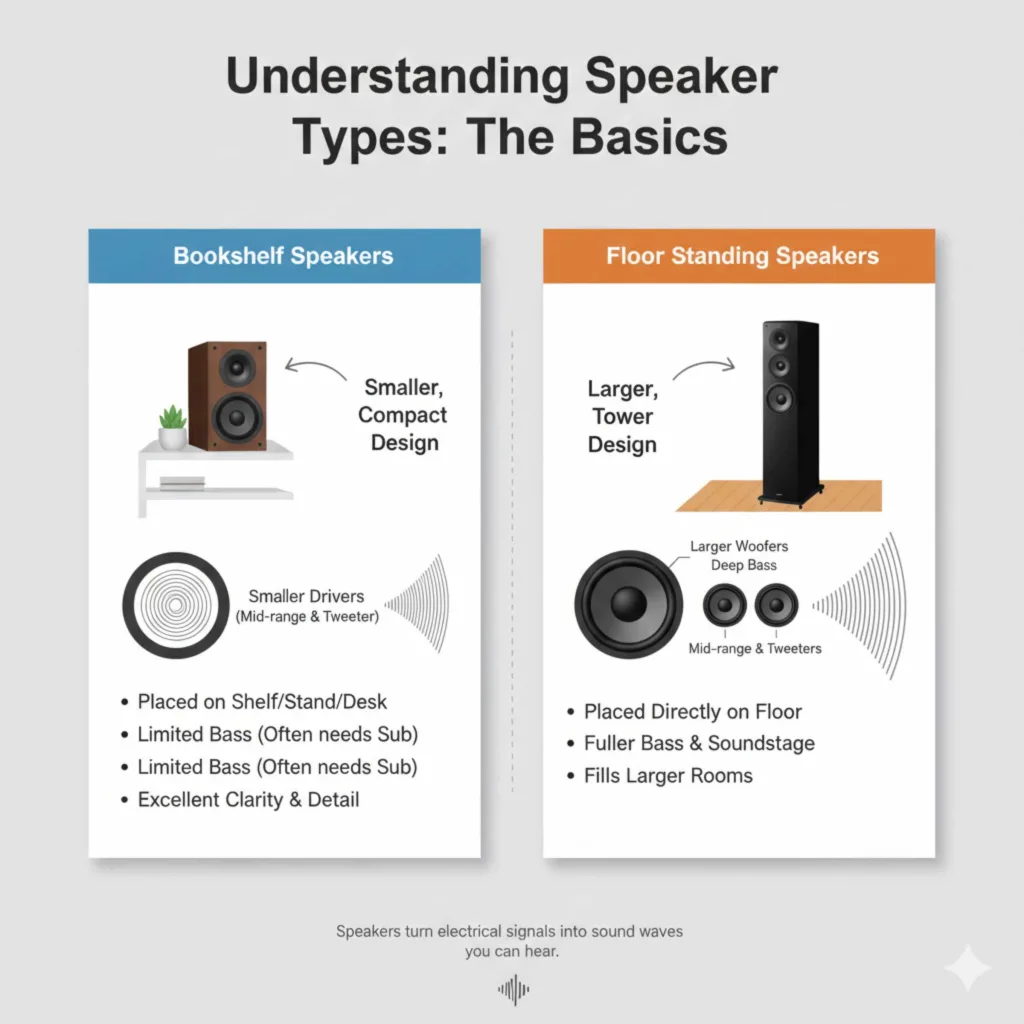
Bookshelf Speakers vs Floor Standing: The Key Differences
The main differences between bookshelf and floor standing speakers come down to size, sound output, placement requirements, and cost. Let’s look at these factors side-by-side.
Size and Space Requirements
This is perhaps the most obvious difference. Bookshelf speakers are compact. They can fit on existing furniture or small stands. This makes them perfect for smaller apartments, dorm rooms, bedrooms, or home offices where space is at a premium. Floor standing speakers, on the other hand, are substantial pieces of equipment. They need dedicated floor space and can easily become the focal point of a living room. If you have a large living room or a dedicated media room, floor standing speakers can be a great fit without feeling overwhelming.
Sound Quality and Performance
When it comes to sound, size matters, especially for bass. Floor standing speakers, with their larger cabinets and woofers (the large speaker cones for low frequencies), can typically produce deeper, more powerful bass. They also tend to go louder with less distortion. Bookshelf speakers, while excellent for clarity and mid-range frequencies, might require a subwoofer to achieve the same level of bass impact as floor standing speakers. However, high-quality bookshelf speakers can offer incredibly detailed sound that rivals some floor standing models, especially in smaller spaces.
The dispersion of sound also plays a role. Larger floor standing speakers are often designed to project sound further and create a wider soundstage, which is the sense of space and depth in the stereo image. This can make music and movies feel more immersive.
Placement and Acoustics
Placement is crucial for any speaker. Bookshelf speakers offer more flexibility. You can place them on stands to get them to ear level, which is ideal for critical listening. They can also be placed on shelves or entertainment centers. However, placing them too close to a wall or on a wobbly surface can negatively impact their sound.
Floor standing speakers are designed to be placed directly on the floor. Their height is usually optimized to direct sound towards a seated listener. While they require more dedicated space, their placement is generally more straightforward in terms of achieving good sound dispersion. They are often best kept a few feet away from walls to prevent bass buildup.
For the best results with any speaker, consider consulting acoustics guides. For example, the Acoustical Society of America offers research and principles that can help understand how sound behaves in a room.
Budget Considerations
Generally, bookshelf speakers are more affordable than their floor standing counterparts. You can find excellent bookshelf speakers at various price points. This makes them a great option for those on a tighter budget or who are just starting out in home audio. Floor standing speakers, due to their size, complexity, and materials, are typically more expensive. If budget is a primary concern, bookshelf speakers often provide a better bang for your buck, especially if you add a subwoofer later on if needed.
Pros and Cons: Bookshelf Speakers
Let’s summarize the advantages and disadvantages of bookshelf speakers to help you weigh your options.
Pros:
- Space-Saving: Ideal for smaller rooms, apartments, or offices.
- Versatile Placement: Can be mounted, placed on shelves, or stands.
- Affordable: Generally less expensive than floor standing speakers.
- Easy to Integrate: Less likely to dominate a room’s decor.
- Excellent Clarity: Often deliver crisp highs and detailed mids.
Cons:
- Limited Bass Response: May require a subwoofer for deep bass.
- Less Immersive Soundstage: Can struggle to fill larger rooms compared to towers.
- Potential Vibration Issues: If placed on furniture, they can cause rattles.
Pros and Cons: Floor Standing Speakers
Here’s a breakdown of the strengths and weaknesses of floor standing speakers.
Pros:
- Powerful Bass Response: Can produce deep, impactful bass without a subwoofer.
- Immersive Soundstage: Better at filling larger rooms and creating a cinematic experience.
- Higher Output Levels: Can typically play louder with less distortion.
- Aesthetically Pleasing: Often designed as statement pieces in a room.
- All-in-One Solution: Don’t necessarily need additional speakers for full-range sound.
Cons:
- Require Significant Space: Not suitable for small rooms.
- More Expensive: A larger investment upfront.
- Placement Sensitivity: Needs careful positioning to avoid acoustic issues.
- Can Be Overpowering: Visually and sonically, they can dominate small spaces.
When to Choose Bookshelf Speakers
So, when is a bookshelf speaker the clear winner for you? Here are some scenarios:
- Your Room is Small: If you live in an apartment, a studio, or have a smaller bedroom or office, bookshelf speakers are almost always the better choice. They simply won’t overwhelm the space.
- Budget is Your Top Priority: You can get fantastic sound from bookshelf speakers without breaking the bank. They are an excellent entry point into quality hi-fi audio.
- You Plan to Add a Subwoofer: If you love the idea of a powerful bass response but want to start with a more affordable system, bookshelf speakers paired with a good subwoofer later on are a fantastic strategy. This hybrid approach can be very effective.
- Minimalist Aesthetic is Important: You don’t want speakers that dominate your living space or decor. Bookshelf speakers can be discreetly placed.
- Near-Field Listening: If you primarily listen to music at your desk or in a smaller, more focused listening area, bookshelf speakers placed on stands or your desk will provide an intimate and detailed sound experience.
When to Choose Floor Standing Speakers
Under what circumstances should you lean towards floor standing speakers?
- You Have a Large Listening Space: For spacious living rooms, media rooms, or open-plan areas, floor standing speakers are designed to fill that space with rich, dynamic sound.
- You Want the Best Bass Without a Subwoofer: If you crave deep, powerful bass for music and movies and want a complete, full-range sound system right out of the box, floor standing speakers excel here.
- Immersive Home Theater is Your Goal: For a truly cinematic experience with powerful soundtracks, floor standing speakers often form the core of an impressive home theater setup.
- Your Budget Allows for a Higher Investment: When you’re ready to invest more in your audio system, floor standing speakers offer a higher level of performance and sonic capability.
- You Want a Statement Piece: Many floor standing speakers are beautifully designed and can add a touch of elegance and sophistication to your room.
A Practical Comparison Table
To make things even clearer, let’s put the key differences into a table. This can help you quickly see where each type shines.
| Feature | Bookshelf Speakers | Floor Standing Speakers |
|---|---|---|
| Size & Footprint | Compact, fits on shelves or stands. | Tall, requires dedicated floor space. |
| Bass Response | Limited; often benefits from a subwoofer. | Strong and deep, typically full-range. |
| Room Size Suitability | Small to medium rooms. | Medium to large rooms. |
| Soundstage & Immersion | Good, but can be less expansive. | Excellent, wide and deep. |
| Price Range | More affordable, wider range. | Generally more expensive. |
| Placement Flexibility | High; on stands, shelves, desks. | Lower; must be on the floor. |
| Ideal For | Beginners, small spaces, tight budgets. | Audiophiles, large rooms, immersive experiences. |
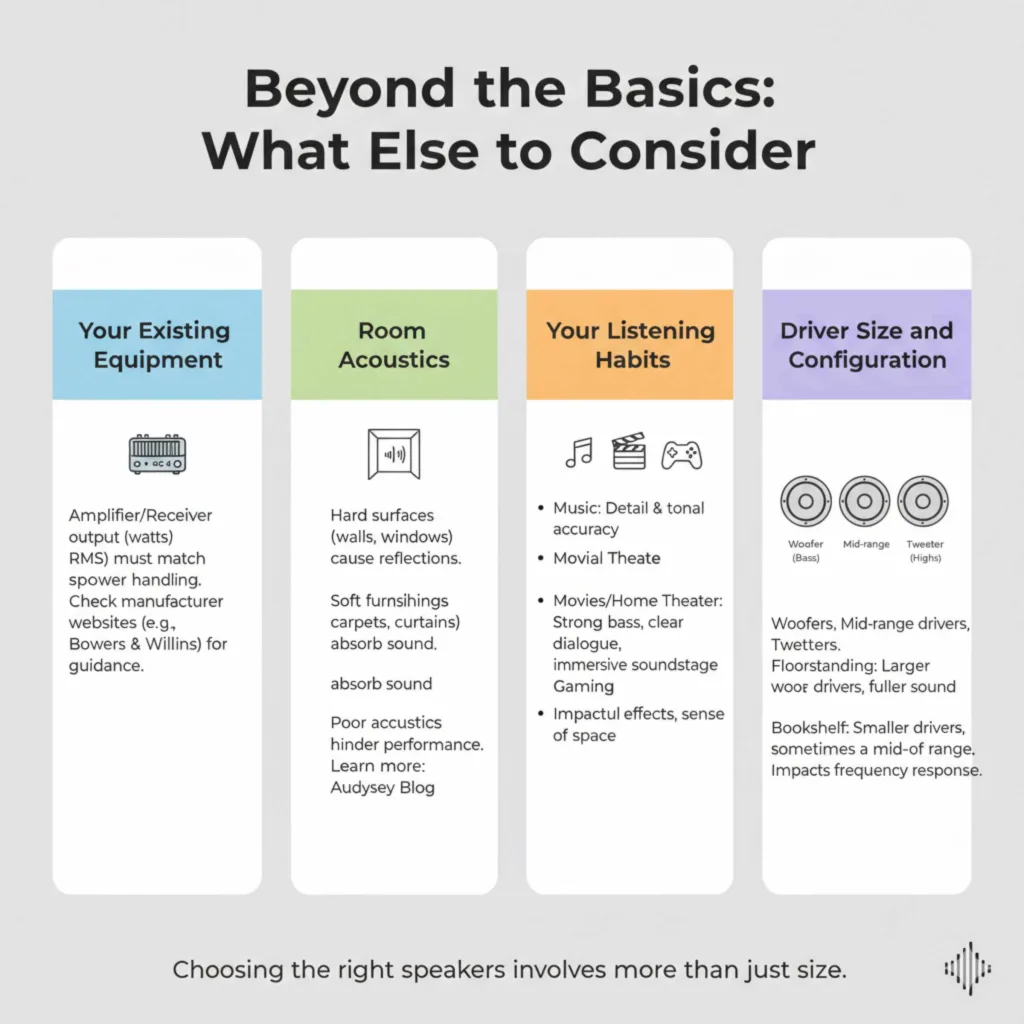
Beyond the Basics: What Else to Consider
While size and output are major factors, there are other things to keep in mind when choosing speakers:
Your Existing Equipment
The amplifier or receiver you use plays a huge role in how your speakers will sound. Make sure your amplifier is powerful enough to drive the speakers you choose. Check the speaker’s power handling (often measured in watts RMS) and compare it to your amplifier’s output. Reputable audio manufacturer websites, like Bowers & Wilkins, offer excellent advice on matching speakers to amplifiers.
Room Acoustics
The way sound interacts with your room is critical. Hard surfaces like bare walls, windows, and floors can cause reflections that make sound muddy. Soft furnishings like carpets, curtains, and upholstered furniture help absorb sound and improve clarity. Even with the best speakers, poor room acoustics can hinder performance. For more on room correction, the Audyssey Blog has some great foundational articles.
Your Listening Habits
What do you primarily use your speakers for?
- Music: If you’re a music lover, consider speakers known for their detail and tonal accuracy. Some find bookshelf speakers excellent for precise music reproduction, while others prefer the grandeur of towers for orchestral pieces.
- Movies/Home Theater: For movies, you’ll want strong bass for explosions and effects, clear dialogue, and a wide soundstage to create an immersive experience. Floor standing speakers often excel here, but a well-matched bookshelf system with a subwoofer can be equally impressive.
- Gaming: Similar to movies, gaming benefits from impactful sound effects and a sense of space, making both types of speakers viable depending on your setup.
Driver Size and Configuration
Speakers have drivers: woofers for bass, mid-range drivers for vocals and instruments, and tweeters for high frequencies (like cymbals and sibilance). Floor standing speakers typically have larger woofers and can accommodate more drivers in a single cabinet, allowing for a fuller sound. Bookshelf speakers usually have smaller woofers and tweeters, sometimes a mid-range driver too. The number and size of drivers directly impact the speaker’s frequency response and its ability to reproduce sound accurately.
Frequently Asked Questions (FAQ)
Q1: Can bookshelf speakers sound as good as floor standing speakers?
Yes, high-quality bookshelf speakers can offer exceptional sound quality and detail that rivals many floor standing models, especially in smaller or medium-sized rooms. However, they typically don’t produce the same deep, powerful bass on their own and might require a subwoofer for a truly full-range experience.
Q2: Do I need a subwoofer with bookshelf speakers?
It depends on your listening preferences and the specific bookshelf speakers. For most music and general listening, good bookshelf speakers can be sufficient. However, if you enjoy deep bass for movies, electronic music, or hip-hop, adding a subwoofer will significantly enhance the low-end performance and provide a more complete sound.
Q3: How far away from the wall should I place my speakers?
Generally, both bookshelf and floor standing speakers sound best with some space between them and the wall. For bookshelf speakers, avoid placing them too close to the back wall, as this can create boomy bass. For floor standing speakers, keeping them at least 1-3 feet away from the wall (depending on the speaker and your room) helps prevent excessive bass buildup and allows for better sound dispersion.
Q4: Are floor standing speakers always better for home theater?
Floor standing speakers are often preferred for home theater because they can create a grander, more immersive soundstage and provide powerful bass for action sequences. However, a well-designed surround sound system using excellent bookshelf speakers for the front channels, along with a capable subwoofer and matching surrounds, can also deliver an outstanding home theater experience.
Q5: Can I use bookshelf speakers as rear surround speakers in a home theater system with floor standing front speakers?
Absolutely! This is a very common and effective setup. Using bookshelf speakers for the rear surround channels in a home theater system that has floor standing speakers for the front left and right channels is a great way to balance performance, cost, and space requirements.
Q6: What does “impedance” and “sensitivity” mean for speakers?
Impedance (measured in Ohms, Ω) is the electrical resistance of the speaker. Lower impedance means the speaker draws more current from your amplifier. Most home speakers are 4 or 8 Ohms. Sensitivity (measured in dB) indicates how loud a speaker will play with a given amount of power (e.g., 90 dB at 1w/1m). Higher sensitivity means the speaker is more efficient and can play louder with less power from your amplifier. Both are important technical specs to consider when matching speakers to your amplifier.
Q7: Should I prioritize looks over sound quality, or vice versa?
This is a personal choice, but ideally, you want a balance. Both bookshelf and floor standing speakers come in a wide range of styles. High-end audio often prioritizes sound quality above all else. However, great-sounding speakers can also be beautifully designed and complement your home decor. It’s perfectly possible to find speakers in either category that excel in both areas.
Conclusion: Making Your Final Choice
So, bookshelf speakers versus floor standing speakers – which is the best choice for you? The answer truly hinges on your unique situation. If you’re working with limited space, a tighter budget, or just want a simpler setup, bookshelf speakers are an outstanding option, offering clarity and versatility. Don’t underestimate their ability to deliver fantastic sound, especially when paired with a subwoofer.
However, if you have the space, the budget, and the desire for a grand, room-filling sound with deep, impactful bass and an immersive audio experience, floor standing speakers are likely your best bet. They are designed to make a statement, both visually and sonically.
Ultimately, the best way to decide is to listen for yourself if possible. Visit a local audio store and hear different types of speakers in person. Pay attention to how they sound in a room that mimics your own. Think about your space, your listening habits, and your budget. Trust your ears and what feels right for your home. Either way, investing in quality speakers will bring a new level of enjoyment to your music and movies!