
Quick Summary: Bookshelf speakers with a subwoofer offer flexibility and a smaller footprint, great for tight spaces, while floorstanding speakers provide fuller sound and deeper bass on their own. Choosing depends on your room size, budget, and listening preferences.
Setting up a new home audio system can feel like navigating a maze, especially when it comes to speakers. You see “bookshelf” speakers and “floorstanding” speakers, and you wonder, “Which one is actually better for me?” It’s a common question, and honestly, it can be confusing. You want great sound without any fuss. You’ve come to the right place. We’ll break down exactly what these speaker types are, how they differ, and how to pick the best fit for your cozy listening corner or your spacious living room. We’ll make sound simple, so you can relax and enjoy your music or movies.
Understanding the Basics: What’s the Big Deal?
At their core, both bookshelf and floorstanding speakers are designed to do the same thing: turn electrical signals into sound waves that fill your room. The main difference lies in their size, design, and how they reproduce sound, particularly low frequencies (bass). This impacts everything from how much space they take up to the depth and richness of the audio experience.
Bookshelf Speakers: Small Package, Mighty Sound
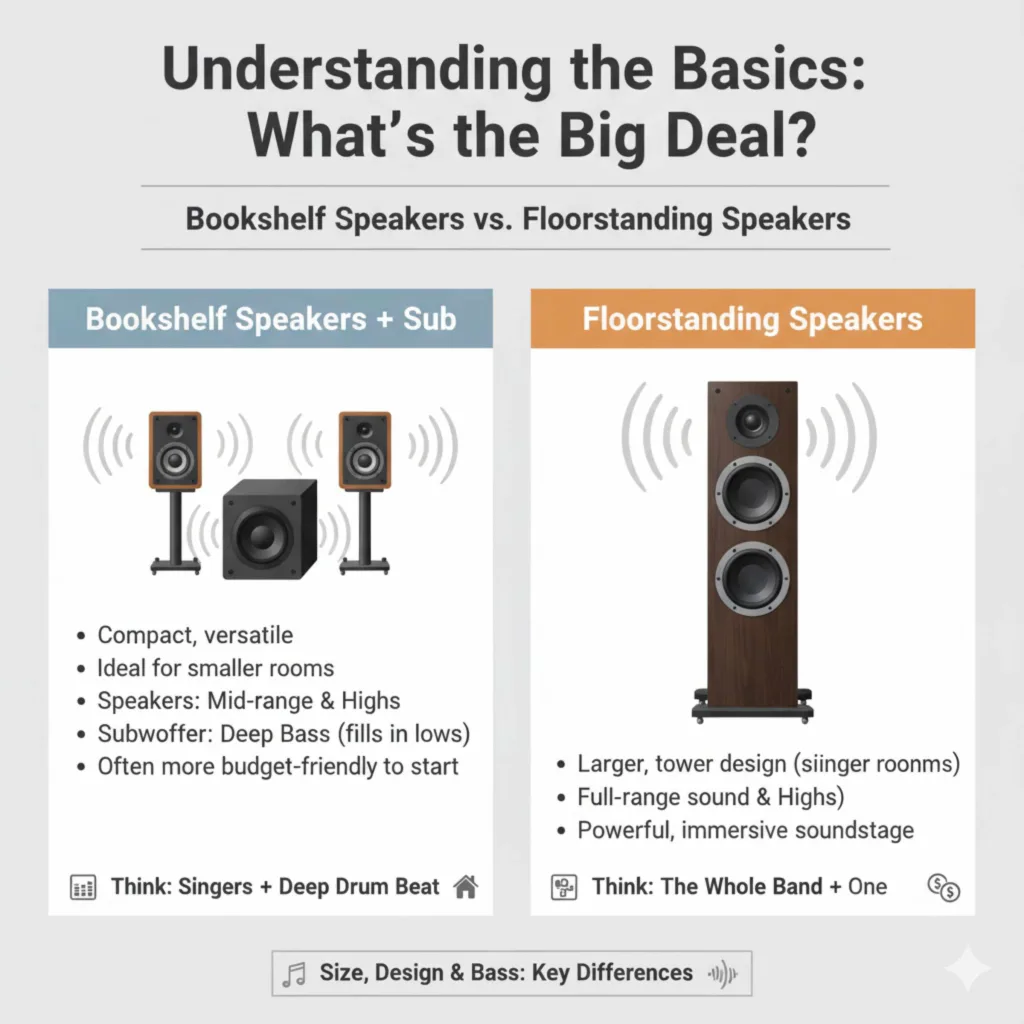
Bookshelf speakers, also known as stand-mount speakers, are compact. As their name suggests, they are often small enough to sit on a shelf, a desk, or a dedicated speaker stand. Because they are smaller, they are typically designed to be paired with a separate subwoofer to handle the deepest bass notes. This allows the main bookshelf speaker to focus on mid-range and high frequencies.
The advantage here is versatility. You can place them in more locations, making them ideal for smaller rooms, apartments, or setups where space is a premium. They are also often more budget-friendly to start with.
Why a Subwoofer is Often Key for Bookshelf Speakers
Small speakers have limitations in moving air. To produce deep, powerful bass, speakers need a larger cabinet and drivers (the cones that vibrate to make sound) to push enough air. Bookshelf speakers, by their nature, can’t do this as effectively as larger speakers. This is where the subwoofer comes in. A subwoofer is a specialized speaker dedicated solely to reproducing low-frequency sounds, typically below 100 Hz. When paired with bookshelf speakers, it fills in the bass that the smaller speakers can’t produce, creating a more complete and impactful sound.
Think of it like this: your bookshelf speakers are the singers hitting all the main notes, and the subwoofer is the deep drum beat keeping the rhythm and emotion. Together, they make the band sound full and rich.
Floorstanding Speakers: The Full-Range Experience
Floorstanding speakers, also called tower speakers, are much larger. They are designed to sit directly on the floor, often requiring no additional stands. Their larger size allows for bigger drivers and cabinet volumes, which means they can produce a wider range of frequencies, including deeper bass, without the need for a dedicated subwoofer. They are essentially designed as a “full-range” solution.
These speakers are built to fill larger rooms with powerful, immersive sound. If you dream of a cinematic experience or want your music to feel as if it’s being performed live in your room, floorstanding speakers are often the go-to choice.
Key Differences: Bookshelf & Sub vs. Floorstanding
Let’s break down the critical differences between these two popular speaker setups across several important categories. This will help you see which one might align better with your listening habits and living space.
Size and Placement
This is the most obvious difference. Bookshelf speakers are compact, offering immense flexibility. You can place them on shelves, entertainment centers, or dedicated stands. This makes them perfect for smaller apartments, bedrooms, or home offices where floor space is limited. Floorstanding speakers, on the other hand, demand more space. They are designed to be the main audio components in a room and need ample space around them to perform optimally. Placing them too close to walls can sometimes muddy the sound, especially the bass.
Sound Quality and Bass Response
This is where things get interesting. A well-matched bookshelf speaker and subwoofer system can offer superb clarity and crispness in the mid and high frequencies, with the subwoofer providing powerful, accurate bass. The key is the “well-matched” part; a good subwoofer can deliver bass that is as good or even better than what some floorstanders can manage. Floorstanding speakers, due to their larger size and drivers, generally offer a more robust and naturally deep bass response on their own. They can create a sense of scale and authority in the sound that is harder to replicate with smaller speakers. However, the quality of bass production can vary significantly between different floorstanding models.
Cost
Generally, a good pair of bookshelf speakers plus a quality subwoofer can be comparable in price to a decent pair of floorstanding speakers. However, entry-level bookshelf speakers are often less expensive than entry-level floorstanders. As you move up the quality ladder, both types can become quite costly. It’s crucial to consider the total package – the speakers themselves, the amplifier needed to drive them, and if applicable, the subwoofer and its amplifier. You can explore reputable brands and compare pricing on sites like Crutchfield, which provides detailed specs and reviews.
Room Impact
Bookshelf speakers have a much smaller physical presence in a room, making them easier to integrate into decor. They don’t dominate the visual space. Floorstanding speakers are statement pieces. They take up significant visual real estate and can influence the room’s aesthetics considerably. Their size also means they can be more sensitive to room acoustics, requiring careful placement to avoid issues like booming bass or harsh reflections.
Amplification Needs
Both types of speakers require an amplifier to produce sound. However, floorstanding speakers generally require more powerful amplification due to their larger drivers and design. Bookshelf speakers, being smaller, can often be driven effectively by less powerful amplifiers or even AV receivers. If you’re using a separate subwoofer, it will typically have its own built-in amplifier, so the main amplifier only needs to power the bookshelf speakers.
When to Choose Bookshelf Speakers with a Subwoofer
Opting for bookshelf speakers and a subwoofer is a smart move in several scenarios:
Ideal Scenarios for Bookshelf + Subwoofer:
- Limited Space: If your living room, bedroom, or office is on the smaller side, bookshelf speakers are a natural fit. They leave more floor space and feel less imposing.
- Decor Flexibility: You can hide bookshelf speakers more easily or integrate them into shelving units, allowing your audio system to blend seamlessly with your home’s design.
- Budget Considerations for Initial Setup: You can start with a good pair of bookshelf speakers and add a subwoofer later as your budget allows, gradually building your system.
- Precise Mid/High-Frequency Clarity: Often, high-quality bookshelf speakers excel at detailed reproduction of vocals, instruments, and treble. Pairing them with a capable subwoofer ensures you don’t miss out on the low end.
- Upgradability: You can upgrade your subwoofer independently of your main speakers, or upgrade your main speakers without needing to replace your subwoofer if it’s already performing well.
- Apartments or Shared Living: While powerful bass can be an issue in apartments, a good subwoofer can be better controlled and directed, and perhaps experienced at lower, more neighbor-friendly volumes.
Pros of Bookshelf + Subwoofer:
- Space-saving and versatile placement
- Can offer exceptional clarity in mid and high frequencies
- Potentially more budget-friendly to start with
- Easier to integrate into existing decor
- Allows for phased upgrades of components
Cons of Bookshelf + Subwoofer:
- Requires careful matching of speakers and subwoofer for optimal sound
- Needs space for both speakers and the subwoofer
- Can sometimes sound less cohesive if not properly integrated
- May require an additional amplifier for the subwoofer (if not self-powered)
When to Choose Floorstanding Speakers
Floorstanding speakers are for those who want a certain kind of sonic grandeur and have the space to support it.
Ideal Scenarios for Floorstanding Speakers:
- Larger Rooms: Their size and design allow them to fill spacious areas with sound effectively.
- Immersive Audio Experience: If you crave a powerful, dynamic, and full-bodied sound for movies and music, these speakers deliver.
- Integrated Bass: You prefer a single, cohesive speaker that handles the full spectrum of sound without relying on an extra box (the subwoofer).
- “Set It and Forget It” Approach: You want a master solution that requires less component matching and is ready to go with a good amplifier.
- Statement Audio Gear: You appreciate the aesthetic of substantial, well-designed audio equipment as a focal point in your room.
- Home Theater Front Channels: They often serve as excellent front left and right speakers in a surround sound setup, providing maximum impact.
Pros of Floorstanding Speakers:
- Excellent full-range sound reproduction, especially deep bass
- Can produce a larger, more dynamic soundstage
- Simplified setup (fewer components)
- Often have a visually impressive presence
- Tend to perform very well in larger spaces
Cons of Floorstanding Speakers:
- Require significant floor space
- Can be more expensive than bookshelf speakers
- Placement is crucial to avoid acoustic issues
- Less flexible for small rooms or minimalist setups
- May require more powerful amplification
A Quick Comparison Table
Here’s a table summarizing the key distinctions:
| Feature | Bookshelf Speakers + Subwoofer | Floorstanding Speakers |
|---|---|---|
| Size | Compact, designed for shelves or stands | Large, designed to sit on the floor |
| Bass Response | Relies on a dedicated subwoofer for deep lows | Produces bass naturally due to size and drivers |
| Room Size Suitability | Best for small to medium rooms, or where space is limited | Best for medium to large rooms |
| Placement Flexibility | High | Moderate to low, specific placement needed |
| Aesthetic Impact | Minimal, easy to integrate | Significant, often a statement piece |
| System Complexity | Potentially more components (speakers, sub, amps) | Fewer core components (speakers, amp) |
| Cost (Entry Level) | Often lower | Often higher |
| Soundstage Potential | Can be excellent, but depth may require a good sub | Often naturally wider and deeper |
Making the Decision: What’s Right for You?
The choice between bookshelf speakers with a subwoofer and floorstanding speakers boils down to your specific circumstances, preferences, and priorities. There’s no single “winner”; the best choice is the one that perfectly fits your life and listening habits.
Consider Your Room First
Measure your space. Do you have a large, open living room that can accommodate imposing speakers? Or is it a cozy den or home office where every inch counts? A good rule of thumb is that floorstanding speakers tend to perform best in rooms that are at least 12 feet by 15 feet. Smaller rooms can easily become overwhelmed by the output of large towers, leading to boomy, uncontrolled bass. For smaller spaces, bookshelf speakers are often the more practical and sonically sensible option.
Think About Your Listening Material
What do you listen to most? If you’re a fan of booming action movies, EDM, or orchestral music with deep organ pedals, powerful bass is a must. Both well-implemented floorstanders and a quality bookshelf/subwoofer combo can deliver this. However, if you primarily listen to acoustic music, jazz, or vocals, and enjoy intricate details in the mid and high frequencies, either option can satisfy, but you might find bookshelf speakers offer exceptional clarity without overpowering the room.
Budget Matters
Set a realistic budget. Remember to factor in not just the cost of the speakers but also the amplifier or receiver required to power them. For bookshelf speakers, you’ll also need to budget for a subwoofer and potentially speaker stands. While entry-level bookshelf systems might be cheaper, a high-end bookshelf setup with a premium subwoofer can easily match or exceed the cost of good floorstanding speakers.
Aesthetic Appeal
How do you want your audio system to look in your home? Floorstanding speakers are often designed to be prominent, luxurious additions to a room. Bookshelf speakers are more discreet, easily blending into cabinetry or standing elegantly on small stands. If you have a minimalist style or prefer your tech to be less visible, bookshelf speakers might be the way to go.
The Importance of Room Acoustics
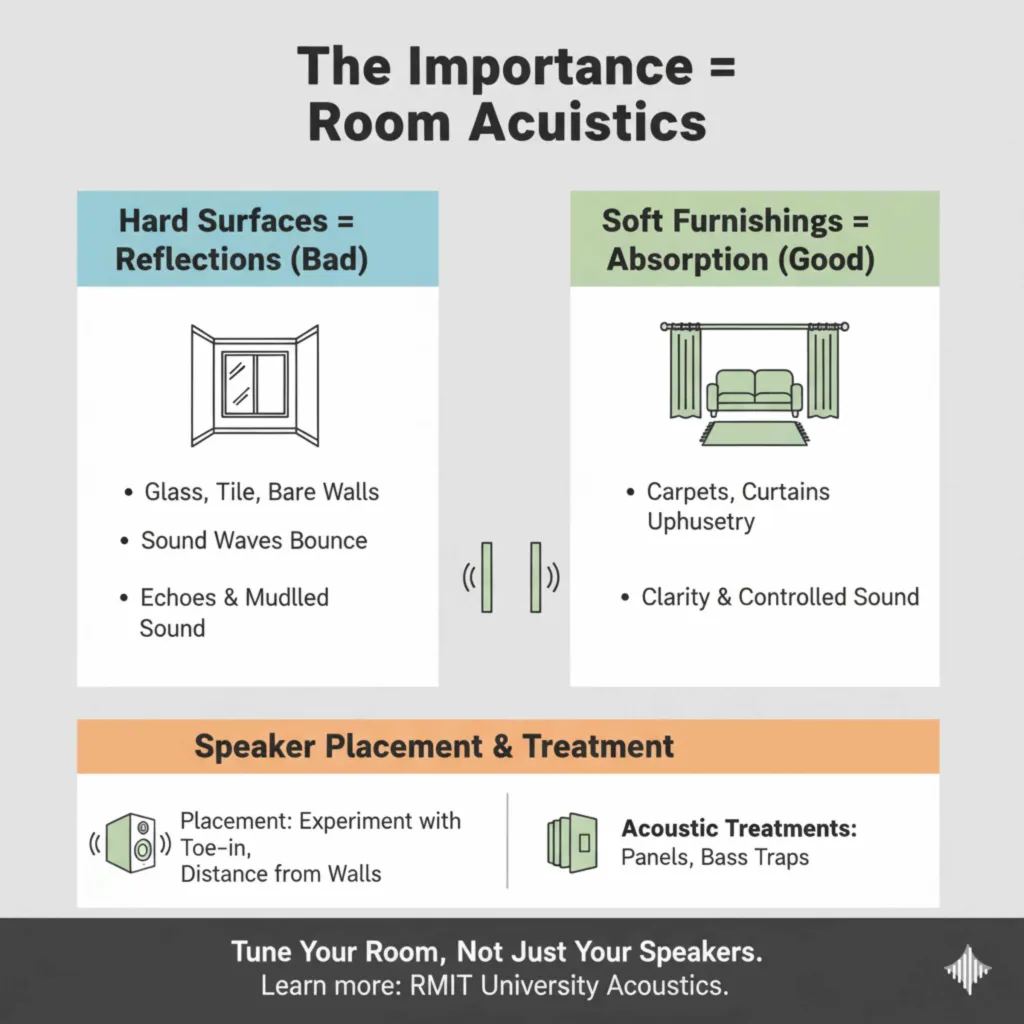
Regardless of your choice, your room’s acoustics play a massive role in how your speakers sound. Hard surfaces like glass, tile, and bare walls reflect sound, leading to echoes and an unnatural listening experience. Soft furnishings like carpets, curtains, and upholstered furniture absorb sound, helping to tune the room. For floorstanding speakers, placement is key. Experimenting with pulling them away from walls, angling them towards your listening position (called “toe-in”), and using acoustic treatments can make a huge difference. This applies to subwoofers too, as bass waves can easily interact with room boundaries, creating peaks and dips in sound.
You can learn more about basic room acoustics and treatments from resources like RMIT University’s Acoustics Department, which offers foundational knowledge on how sound behaves in spaces.
Frequently Asked Questions (FAQ)
Q1: Can bookshelf speakers sound as good as floorstanding speakers?
Yes, with a good subwoofer, a bookshelf speaker system can absolutely rival or even surpass the sound quality of many floorstanding speakers. The subwoofer handles the low end, allowing the bookshelf speakers to focus on clarity in the mids and highs. The key is selecting quality components for both the speakers and the subwoofer and ensuring they are well-matched.
Q2: Do I really need a subwoofer with bookshelf speakers?
For the most satisfying and full-range audio experience, yes, a subwoofer is highly recommended for most bookshelf speakers. While some larger bookshelf models can produce a bit of bass, they typically can’t reproduce the deep, impactful lows that subwoofers are designed for. It’s essential for movies, modern music genres, and a truly immersive sound.
Q3: Will floorstanding speakers make my small room sound bad?
Potentially, yes. Floorstanding speakers are designed to fill larger spaces. In a small room, their powerful bass output can easily overwhelm the space, leading to boomy, indistinct sound. They can also be difficult to place optimally without causing acoustic problems. If you have a small room, bookshelf speakers often provide a much better and more controlled listening experience.
Q4: How much space do floorstanding speakers need around them?
Ideally, floorstanding speakers benefit from being at least 1 to 2 feet away from the rear wall and about 2 to 3 feet away from side walls. This allows the sound to develop properly and prevents the bass frequencies from becoming too boomy due to reflections off nearby surfaces. Experimentation is key, as every room is different.
Q5: Can I use bookshelf speakers for my front left and right in a surround sound system?
Absolutely! Bookshelf speakers are very common and effective as front left and right channels, especially in smaller to medium-sized rooms or when space is a concern. When paired with a subwoofer, they provide a great foundation for a surround sound system. For larger home theaters, floorstanding speakers as front channels might offer more impact.
Q6: What is the main advantage of a bookshelf and sub system over floorstanding speakers?
The main advantage is flexibility and a smaller physical footprint. Bookshelf speakers are easier to place, integrate into decor, and are ideal for smaller rooms. The subwoofer can often be placed more discreetly than a full tower speaker. This combo also allows for more targeted upgrades in the future.
Conclusion
Choosing between bookshelf and floorstanding speakers is a fundamental step in building your ideal home audio system. Bookshelf speakers, when paired with a capable subwoofer, offer an adaptable and powerful solution that fits seamlessly into smaller spaces and diverse décors. They provide excellent clarity and a full sound experience without demanding a large physical presence. On the other hand, floorstanding speakers are the kings of space, delivering a naturally rich, dynamic, and full-range sound that truly fills a room.