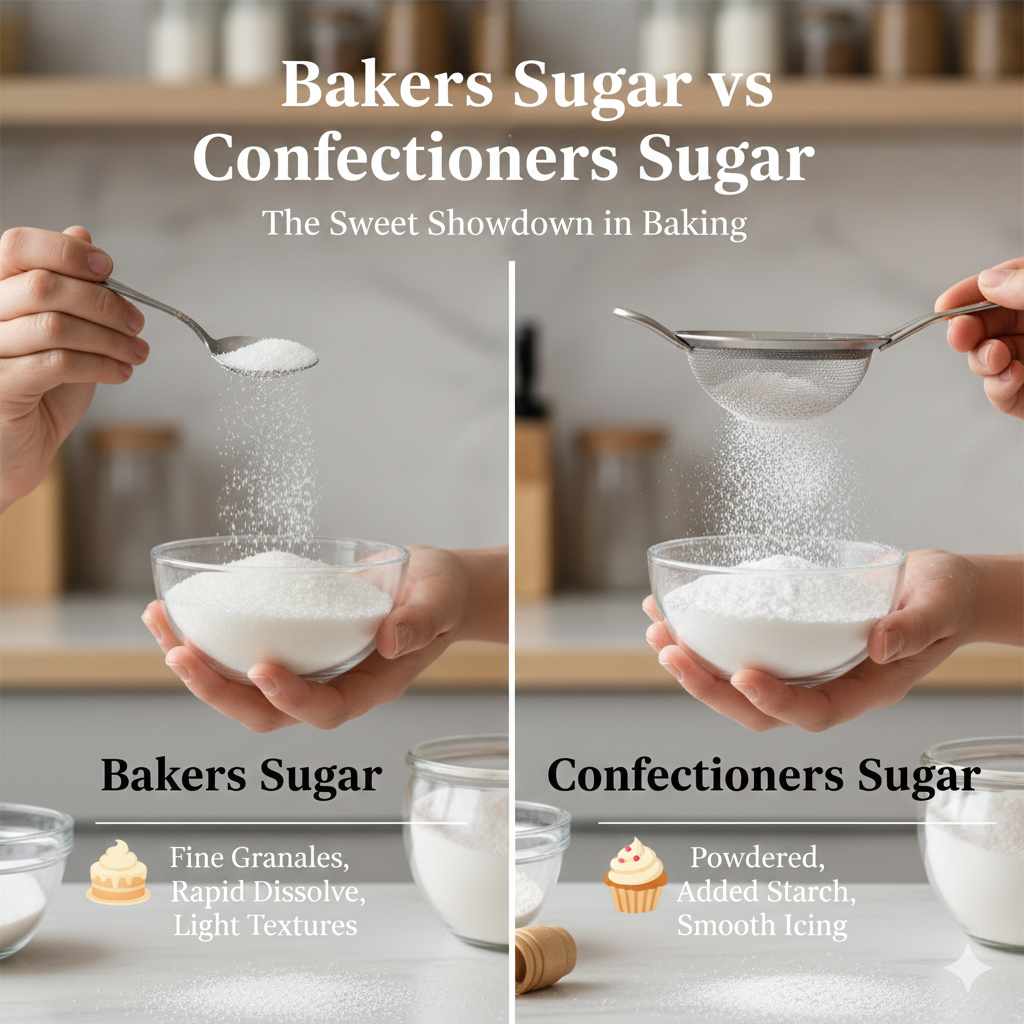
Baker’s sugar (superfine) is a coarser, uniform sugar perfect for tender baking like cakes. Confectioners’ sugar (powdered) is finely ground with cornstarch, ideal for smooth frostings and dusting. Understanding the difference ensures your recipes turn out exactly right every time.
When you’re standing in the baking aisle, staring at two white bags that look exactly the same, it can be confusing. We are talking about two very popular types of sugar: Baker’s sugar and Confectioners’ sugar. Do they mix? Can you swap them out? Honestly, trying to use the wrong one can mess up your favorite cookie recipe! Don’t worry, that’s why I’m here. We are going to break down the crystal size, what they do best, and how to confidently pick the right sugar for your next kitchen project. Let’s clear up this common baking confusion so you can bake with confidence!
What Exactly is Baker’s Sugar? (The Superfine Secret)
Baker’s sugar might sound fancy, but it’s actually one of the simplest sugars to use. It is often called “superfine sugar” or “caster sugar” outside the US. Think of it as regular granulated sugar that got a little haircut—it’s just much finer.
The Science of Crystal Size
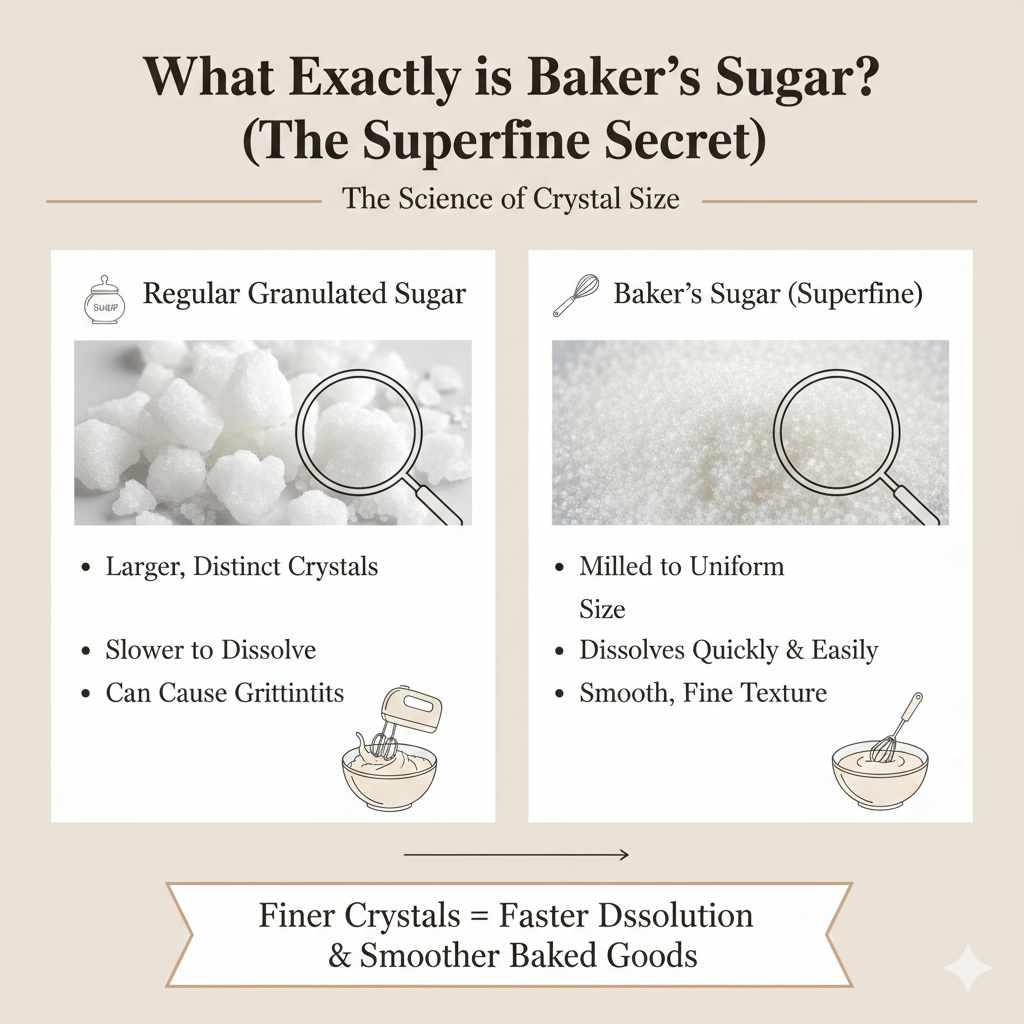
The main difference between standard table sugar and baker’s sugar comes down to how small the crystals are.
Regular granulated sugar has larger, more distinct crystals. When you mix these into delicate batters, those larger crystals can sometimes take longer to dissolve completely. This might lead to an undesirable slight grittiness in your finished product.
Baker’s sugar, however, has been milled down to a much smaller, uniform size. Imagine grains of sand instead of small pebbles. Because the crystals are smaller, they dissolve much faster and more easily into wet ingredients—even when you are mixing by hand and not using a high-powered stand mixer.
Why Baker’s Sugar is a Baking Essential
This fast dissolving action is what makes baker’s sugar so valuable for specific tasks. It’s used when you want a smooth texture where you can’t afford any gritty texture remaining.
Top Uses for Baker’s Sugar:
- Meringues: When whipping egg whites, superfine sugar incorporates quickly, creating extremely stable and light peaks.
- Delicate Cakes and Sponge Layers: It ensures fine crumbs and a tender texture because the sugar fully integrates into the butter and eggs.
- Cocktails and Syrups: It dissolves instantly in cold liquids, making perfect simple syrups or sugar rims for drinks.
- Creaming Butter: It mixes into butter more easily, leading to better aeration (more air whipped in), which helps your baked goods rise better.
If you see a recipe with “caster sugar,” reaching for the bag labeled “Baker’s Sugar” is your best bet for mimicking that intended texture.
Understanding Confectioners’ Sugar (The Powdered Powerhouse)
Confectioners’ sugar is a completely different animal than baker’s sugar, even though they look similar in the bag if you don’t look closely. This sugar is pulverized into an ultra-fine powder—finer than flour!
The Secret Ingredient: Cornstarch
If you look at the ingredient label on a bag of confectioners’ sugar (also known as powdered sugar or icing sugar), you will almost always see something else listed besides sugar. Usually, it’s about two to three percent cornstarch.
Why is that cornstarch there? It serves a crucial purpose: anti-caking. Because the sugar particles are so tiny, they naturally clump together (cake) when exposed to humidity. The cornstarch prevents this, keeping your powdered sugar light, fluffy, and ready to pour.
Where Confectioners’ Sugar Shines
Because it is powdery and contains an additive, confectioners’ sugar is generally not a good substitute for granulated or baker’s sugar in cake batter or doughs. When it dissolves, that cornstarch remains, which can make your baked goods dense, gummy, or cloudy.
Perfect Applications for Confectioners’ Sugar:
- Frostings and Icings: This is its true calling. The fine powder dissolves quickly into fats and liquids (like butter and milk), resulting in silky-smooth buttercream, cream cheese frosting, or royal icing without any graininess.
- Dusting and Finishing: It provides a beautiful, delicate finish when sifted over finished pastries, donuts, tarts, or coffee drinks.
- Glazes: When mixed with just a little liquid (like lemon juice or water), it forms thin, smooth glazes that set quickly.
- Dusting Molds: Sometimes used to lightly coat fruit, or to dust baking surfaces when you need a very thin, non-gritty layer of sugar protection.
Baking Showdown: Baker’s Sugar vs Confectioners Sugar
To really understand when to use which, it helps to see their measurable differences side-by-side. Think of this as checking your dipstick before heading out on a long drive—you need to know what you are working with!
The differences are mainly structural: crystal size and additives. This structural difference dictates their function in the kitchen.
Comparison Table: Key Differences
| Feature | Baker’s Sugar (Superfine) | Confectioners’ Sugar (Powdered) |
|---|---|---|
| Crystal Size | Fine, uniform (larger than powdered, smaller than granulated) | Extremely fine powder |
| Additives | None (Pure sucrose) | Usually contains 2-3% cornstarch |
| Primary Use | Incorporating into batters for tenderness and stability (e.g., cakes, meringues) | Topping, dusting, and creating smooth icings/frostings |
| Dissolvability | Dissolves quickly in wet ingredients | Dissolves almost instantly into liquids/fats |
When you are working on something delicate, like adjusting the suspension in your tire pressure monitoring system—wait, wrong analogy! Think of it like oil viscosity in your engine: the shape and size absolutely change how it flows and interacts with other parts. Use the right one for the job!
Can I Substitute Baker’s Sugar for Confectioners’ Sugar? (And Vice Versa)
This is the question that trips up most beginner bakers. The answer is almost always no, especially when dealing with frostings or dusting.
Substituting Baker’s Sugar for Confectioners’ Sugar
If a recipe calls for confectioners’ sugar (for frosting, for example), and you only have baker’s sugar, you have a project ahead of you.
You need to grind the baker’s sugar down to a powder size, and you must add an anti-caking agent like cornstarch.
How to Make Homemade Powdered Sugar (If You Must):
- Measure: Take 1 cup of Baker’s Sugar.
- Add Starch: Add 1 tablespoon of cornstarch (this mimics the standard commercial proportion).
- Blend: Place both into a high-powered blender or a clean coffee grinder that you only use for spices/baking.
- Pulse Gently: Pulse the mixture in short bursts. Do not run the blender continuously, as the friction can cause the sugar to melt or clump. Stop frequently to scrape the sides.
- Sift: Sift the resulting powder thoroughly to remove any lingering larger grains.
Safety Note: If you are dealing with home car maintenance, remember you wouldn’t use regular sand instead of fine valve grinding compound. The textures have to match the job requirements!
Substituting Confectioners’ Sugar for Baker’s Sugar
If a recipe calls for baker’s sugar (for a tender cake batter) and you only have confectioners’ sugar, you might be able to get away with it in some recipes, but it’s risky.
When you put powdered sugar into a cake batter, you are adding the cornstarch directly into the structure of the cake. This can lead to a texture that is heavier or slightly gummy. Furthermore, the fine powder absorbs moisture differently than the uniform crystals of baker’s sugar.
If you need to substitute, use 1 cup of confectioners’ sugar, but remove 1 tablespoon of the flour required by the recipe to compensate for the cornstarch already present in the powdered sugar. This adjustment won’t give you the exact texture, but it minimizes the density issue.
The Science Behind Sugar Subtleties in Baking Structure
To build confidence in your kitchen, it helps to know why these small textural differences matter so much. It revolves around air incorporation and moisture retention.
Aeration and Creaming
When a recipe asks you to “cream” butter and sugar together (a common first step in cookies and cakes), the sharp edges of sugar crystals cut into the butter, creating thousands of tiny air bubbles. These bubbles expand in the oven, giving your baked goods lift.
Baker’s sugar excels here. Its uniform, sharp-enough-but-small-enough crystals incorporate air extremely efficiently without overworking the gluten in the flour.
Confectioners’ sugar, being too fine, often just smears into the butter without cutting in effectively to create stable air pockets. You spend more time mixing and get less lift. This is why recipes designed for powdered sugar (like fudge or creamy frostings) don’t require powerful creaming—they rely on different mechanisms to blend.
Moisture and Final Texture
Sugar is a hydroscopic ingredient, meaning it attracts and holds onto water.
| Sugar Type | Moisture Impact |
|---|---|
| Baker’s Sugar | Dissolves fully, maximizing tenderness and creating a fine, moist crumb structure without added starch. |
| Confectioners’ Sugar | The cornstarch content interferes with moisture distribution in baked goods, often leading to a denser body if used in batter. |
For recipes where you want a structure that holds up—like the interior of a sponge cake—you want that sugar to dissolve completely, which baker’s sugar does best. If you were troubleshooting your vehicle’s braking system, you wouldn’t want your brake fluid to have extra fillers; the same principle applies to your delicate batters!
Practical Tips for Buying and Storing Sugars
Knowing the difference is the first step; making sure they are ready to use when you need them is the second. Proper selection and storage help you avoid the very problems these sugars are designed to solve.
When to Buy Which Bag
If you are restocking your pantry, think about what you bake most often.
- Buy Baker’s Sugar if: You frequently make cheesecakes, classic sponge cakes, light cookies, or often use recipes that call for dissolving sugar quickly into liquids (like macerating fruit or making fresh lemonade).
- Buy Confectioners’ Sugar if: You make homemade frostings, glazes, donuts, or need dry topping powders regularly.
- For General Use: Most home bakers find they use standard granulated sugar most often. Baker’s sugar is a specialty item, but a highly useful one for improving finicky recipes.
Storage for Longevity and Quality
Sugar storage is simple, but humidity is the enemy of powdered sugar!
- Airtight Containers are Key: Never store opened sugar bags directly on a shelf. Transfer both baker’s sugar and confectioners’ sugar to sturdy, airtight containers immediately after opening. Glass jars with sealing lids are excellent choices.
- Keep Powdered Sugar Dry: Because of the cornstarch, confectioners’ sugar clumps faster. Ensure your container seals tightly to keep humidity out. If it does clump, you can often revive it by pulsing it briefly in a food processor or sifter.
- Cool, Dark Place: Store all sugars away from the stove, dishwasher, or window. Heat and moisture cause degradation and clumping. A pantry shelf works perfectly.
- Check Dates: While sugar doesn’t truly expire, if it smells off or looks discolored after years in storage, it’s time to toss it. For instance, the U.S. Department of Agriculture (USDA) confirms that pure sugar preserves food indefinitely when stored correctly, but additives in powdered sugar can sometimes degrade over long periods.
Expert Insights: When Texture Matters Most
Think about the precision required when rebuilding a differential or balancing tires. Small variances matter immensely. In baking, texture is just as critical.
The Meringue Test Case
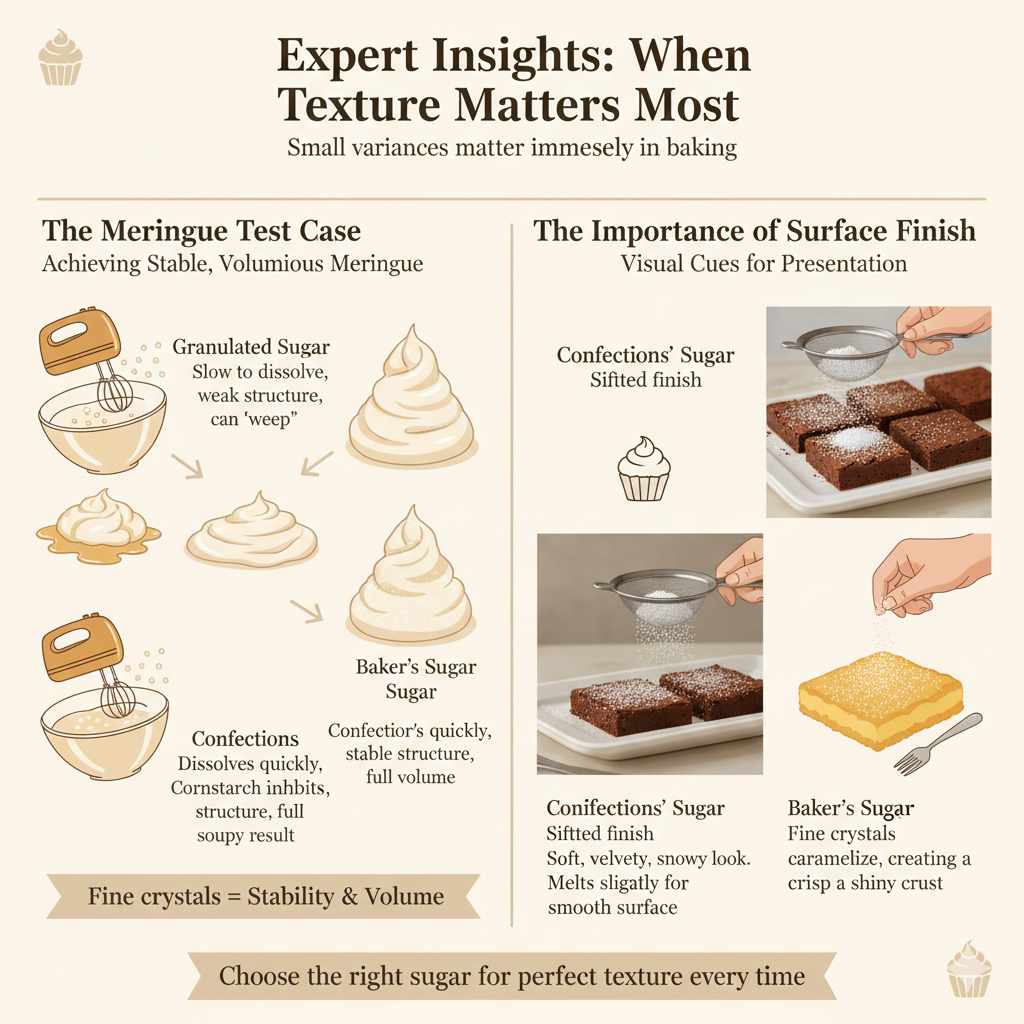
Meringue is perhaps the best demonstration of why baker’s sugar is superior to both granulated and confectioners’ sugar when stability is required.
When making Swiss or Italian meringue, you are dissolving sugar into heated egg whites. If you use standard granulated sugar, the crystals take too long to dissolve, leading to a weak structure that can weep (leak liquid syrup) later. If you use confectioners’ sugar, the cornstarch will inhibit the meringue from reaching its full volume or stability, leading to a disappointing, soupy result.
Baker’s sugar dissolves quickly, providing the necessary sweetness and structure stabilization without introducing disruptive elements like excess cornstarch or leaving undissolved crystals.
The Importance of Surface Finish
When decorating cookies or finishing treats for presentation, the visual cue matters.
- Confectioners’ Sugar: Sifted over brownies or French toast, it creates a soft, velvety, snowy look. It melts slightly upon contact with warm surfaces, smoothing out.
- Baker’s Sugar: If you use baker’s sugar to sprinkle on top of something before baking (like on a lemon bar), the fine crystals caramelize slightly faster and more evenly than standard sugar, providing a slightly crisp, shiny crust. It doesn’t provide the dusty finish; it provides a light crust effect.
Frequently Asked Questions (FAQs) for Beginner Bakers
Q1: Can I just use regular white granulated sugar instead of baker’s sugar?
A: Sometimes, yes, but only if you are not worried about a totally smooth texture. Use 1 cup of granulated sugar for every 1 cup of baker’s sugar called for. If the recipe relies heavily on creaming or delicate folding (like angel food cake), the texture might be slightly gritty or less light.
Q2: Is confectioners’ sugar the same as icing sugar?
A: Yes, they are generally the same product. Confectioners’ sugar is the common American term, while icing sugar is often used in the UK and other regions. Both refer to finely ground pure sucrose mixed with a small amount of cornstarch.
Q3: Does the cornstarch in confectioners’ sugar really make a difference in cakes?
A: Yes, it absolutely does. The cornstarch doesn’t disappear during baking. When you replace granulated or baker’s sugar with confectioners’ sugar in a cake recipe, you’re introducing extra starch into the batter. This interferes with proper gluten development and moisture distribution, often resulting in a cake that is denser, slightly gummy, or lacking lift. While a small amount might not completely ruin a recipe, the texture will almost never be as light or tender as intended.
Q4: Can I make baker’s sugar at home if I can’t find it in stores?
A: Yes! Baker’s sugar is easy to make at home. Simply place regular granulated sugar into a blender or food processor and pulse it for 10–15 seconds. The goal is a finer crystal—not powder. Let the sugar settle before opening the lid to avoid a sugar dust cloud. This homemade version works very well for cakes, meringues, and quick-dissolving needs, though it won’t be quite as uniform as store-bought superfine sugar.
Conclusion: Choosing the Right Sugar Makes All the Difference
At first glance, baker’s sugar and confectioners’ sugar may look nearly identical, but as you’ve seen, their differences matter far more than most bakers realize. From crystal size to added ingredients, each sugar plays a specific role that directly affects texture, structure, and overall success in your baked goods.
Baker’s sugar shines when smooth integration, proper aeration, and delicate crumb are essential. Its superfine crystals dissolve quickly and evenly, making it the ideal choice for cakes, meringues, and recipes where precision truly counts. Confectioners’ sugar, on the other hand, is unmatched for frostings, glazes, and finishing touches, delivering silky smooth results and a beautiful presentation—thanks to its ultra-fine texture and cornstarch content.
Understanding when (and when not) to substitute these sugars helps you avoid common baking mistakes like dense cakes, gummy textures, or grainy frostings. Instead of guessing in the baking aisle or hoping for the best mid-recipe, you can now choose confidently, knowing exactly how each sugar will behave.
In baking, small details make a big difference. Just like temperature, mixing method, or ingredient ratios, sugar selection is a quiet but powerful tool. Master it, and your cakes will be lighter, your frostings smoother, and your results consistently better—every single time.