

Kitchen Table Poly is a relationship style where partners in a polyamorous setup have open, honest, and friendly interactions, often including meeting or spending time together, without necessarily having romantic involvement with each other. It focuses on cooperative co-parenting or maintaining household harmony.
Do you feel like navigating modern relationships can sometimes feel like reading a confusing car manual? You are not alone! When it comes to polyamory, terms like “Kitchen Table Poly” pop up, leaving many new explorers scratching their heads. This concept sounds complicated, but it is really just a way people choose to structure their non-monogamous life—it’s all about comfort and clear boundaries. We will break down exactly what Kitchen Table Poly means using simple terms. You will walk away feeling confident, knowing if this style might fit your life. Let’s pop the hood on this relationship model!
What Is Kitchen Table Poly? Unpacking the Term
If you are new to exploring polyamory—the practice of having multiple loving, consensual relationships—you will quickly find there are many ways to organize things. “Kitchen Table Poly” (often shortened to KTP) is one of the most common ways people define their structure.
The Simple Definition
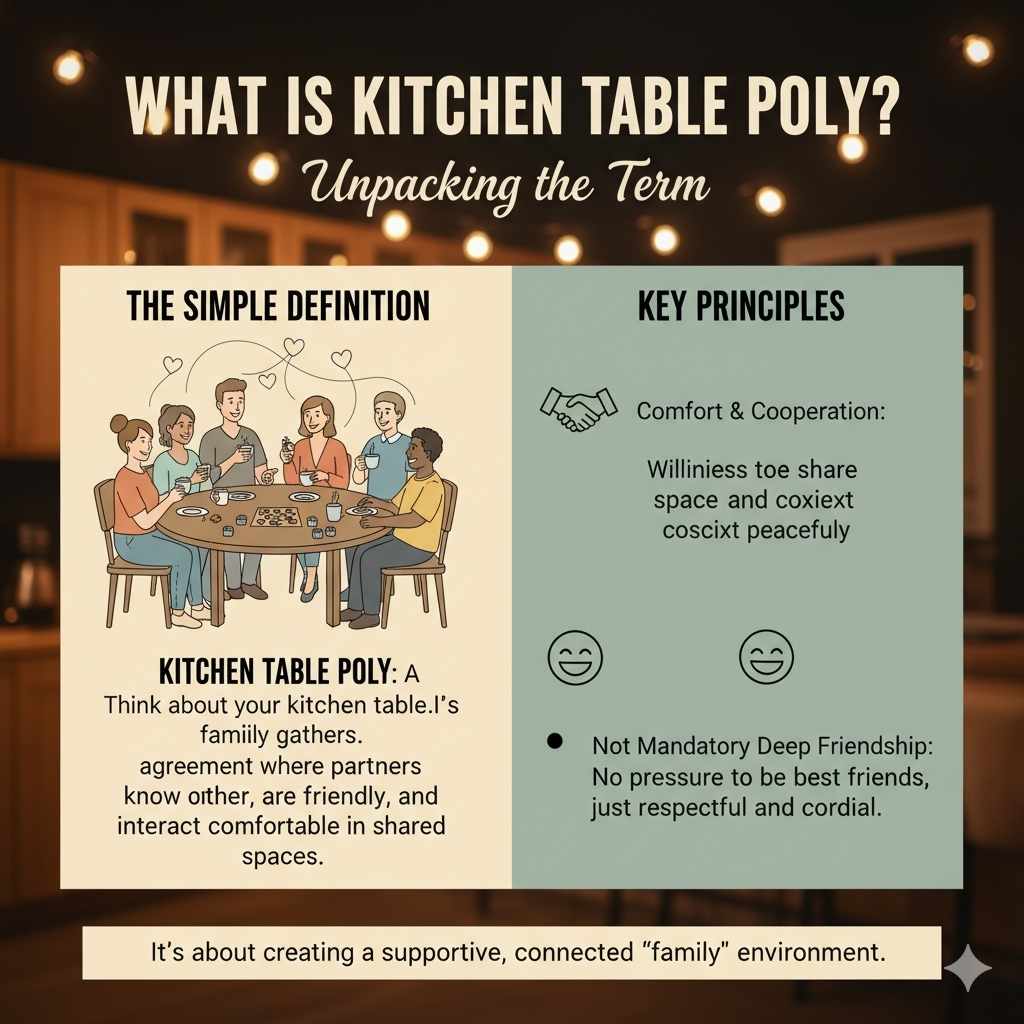
Think about your kitchen table. It is often the central hub of the home, where family gathers for meals, talks happen, and life gets planned. Kitchen Table Poly describes a relationship agreement where the various partners of an individual (and sometimes the partners of those partners) know each other, are friendly, and are willing to interact comfortably in shared spaces—like sitting around that imaginary kitchen table.
The key here is comfort and cooperation, not mandatory deep friendship.
Kitchen Table Poly vs. Parallel Poly
To really understand KTP, it helps to see what it is not. The opposite concept is often called “Parallel Poly.”
| Feature | Kitchen Table Poly (KTP) | Parallel Poly |
|---|---|---|
| Interaction Level | High interaction; partners know and spend time together. | Low or no interaction; partners know of each other but stay separate. |
| Involvement | Often involves shared scheduling, communication, and community events. | Partners focus only on their direct relationship lines. |
| Goal | Harmony, shared support structure, often blended family approach. | Respecting boundaries by keeping relationships independent. |
In KTP, if Alex dates Sam, and Sam also dates Jamie, Alex, Sam, and Jamie are comfortable enough to share a pot of coffee together occasionally. In Parallel Poly, Alex and Jamie would likely never meet, or if they did, it would be brief and purely logistical.
Why Do People Choose Kitchen Table Poly? The Core Benefits
Choosing a relationship structure is personal. People choose KTP because it helps manage complexity, especially when children or shared homes are involved. It takes the “secret” or “shadowy” aspects out of relationships, replacing them with transparency.
1. Enhanced Support Networks
When you have multiple partners, having them know and trust each other creates a much stronger safety net. If one partner is sick, another partner might step in to help coordinate things or support the primary partner. This feels similar to having a larger family unit.
2. Easier Logistics and Parenting
For those co-parenting or living together (often called “nesting partners”), KTP is almost essential. If you have three adults living in the house, they need to be able to communicate clearly about household chores, finances, and schedules. They are literally gathering around the “kitchen table” to make decisions.
3. Reduced Jealousy Through Familiarity
Sometimes, the unknown breeds anxiety. When you know your partner’s other partner—you see they are kind, respectful, and treat your partner well—it can reduce the fear that they are taking something away from you. Familiarity often breeds comfort, not conflict.
4. Boundary Clarity
KTP demands excellent communication upfront. You have to discuss what meeting looks like, how often it happens, and what topics are off-limits. This forces everyone to define their comfort zones clearly, which is a healthy practice in any relationship.
The Essential Secrets: Making Kitchen Table Poly Work Safely
Just because you decide on a KTP structure does not mean it will automatically be smooth sailing. Like maintaining a car, you need the right setup and regular check-ups. Here are the non-negotiable secrets to success in KTP.
Secret 1: Never Force the Friendship
This is the most crucial point. KTP means partners should be capable of existing together peacefully. It does not mean they have to become best friends, go shopping together, or share deep secrets.
Think of it like this: You might not love your spouse’s coworker, but you respect them, and you don’t start fights when they are in the breakroom. KTP requires that level of functional respect.
If someone is uncomfortable meeting the metamour (your partner’s partner), forcing a coffee date will likely cause resentment. The structure must serve the comfort of the individuals, not the other way around.
Secret 2: Prioritize Vetting and Respecting Boundaries
Before introducing partners, you must ensure everyone involved is safe and respected within their own relationships.
- Vet Your Partners: Ensure your current partners are treating their other partners (your metamours) ethically and honestly. Transparency is key.
- Establish “Off-Limits” Topics: Are you comfortable hearing about your partner’s date night? Maybe, but maybe not the intimate details. Agree on what shared information is okay.
- Define Physical Space: Does “kitchen table” mean they sit together on the couch? Or does it mean they are in the same house, but in separate rooms? Be specific. For instance, in some KTP households, metamours might attend a family movie night but will not engage in cuddling on the couch while others are present.
Secret 3: The Primary Partner is Not the ‘Gatekeeper’
In a structure with more than two people, one person often feels like they are responsible for managing everyone else’s feelings. This is exhausting and unsustainable.
If you are Partner A, and you date B and C, you cannot expect B to manage C’s feelings about meeting you. Each individual is responsible for managing their own emotional reactions and communicating their needs directly to the person they are dating.
It is healthy to check in: “Hey, how did you feel after meeting my other partner?” But it is unhealthy to take on the burden of ensuring they loved the meeting.
Secret 4: Continuous, Low-Stress Meetings
For KTP to function, meetings need to be low-pressure and incremental. Do not start with an eight-hour holiday gathering. Start small, maybe a quick 30-minute hello while handing off a shared item.
| Stage | Activity Suggestion | Goal |
|---|---|---|
| Stage 1: Awareness | Partners know of each other via text or quick phone call introductions. | Establish basic acknowledgement. |
| Stage 2: Brief Encounter | A short, scheduled meeting (e.g., 15 minutes) in a neutral or shared space. | Confirming presence and basic safety/respect. |
| Stage 3: Shared Activity | A low-stakes group activity, like ordering pizza or running a shared errand together. | Building simple, shared positive memory blocks. |
Navigating Conflicts in a KTP Structure
When conflict arises—and it always does, in every relationship style—KTP requires an extra layer of careful communication because more people are involved.
The “Don’t Drag the Table In” Rule
When Partner A and Partner B have a disagreement, they should try hard not to pull Partner C into the middle of it unless Partner C is directly necessary for the resolution (e.g., it involves shared custody of a pet).
If Partner A is upset with Partner B, Partner A should not go complain about Partner B to Partner C, especially if Partner C is also dating Partner B. This creates unnecessary triangulation and forces Partner C into an uncomfortable role.
Handling Incompatibility
Sometimes, metamours simply do not click. Maybe your partner’s other partner has very loud tastes in music, or perhaps their political views clash sharply with yours.
If you cannot become friends, you must revert to the “functional respect” model (Secret 1). If your continued co-existence around the shared table becomes toxic, you need to revisit your boundaries:
- Can you simply agree to only meet for necessary transitions (like swapping kids or keys)?
- Does one partner need to spend less time at the shared home?
- Do you need to explore a Parallel structure for a time, even if you started with KTP?
Remember, ethical non-monogamy values autonomy. If the KTP structure is actively harming your mental health, it is okay to change the rules.
Tools for Communication: Essential for KTP Success
Clear communication is the engine of any healthy relationship, but in KTP, it acts as the roadmap for multiple journeys intersecting. You need systems in place that keep information flowing without causing overload.
Shared Calendars and Coordination
If you share a home or children, a shared digital calendar (like Google Calendar) is non-negotiable. This isn’t just about romantic dates; it’s about logistics.
According to relationship experts who study diverse family structures, explicit scheduling reduces ambiguity. Ambiguity breeds insecurity.
You should be able to look at the calendar and see:
- When Partner A is having a dedicated date night with Partner B.
- When all nesting partners are scheduled to be home for household meetings.
- When Partner C is visiting and needs quiet time in their guest room.
Regular Relationship Check-Ins (RCIs)
These are scheduled times to talk about the relationship structure itself, not specific relationship dramas. Think of it like preventative maintenance on your vehicle. You check the oil level before the engine seizes!
A good RCI in a KTP setting should include all relevant parties, perhaps rotating who hosts the meeting. Key questions to ask include:
- How is our current level of interaction feeling? Too much, too little, or just right?
- Are any of my boundaries being accidentally crossed by someone else?
- Is there anything I can do better to support your relationship with your other partner? (This shows respect for the whole network.)
KTP and Legal/Financial Realities
While relationship structures are personal, they often intersect with the real world of leases, bank accounts, and legal documents. KTP often thrives when there is a high degree of interdependency, which brings up financial considerations.
Understanding Co-Habitation
Many KTP arrangements involve at least two people living together as “nesting partners.” If you are considering this, it is wise to look into resources about shared living agreements, even if you are not married. This protects everyone involved if the living situation changes.
For instance, the National Coalition for Family Living promotes understanding diverse family structures and encourages clear legal planning, even outside traditional marriage frameworks. Understanding basic tenant rights or shared property laws is essential to protecting everyone’s stake in the shared home.
Financial Transparency
If you are sharing expenses (like utilities or groceries), KTP requires radical transparency. Unlike Parallel Poly, where partners might keep finances entirely separate, KTP often involves communal spending.
Use clear methods to track shared costs. Are you splitting utilities 50/50 even if three people live there? Or are you splitting based on usage or income? Whatever you decide, document it. This prevents resentment from building around perceived unfairness.
Dispelling Kitchen Table Poly Myths
Misinformation spreads fast, especially about relationship styles that deviate from the norm. Let’s clear up a few common misunderstandings about KTP.
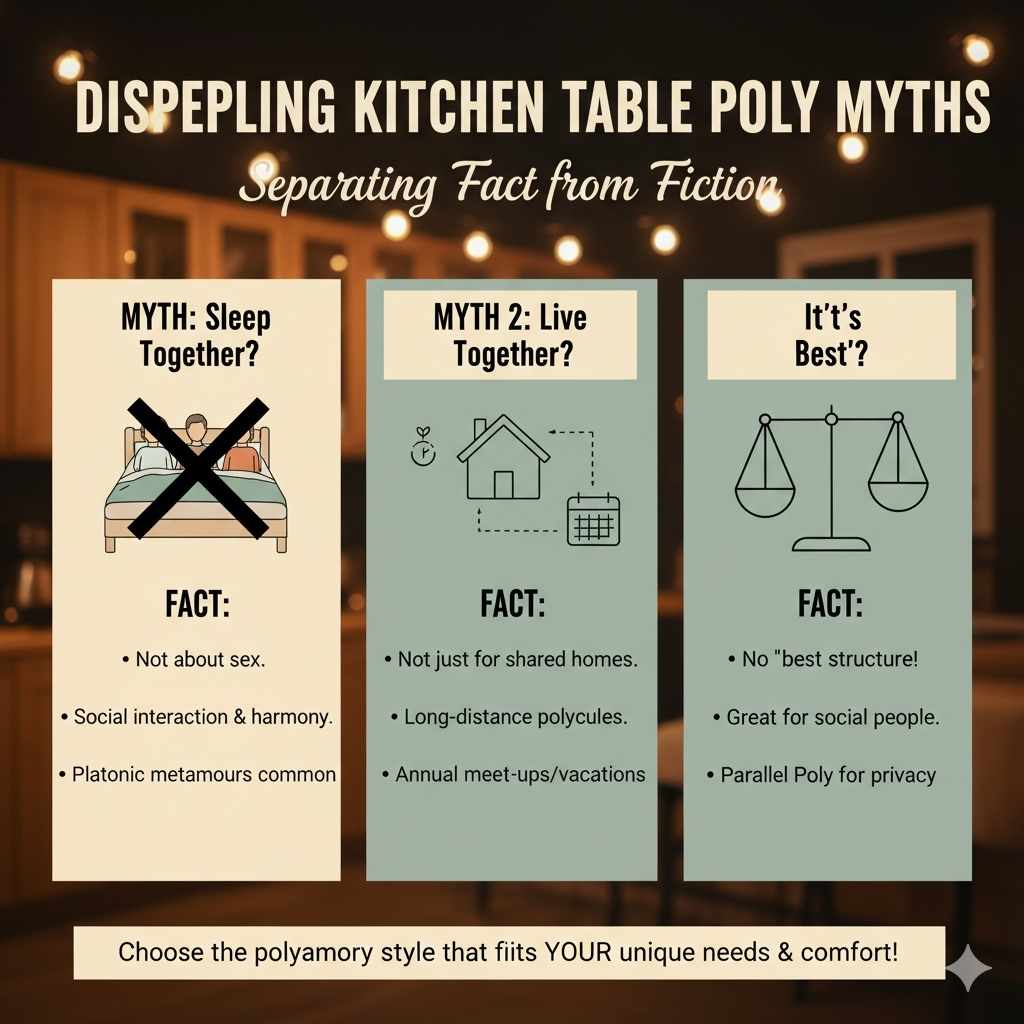
Myth 1: KTP Means Everyone Must Sleep Together
Fact: Absolutely false. KTP relates to social interaction and logistical harmony, not sexual activity between metamours. Many KTP networks include partners who are strictly platonic toward one another.
Myth 2: KTP is Only for People in One Household
Fact: While KTP is common in shared homes, it can also apply to long-distance polycules where partners meet up annually for a group vacation or a commitment ceremony. The core requirement is the willingness to interact comfortably, not necessarily daily co-habitation.
Myth 3: KTP is the “Best” Form of Polyamory
Fact: There is no best form! KTP works incredibly well for some personalities (those who enjoy large social circles and high organization) but might feel suffocating to others who prefer distance. If you value privacy, Parallel Poly might be a better fit.
FAQ Section: Getting Your KTP Questions Answered
Q1: Do I have to like my metamour if we are practicing Kitchen Table Poly?
A: No, you only need to achieve a level of functional respect. You must be able to coexist peacefully and communicate politely when necessary. Friendship is a bonus, not a requirement for KTP.
Q2: What if my partner’s other partner seems jealous of our time together?
A: That jealousy is a signal that needs to be addressed between your partner and their other partner first. In KTP, the primary commitment is that everyone feels secure in their own primary bond. Your partner needs to reassure their other partner without sacrificing your established connection.
Q3: Is KTP the same as being married to everyone?
A: No. KTP is a structural arrangement for interaction. Marriage involves specific legal and cultural commitments. KTP is simply a chosen framework for how non-monogamous partners interact socially.
Q4: If we meet for holidays, should we exchange gifts?
A: This is entirely up to the group’s boundaries! Some KTP networks exchange small, token gifts for fun, while others agree that only direct partners exchange gifts to maintain clear boundaries. Discuss this during your initial boundary setting.
Q5: What happens if I move away, but my partner wants to keep the KTP arrangement?
A: The structure can adapt. You might shift from daily KTP interaction to planned quarterly meetups that maintain the familiarity and cooperative spirit, even if you are no longer sharing the same physical kitchen table.
Q6: If I am dating someone who practices KTP, how do I know if I am welcome at the “table”?
A: Ask directly! Use clear language: “What level of interaction do you foresee between me and your other partner(s)?” A good KTP partner will have a clear answer about whether they envision you meeting, and what that meeting would entail.
Conclusion: Building Your Own Comfortable Table
Understanding what Kitchen Table Poly is—a structure built on transparent, cooperative, and comfortable relationships among all involved parties—removes much of the initial mystery. It is not about forcing closeness; it is about building a broad, supportive infrastructure where everyone knows the rules of engagement.
Whether you adopt KTP, Parallel Poly, or invent a structure entirely unique to your partners, the true “secret” remains the same as it is for maintaining any vehicle: consistent, honest maintenance. Use clear communication, respect individual boundaries fiercely, and never mistake friendly co-existence for mandatory deep friendship. By taking these steps, you gain the confidence to navigate complex relationship dynamics safely and ensure that your personal arrangement is reliable, supportive, and built on a solid foundation. You have the tools now; go build a wonderful setup!