
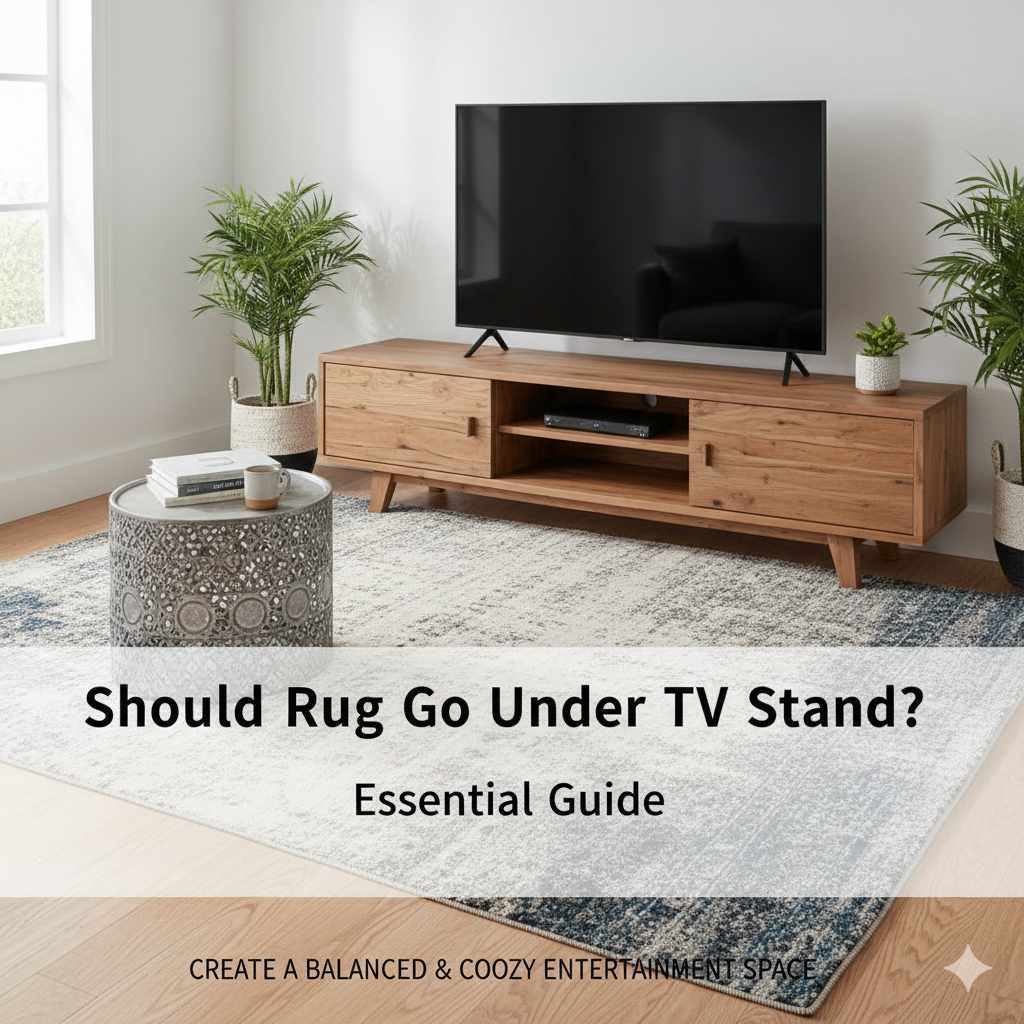
Yes, generally the rug should go under the TV stand for a cohesive, anchored look that defines the viewing space. Proper placement ensures the stand sits firmly on the rug, improving room flow and protecting your floor. We’ll show you the simple rules for perfect rug sizing and placement.
Hey there! Dustin Hall here. If you’re setting up a new living room or just trying to make your current one look more put-together, figuring out where the rug goes is a common hurdle. It feels like a big decision! Should the rug hug the furniture, or sit just in front of it? Especially with your TV stand—that heavy, central piece—it can cause some confusion.
You want your room to look intentional, not like the furniture just randomly landed there. A correctly placed rug acts like an anchor, tying your whole entertainment area together. Don’t worry; getting this right is easier than changing your oil! We are going to walk through the simple design rules that make this decision clear. Stick with me, and by the end, you’ll know exactly how to position that rug with confidence.
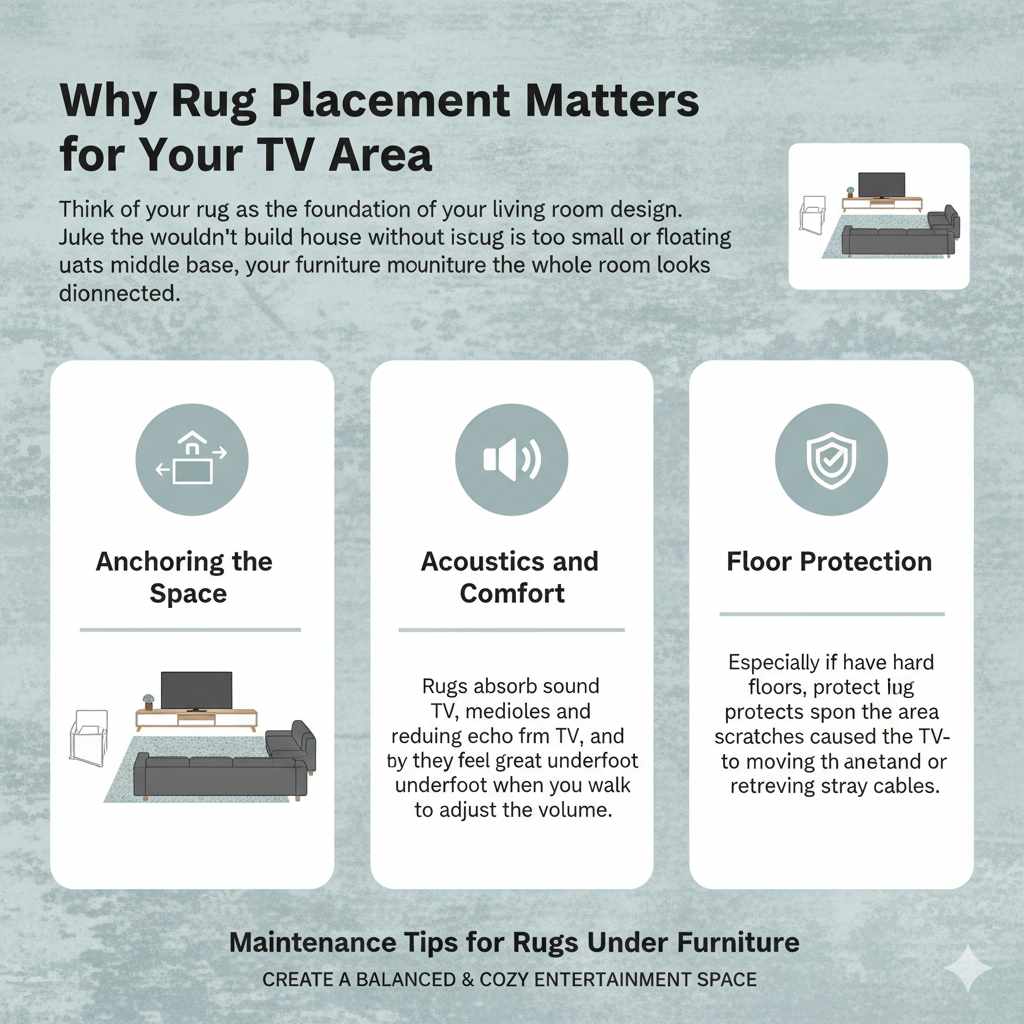
Why Rug Placement Matters for Your TV Area
Think of your rug as the foundation of your living room design. Just like you wouldn’t build a house without a solid base, your furniture needs grounding. If the rug is too small or floating in the middle, the whole room looks disconnected.
When dealing with a TV stand, the rug plays a few key roles:
- Anchoring the Space: It visually groups the TV, media consoles, and any adjacent seating, defining the “entertainment zone.”
- Acoustics and Comfort: Rugs absorb sound, reducing echo from the TV, and they feel great underfoot when you walk over to adjust the volume.
- Floor Protection: Especially if you have hard floors, the rug protects the area from scratches caused by moving the TV stand or retrieving stray cables.
The Golden Rule: Should the Rug Go Under the TV Stand?
This is the big question. In most standard living room setups, the answer is a resounding yes.
Placing the rug under the TV stand achieves a sense of visual weight and stability. It signals that the stand is a permanent, important fixture in that spot.
However, “under” doesn’t mean the rug needs to be the size of a basketball court! We are talking about strategic overlap. Here’s the breakdown of the two main scenarios:
Scenario 1: The Rug Extends Under the Stand (The Recommended Approach)
For almost all standard setups, the front legs (or the entire base) of your TV stand, along with the primary seating area (like the front two legs of the sofa), should rest on top of the rug.
Why this works so well:
- It creates a unified “zone.”
- It prevents the rug from slipping or looking like an island in the middle of the floor.
- It provides a continuous surface under the heaviest furniture piece.
If you have a very long console or a wide sectional, you might only need the front two-thirds of the stand resting on the rug, but ensuring the front legs are on it is key for stability.
Scenario 2: The Rug Sits Just In Front of the Stand (When to Consider It)
There are rare exceptions where the rug might sit just in front of the TV stand, touching the base but not going underneath. This usually only happens in very specific situations:
- Extremely Large Rugs: If you are using a massive rug meant to cover most of the floor, placing the stand completely on it might look awkward if the rug placement is dictated by the seating arrangement farther away.
- Wall-Mounted TVs: If your TV is mounted directly to the wall with no stand underneath (just a very small floating shelf), you may position the rug to align with the seating area, leaving a few inches of bare floor between the rug edge and the wall/shelf.
Pro Tip from Dustin: When in doubt, aim to have at least the front two feet of your main seating furniture and the front edge of your TV stand resting on the rug. This simple overlap instantly upgrades the look.
Getting the Size Right: The Most Common Mistake
The biggest reason rugs fail to look right is simple: they are too small. This creates the dreaded “floating rug” syndrome. When it comes to TV stands and seating, size dictates success.
How to Measure for Your TV Area Rug
Think about the entire viewing area as one unit. You need a rug large enough to encompass the stand and the seating arrangement that faces it.
Here is a simple measuring guide:
- Measure the TV Stand Width: Note the total width of your stand or media console.
- Measure the Seating Depth: Measure how far your sofa or primary chairs extend into the room from the wall.
- Add Overlap: You want the rug to extend at least 6 to 12 inches past the front of your TV stand.
- Define Seating Placement: Crucially, ensure the rug extends at least 6 to 8 inches under the front legs of your sofa/chairs.
If your rug is only covering the space directly under the TV stand, it’s too small for the room. For a typical family room with a standard sofa, an 8×10 foot rug is often the minimum starting point, even if the stand itself is smaller.
Rug Placement Options Based on Your TV Setup
The exact placement slightly shifts depending on whether your TV stand is against a wall or if you are using a larger, open-concept space.
1. Standard Wall-Mounted Setup
This is the easiest scenario. The TV stand is flush against the main viewing wall.
Goal: Anchor the stand and the immediate area in front of it.
Placement: The rug should sit centered relative to the TV screen. The back edge of the rug should run parallel to the wall, ideally tucked a few inches under the base of the stand. The front edge should extend well into the room, ensuring the front legs of any surrounding chairs or coffee table are on the rug.
2. Open Concept or Floating Setup
If your TV area is defined by a large sectional or seating that creates a boundary in the middle of a room (not against a wall), the rug placement is even more critical for zone definition.
Goal: Create a distinct “TV watching pit.”
Placement: The rug must be large enough to accommodate the TV stand and the front half of the L-shape created by the sectional. The TV stand must be fully seated on the rug. Use the rug to visually separate the media zone from, say, a walkway or dining area behind it.
3. Dealing with Awkwardly Sized Stands
Sometimes you have a very narrow, tall stand or a very wide, short one.
Very Narrow Stand: If the stand is much narrower than your sofa, place the rug so that it is centered under the TV screen, and allow the stand to sit slightly off-center on the rug. This ensures the main seating area is centered on the rug, which looks better than centering a narrow rug under a wide sofa.
Very Wide Stand: If the stand is exceptionally wide, ensure the rug extends past the stand on both sides by at least 6 inches. If the rug cannot cover the entire width, center the stand as best as possible, but prioritize having the front legs of the adjacent seating land firmly on the rug.
Comparing Placement Styles: A Quick Visual Guide
To help you decide on the overlap, here is a simple comparison table based on what you are trying to achieve.
| Placement Style | TV Stand Coverage | Visual Effect |
|---|---|---|
| Fully Anchored (Recommended) | Rug goes completely under the stand, extending 6″+ in front of seating. | Grounded, cohesive, professional look. Best for defining the zone. |
| Front Legs Only | Only the front edge of the stand rests on the rug; back edge is bare. | Acceptable for very large rooms or when seating dictates placement. Still feels anchored. |
| Floating (Generally Avoided) | Rug is positioned completely in front of the stand, not touching it. | Can look awkward, choppy, or like the furniture is floating. Best reserved for very small accent rugs. |
Protecting Your Floors: A Practical Consideration
Since we are talking about placing heavy furniture on a rug, we should also talk about floor protection. When you anchor a heavy TV stand onto a rug, you create a point of pressure that can sometimes cause the rug to press too hard against the floor underneath, potentially causing damage over the long term, especially with sensitive flooring.
Preventing Floor Scuffs and Rug Impressions
If you have hardwood floors, vinyl, or luxury vinyl plank (LVP), you need to be mindful of two things: indentation and dye transfer.
1. Rug Pads Are Your Best Friend
Before placing anything heavy, always use a quality rug pad. A rug pad offers several benefits crucial for this setup:
It prevents the rug from slipping out from under the stand when you move it slightly.
It adds cushioning, which reduces deep indentations from the stand’s legs or base.
It protects the floor from abrasive rubbing.
When buying a pad for under a TV stand, look for pads made of natural rubber or felt/rubber blends, as they offer better grip and support than cheaper plastic mesh options. Check resources like those provided by the Spruce on rug pad selection for more detail on materials.
2. Dealing with Heavy Furniture Feet
If your TV stand has thin metal or hard plastic feet, they will sink deeply into the rug pile. You might need an extra layer of protection.
Furniture Coasters: These are small, flat discs (often plastic or felt-backed) designed to distribute the weight of heavy furniture over a wider area. Place these under the feet of the TV stand, on top of the rug pad, but before the rug goes down, or place them directly on the rug if the stand is already on it.
Re-positioning Regularly: Even with the best setup, heavy furniture leaves impressions. Plan to nudge the TV stand a few inches every six months, then move it back. This allows the rug fibers to relax and prevents permanent crushing in one spot.
Achieving Perfect Balance: Centering and Alignment
Placing the rug under the stand is only half the battle; centering it correctly is what makes it look professionally done.
Centering on the Wall vs. Centering on the Seating
This is where many beginners get stuck. Do you center the rug on the TV stand, or do you center it based on where your sofa sits?
The Rule of Thumb: Center on the Primary Seating Arrangement.
The sofa or the main chair arrangement is what you interact with most; it defines the functional zone. The rug should serve as the visual platform for that seating group.
Here is a step-by-step process for achieving the right alignment:
- Identify Seating Center: Imagine a vertical line running down the middle of your main sofa or seating area.
- Position the Rug: Place the rug so this imaginary center line runs down the middle of the rug.
- Place the TV Stand: Now, place the TV stand. Since the stand is usually centered on the TV (which is centered on the sofa), the stand should naturally fall into the correct position on the rug, often sitting slightly further back toward the wall.
- Check the Overlap: Ensure the front edge of the rug extends out far enough so that when you sit on the sofa, your feet are resting comfortably on the rug, not dangling off the edge.
Visual Check: The Walkway Test
Once everything is placed, take a step back. Can you see a consistent border of bare floor around the edges of the rug that are nottouching furniture?
If the rug is too small, the borders near the seating area will be tiny or non-existent, making the seating group look cramped.
If the rug is too big, you might have too much exposed floor between the rug and the wall, which can make the room feel too large or empty around the edges.
Remember, the rug should define the conversation/viewing area. For safety and floor care, always follow guidelines provided by flooring manufacturers. For instance, experts at the National Wood Flooring Association often recommend using breathable pads and avoiding hard rubber backing on wood floors to prevent chemical interactions.
Rug Placement in Relation to Other Living Room Elements
The TV stand and rug don’t exist in a vacuum. They need to coordinate with the coffee table and any accent chairs.
The Coffee Table Connection
If you use a coffee table, it MUST share the same rug as the TV stand and sofa.
Placement: The coffee table should be centered on the rug, just like the TV stand.
Overlap Rule: The coffee table should be mostly on the rug, leaving about 12 to 18 inches of rug showing between the coffee table edge and the sofa legs. This spacing allows people to comfortably pull their chair out and walk between the sofa and the table.
TV Stand/Coffee Table Alignment: The TV stand, rug center, and coffee table center should all align perfectly on that main viewing axis.
Handling Accent Chairs
If you have two accent chairs angled toward the TV, they should also be incorporated into the rug boundary.
Full Inclusion (Ideal): If the rug is large enough (e.g., 10×14 or larger), both accent chairs should have their front legs firmly on the rug.
Partial Inclusion (Acceptable): If the chairs are farther back, ensure at least their front legs are on the rug, or that the rug extends far enough out so that when someone sits there, their feet land on the rug. Having the feet dangling off the edge of the rug is visually jarring.
Troubleshooting Common Placement Issues
Even with the best intentions, you might run into layout snags. Here are quick fixes for common problems when deciding whether the rug goes under the TV stand.
Problem 1: The Rug is Too Small for the Stand and Sofa Together
If you bought an 8×10 rug but your sofa is huge, the rug ends up looking awkward, with the sofa completely off the rug.
Solution: If you cannot replace the rug right now, treat the TV stand area as its own separate zone. Ensure the TV stand is completely on the rug, and perhaps pull the sofa closer to the rug, accepting that the front legs might float slightly. Focus on anchoring the standperfectly, even if the sofa is compromised temporarily.
Problem 2: Cable Clutter Visibility
When the rug is under the stand, it can sometimes make cable management harder if the rug bunches up near the back where wires enter the wall.
Solution: Before laying the rug down, ensure all power strips and major cables are routed neatly along the baseboard or secured flat against the floor. Use cable ties or channels. Once the rug is in place, lift the back edge of the stand just enough (a helper is great here) to tuck any slack underneath the rug so it lays perfectly flat against the stand’s back edge.
Problem 3: Rug Slippage Near Heat Vents
If your TV stand sits over a floor vent, the airflow can sometimes cause a rug pad to shift or the rug itself to move slightly.
Solution: Use a high-quality, high-tack natural rubber rug pad specifically designed for hard floors. Ensure the rug pad extends slightly beyond where the feet of the stand rest. For extreme cases, some homeowners use specialized, non-damaging adhesive dots meant for securing rugs to the floor underneath the pad only (never directly on the wood floor).
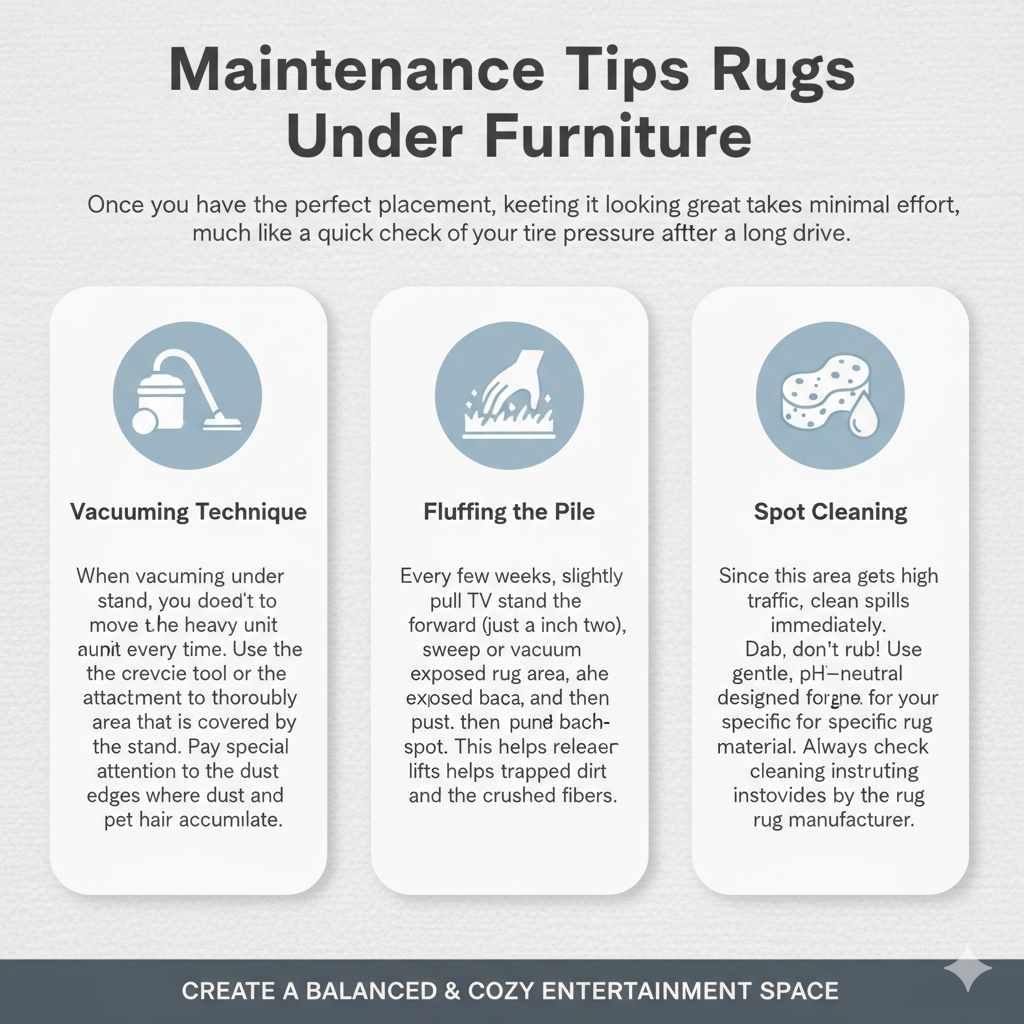
Maintenance Tips for Rugs Under Furniture
Once you have the perfect placement, keeping it looking great takes minimal effort, much like a quick check of your tire pressure after a long drive.
Here’s how to keep that TV area looking sharp:
- Vacuuming Technique: When vacuuming under the stand, you don’t need to move the heavy unit every time. Use the crevice tool or the hose attachment to thoroughly clean the area that is covered by the stand. Pay special attention to the edges where dust and pet hair accumulate.
- Fluffing the Pile: Every few weeks, slightly pull the TV stand forward (just an inch or two), sweep or vacuum the exposed rug area, and then push the stand back into its spot. This helps release trapped dirt and lifts the crushed fibers.
- Spot Cleaning: Since this area gets high traffic, clean spills immediately. Dab, don’t rub! Use a gentle, pH-neutral cleaner designed for your specific rug material. Always check the cleaning instructions provided by the rug manufacturer.
Frequently Asked Questions (FAQ) for Beginner Decorators
Q1: Does the rug need to be centered perfectly under the TV?
Not necessarily. It’s more important that the rug is centered under your main seating arrangement (like the sofa). Since the TV is usually centered above the sofa, the rug often ends up centered on both, but prioritize the seating alignment for the best traffic flow and visual comfort.
Q2: What if my TV stand is really long and hangs over the rug edges?
If the stand is much wider than the rug, try to ensure at least the front half (or the front legs) of the stand are on the rug. If the entire stand cannot fit, centering the stand on the rug is better than having the rug centered under the TV screen but having the stand sit awkwardly off to one side.
Q3: Should I worry about the rug making the TV stand wobble?
A thin, slippery rug can cause wobble. This is why using a non-slip, high-quality rug pad underneath is essential. The pad grips the floor and stabilizes the rug, providing a solid base for the stand.
Q4: Is it okay for the rug to touch the wall behind the TV stand?
Yes, if you have a very small room, the rug might run right up to the wall. However, try to leave at least 2 to 3 inches of space between the rug and the baseboard/wall if possible. This prevents moisture buildup and makes vacuuming easier.
Q5: How far should the rug extend past the front of the sofa?
Aim for at least 6 to 8 inches of the rug to extend past the front edge of your sofa. This ensures that when someone sits down, their feet are resting on the rug, not the bare floor, which makes the seating area feel complete.
Q6: Should I use a different rug if my TV is wall-mounted versus on a stand?
The guiding principle remains the same: anchor the seating area. If the TV is mounted with no stand, place the rug to align with the sofa and coffee table. Ensure the rug extends at least 6 inches under the bottom of the wall-mounted area (or under a small floating shelf) to maintain that anchored feeling.
Conclusion: Anchor Your Entertainment Zone with Confidence
Figuring out rug placement can feel technical, but remember, it’s all about creating defined zones that feel comfortable and look intentional. For your TV stand setup, the clear answer is to have the rug go under* the stand. This simple act of overlapping anchors the visual weight of your electronics and connects them seamlessly with your primary seating.
Take the time to measure twice, choose a rug large enough for the entire viewing grouping, and always use a quality rug pad underneath for safety and floor protection. By following these straightforward guidelines, you’ve mastered a key element of interior design. Now go enjoy your perfectly laid out, stable, and stylish living room—no mechanic’s manual required!