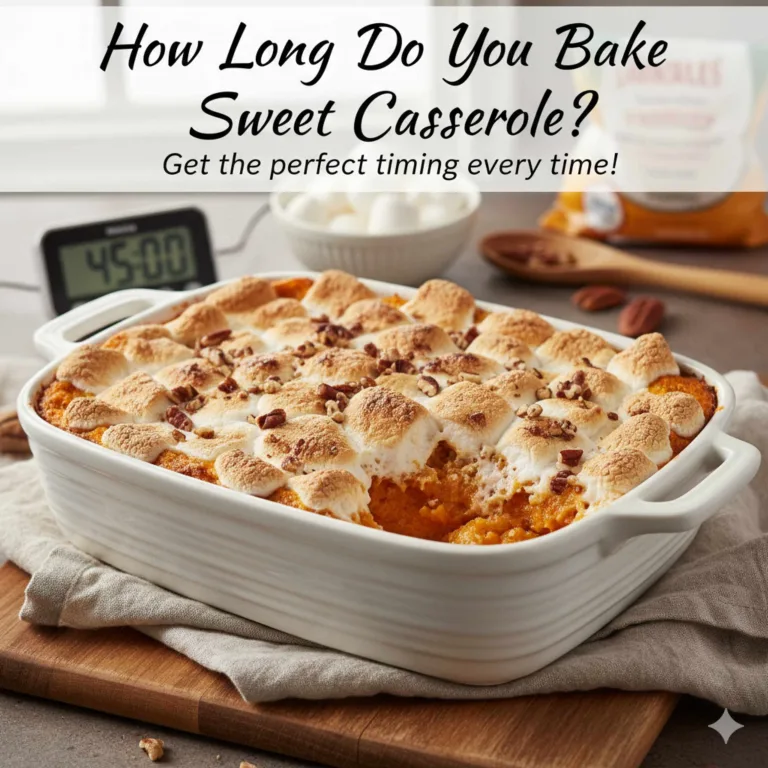
Sweet Potato Casserole Baking Time: The Science-Based Guide to Perfect Doneness
You’ve assembled the casserole, the topping is ready, and now you’re staring at the oven with a single question: how long does this actually bake? Most recipes say something vague like “35–40 minutes” and leave you guessing. That gap between undercooked and burnt is where a good holiday side dish goes to die.
This guide gives you the exact sweet potato casserole baking time for every common dish size, the internal temperature that guarantees doneness, and the specific adjustments for marshmallow vs. pecan toppings. You’ll also learn how to handle make-ahead prep, frozen casseroles, and the common problems like watery filling or burnt marshmallows. No more guesswork.

DOWAN
DOWAN Casserole Dish, 9x13 Ceramic Baking Dish,…
- Meet Your Daily Needs: DOWAN larger and deeper ceramic baking dish measures 15.6"L x 9.3"W x 3.1" H (including handle size)-135 OZ…
- Durable and Safe: Made from lead-free and pro-grade ceramic, this 4.2 quarts extra-large casserole dish is designed for safe use a…
- Easy to Hold: With its double-handled design, the 9x13 rectangular baking dish is easy to carry from the oven or freezer to the ta…
As an Amazon Associate I earn from qualifying purchases.
A good baking dish makes timing easier. The DOWAN ceramic casserole dish (9×13, 4.2 quarts) heats evenly and its depth gives you predictable results. Even heat distribution means the edges and center finish at roughly the same time, which is half the battle.
The Exact Sweet Potato Casserole Baking Time (And Why It Varies)
At 350°F, a standard 9×13-inch casserole with pre-cooked sweet potatoes takes 25–35 minutes if uncovered, or 35–45 minutes if covered with foil for part of the bake. That’s the honest range. The variation comes from three things: dish depth, starting temperature of the filling, and whether you’re using fresh chunks or leftover mashed sweet potatoes.
Dish depth matters more than most people think. A shallow 8×8 dish holds less volume per square inch, so it heats through faster. A deep 2-quart casserole dish has more mass to warm, which adds up to 15 minutes to the total bake. The science is simple: heat penetrates from the surface inward, so a thinner layer reaches the target temperature sooner.
Starting temperature shifts the clock too. A casserole assembled with room-temperature sweet potato mash (around 70°F) bakes faster than one pulled straight from the fridge at 38°F. The fridge-cold version needs roughly 10 extra minutes to compensate for that 30-degree difference.
Here’s the breakdown for a 9×13 dish at 350°F:
- Fresh, warm mashed sweet potatoes: 25–30 minutes
- Room-temperature mash from the fridge (rested 30 min): 30–35 minutes
- Cold mash straight from the fridge: 35–40 minutes
- Frozen casserole (thawed overnight first): 40–45 minutes
These times assume the filling is already cooked. If you’re using raw sweet potato chunks instead of pre-cooked mash, you’re looking at 50–60 minutes, and you’ll need to test the chunks with a fork before the topping goes on.
The Golden Temperature: Why 350°F Wins Every Time
350°F is the standard for a reason. It’s hot enough to caramelize the sugars in the sweet potato and crisp a pecan streusel, but gentle enough that it won’t scorch a marshmallow topping before the center heats through. At 375°F or higher, you risk burnt edges and a cold middle. At 325°F, the bake time stretches out and the topping can turn soggy.
Convection ovens are the exception. A convection oven uses a fan to circulate hot air, which speeds up cooking by roughly 25%. If your oven has a convection setting, drop the temperature to 325°F and start checking for doneness at 20 minutes for a 9×13 dish. Watch it closely — convection ovens are aggressive and will brown the topping faster than a conventional oven.
One thing most recipes don’t mention: humidity. On a rainy day, the air is more humid and the sweet potato filling holds onto moisture longer. This can add 5–7 minutes to the bake. High altitude (above 3,500 feet) has the opposite effect — water boils at a lower temperature, so the casserole may dry out faster and finish 5 minutes earlier. Keep an eye on it and trust the internal temperature, not just the clock.
How to Know It’s Done: Visual Cues, Toothpick Test, and Internal Temp
The clock is a starting point, not the final word. You need to verify doneness, and there are three reliable ways to do it.
The Toothpick Test
Insert a toothpick into the center of the casserole, about 1 inch deep. It should come out clean, with no raw sweet potato clinging to it. If you feel resistance, the filling isn’t done. This test works best for casseroles made with mashed sweet potatoes — the toothpick should slide in and out with almost no friction.
Visual Cues
Look at the edges first. The filling should be bubbling gently around the sides, which means the liquid is hot enough to steam and thicken. The top should be golden brown — a light caramel color for pecan streusel, or a toasted tan for marshmallows. If the edges are bubbling but the center looks flat and still, give it another 5–7 minutes.
Internal Temperature (The Most Reliable Method)
Use an instant-read thermometer. Insert it into the center of the casserole, avoiding the topping. The filling should read between 165°F and 180°F. Below 165°F, the casserole is not fully heated through. Above 180°F, it’s at risk of drying out. This range is your safety net — it removes all guesswork, regardless of dish size, oven calibration, or altitude.
If you don’t have a thermometer, the toothpick test plus visual browning is sufficient. But a thermometer costs less than a ruined holiday dish, and it’s the only way to be certain.
Baking Time by Dish Size and Depth (8×8 vs. 9×13 vs. Ramekins)
Dish size changes the baking time because it changes the depth of the filling. Here’s the rule of thumb: every extra inch of depth adds roughly 10 minutes to the bake. A 9×13 dish holds about 3 quarts of filling at a depth of 1.5–2 inches. An 8×8 dish holds the same volume but at a greater depth, so it takes longer.
Let’s break it down by dish size at 350°F, using room-temperature pre-cooked mash:
- 8×8-inch dish (2 quarts): 30–35 minutes. Deeper filling means slower heat penetration.
- 9×13-inch dish (3 quarts): 25–30 minutes. Shallow and wide — the fastest option.
- 2-quart round casserole dish: 35–40 minutes. Similar volume to an 8×8 but round edges change the heat distribution.
- Individual ramekins (6-ounce): 18–22 minutes. Small portions heat quickly, but they also cool fast at the table.
The shallow dish advantage is real. A 9×13 dish spreads the filling thin, so the surface area is large relative to the volume. That’s why it finishes up to 15 minutes faster than a deep 2-quart dish with the same amount of filling. If you’re short on time, use the wider dish.
For a 2-quart casserole dish, expect the longer end of the range. The extra depth protects the topping from burning, but it also means the center takes longer to reach 165°F. Check at 30 minutes, then every 5 minutes after.
How Your Topping Changes the Bake Time (Marshmallow vs. Pecan Streusel)
Your topping isn’t just decoration — it changes how the casserole bakes.
Pecan Streusel
A pecan streusel (butter, brown sugar, flour, and pecans) acts as an insulator. It creates a barrier that slows heat transfer to the filling below. This means you can bake the casserole uncovered the entire time without worrying about the topping burning. The streusel needs 25–30 minutes at 350°F to crisp up and turn golden brown. The filling underneath will be done at the same time, assuming it started warm.

Marshmallow Topping
Marshmallows are a different beast. They melt and brown quickly — too quickly. If you put marshmallows on before the casserole goes in the oven, they’ll be a burnt, gooey mess by the time the filling reaches 165°F. The solution is to bake the casserole uncovered for the full time (or until the filling is nearly done), then add the marshmallows and bake for another 8–12 minutes, watching closely. The marshmallows should puff up and turn golden brown, not black.
Here’s the timing for a 9×13 dish at 350°F:
- Pecan streusel on top from the start: 25–30 minutes total.
- Marshmallows added at the start: Not recommended — they’ll burn. Use the two-stage method below.
- Two-stage marshmallow method: Bake filling 20–25 minutes, add marshmallows, bake 8–12 minutes more. Total: 28–37 minutes.
The two-stage method is the only way to get puffy, golden marshmallows without a burnt exterior. It adds a few minutes of hands-on time, but the result is worth it.
Make-Ahead, Fridge, and Frozen Casserole Baking Adjustments
Sweet potato casserole is a great make-ahead dish, but the baking time changes based on how you store it.
Assembled and Refrigerated (Unbaked)
If you assemble the casserole a day ahead and refrigerate it, add 10–15 minutes to the bake time. The cold filling needs extra time to come up to temperature. Bake at 350°F, covered with foil for the first 20 minutes to prevent the topping from over-browning, then uncover and bake until the internal temperature hits 165°F. Total time: 40–50 minutes for a 9×13 dish.
Fully Baked and Refrigerated
If the casserole is already baked and you’re reheating it, use a lower temperature to avoid drying it out. Cover with foil and reheat at 325°F for 20–25 minutes, or until the internal temperature reaches 165°F. Remove the foil for the last 5 minutes if you want to re-crisp the topping.
Frozen Casserole
Frozen casseroles take the longest. The safe method is to thaw in the refrigerator overnight (24 hours), then bake as if it were a refrigerated casserole. If you bake from frozen, expect 60–75 minutes at 350°F, and cover with foil for the first 45 minutes. Check the internal temperature in the center — it’s the only reliable way to know if the middle is done.
The biggest mistake people make is baking a frozen casserole uncovered. The top burns while the center stays cold. Foil is your friend for the first portion of the bake.
Troubleshooting: Watery Filling, Burnt Topping, and Cold Centers
Three problems ruin more sweet potato casseroles than anything else. Here’s how to fix each one.
Watery Filling
A watery casserole usually means the sweet potatoes weren’t drained properly before mashing. If you boil your sweet potatoes, drain them thoroughly and let them steam dry for 5 minutes before mashing. If you roast them, the problem is less common. To fix a watery casserole mid-bake, leave it uncovered for the last 10 minutes and let the excess moisture evaporate. You can also add a tablespoon of flour or cornstarch to the mash before baking to absorb extra liquid.
Burnt Topping
Burnt marshmallows or a dark streusel mean the topping went on too early or the oven was too hot. For marshmallows, use the two-stage method. For streusel, if it’s browning too fast, tent a piece of foil loosely over the top (don’t seal it) for the last 10 minutes. That blocks direct heat while letting steam escape.
Cold Center
A cold center with hot edges is a classic sign of a too-deep dish or a too-hot oven. Drop the temperature to 325°F and give it more time. Or, transfer the filling to a wider, shallower dish — the shallow dish approach reduces baking time by up to 15 minutes because heat doesn’t have to penetrate as far. Always test the center, not the edges.
Quick Reference Baking Time Chart
Here’s the chart you’ll want to save. All times assume pre-cooked sweet potato filling and a conventional oven at 350°F.
| Dish Size | Filling Temp | Topping | Total Bake Time |
|---|---|---|---|
| 8×8-inch (2 qt) | Room temp | Pecan streusel | 30–35 min |
| 8×8-inch (2 qt) | Cold from fridge | Pecan streusel | 40–45 min |
| 9×13-inch (3 qt) | Room temp | Pecan streusel | 25–30 min |
| 9×13-inch (3 qt) | Cold from fridge | Pecan streusel | 35–40 min |
| 9×13-inch (3 qt) | Room temp | Marshmallows (added at 20 min) | 28–32 min |
| 2-quart round | Room temp | Pecan streusel | 35–40 min |
| Individual ramekins (6 oz) | Room temp | Pecan streusel | 18–22 min |
| Frozen (thawed overnight) | Cold | Any (cover with foil first) | 40–50 min |
Remember: these times are starting points. The internal temperature of 165°F–180°F is the final word. When in doubt, take the casserole out, insert a thermometer, and check.
Frequently Asked Questions
Can I use leftover mashed sweet potatoes instead of fresh?
Yes, and it saves time. Leftover mashed sweet potatoes are already cooked, so you can skip the pre-cooking step entirely. Assemble the casserole and bake at 350°F for 25–30 minutes in a 9×13 dish. The only caveat is that leftover mash may be drier or more seasoned than fresh, so taste it first and adjust the butter or sugar in the recipe.
What if my casserole is still cold in the middle after the recommended time?
That happens when the dish is deeper than expected or the filling was colder than room temperature. Put it back in the oven, covered with foil, and bake another 10–15 minutes. Check the internal temperature in the center. If it’s still cold after 20 extra minutes, your oven might be running cool — verify with an oven thermometer.
Can I bake sweet potato casserole at 400°F to speed it up?
You can, but you’ll risk a burnt topping and a raw center. At 400°F, the top browns before the interior reaches 165°F. If you’re in a rush, use a wider, shallower dish rather than raising the temperature. That’s the safer way to cut baking time.
Does the baking time change if I use raw sweet potato chunks?
Yes, dramatically. Raw chunks need 50–60 minutes at 350°F to soften. You’ll need to check the chunks with a fork before adding the topping. For a faster result, par-cook the chunks for 10 minutes in boiling water before assembling the casserole.
How do I reheat a fully baked casserole without drying it out?
Cover it with foil and reheat at 325°F for 20–25 minutes. The foil traps steam and keeps the filling moist. Remove the foil for the last 5 minutes if you want to re-crisp the topping. Avoid the microwave — it turns the topping rubbery and the filling watery.
What to Remember Next Time You Bake
- Bake at 350°F — it’s the sweet spot for even cooking and browning.
- Use a 9×13 dish for the fastest bake; a deeper dish adds up to 15 minutes.
- Always check the center with a thermometer — 165°F to 180°F means done.
- Add marshmallows in the last 10 minutes to prevent burning; pecan streusel can go on from the start.
- Cold filling from the fridge adds 10–15 minutes; frozen casseroles need 60+ minutes unless thawed first.
- Cover with foil if the topping browns too fast or the center is lagging.
- Trust the internal temperature over the clock, every time.
Products related to this article
Sponsored / affiliate links. As an Amazon Associate I earn from qualifying purchases. I may earn additional commission from eligible campaigns.
 Christmas Tree Forest Ornament Round Ceramic Ornament Star Snowflake Xmas Keepsake for Christmas Tree Winter Holiday Xmas Gift for Women Men Xmas Hanging Ornament 3"
 Orepzinc 4 Pcs Mattress Retainer Bar, Metal Mattress Slide Stopper, Non Slip Mattresses Holder in Place Gripper, Thicken Bed Frame Gaskets to Prevent Sliding, Stabilizer Baffle for Bedroom Bed Frame