
Generally, bake sweet potato casserole for 25 to 35 minutes at 375°F (190°C) until it is warm throughout and the topping is golden brown. Always check with a knife or thermometer for doneness, as exact times vary based on your dish size and oven calibration.
So, you’ve mashed the sweet potatoes, mixed in the butter and spice, and now the big question looms: How long does this creamy dream need in the oven? It’s a common kitchen challenge, especially when trying to nail the timing around a big holiday meal. Over-bake it, and it gets dry; under-bake it, and it’s cold in the middle. Don’t worry! Getting that perfect, bubbling, golden-brown casserole is simpler than you think. Think of me, Dustin, as your guide to the perfect bake time and temperature. We’ll break down the key factors and give you foolproof checks so your casserole comes out just right, every single time. Let’s get cooking!
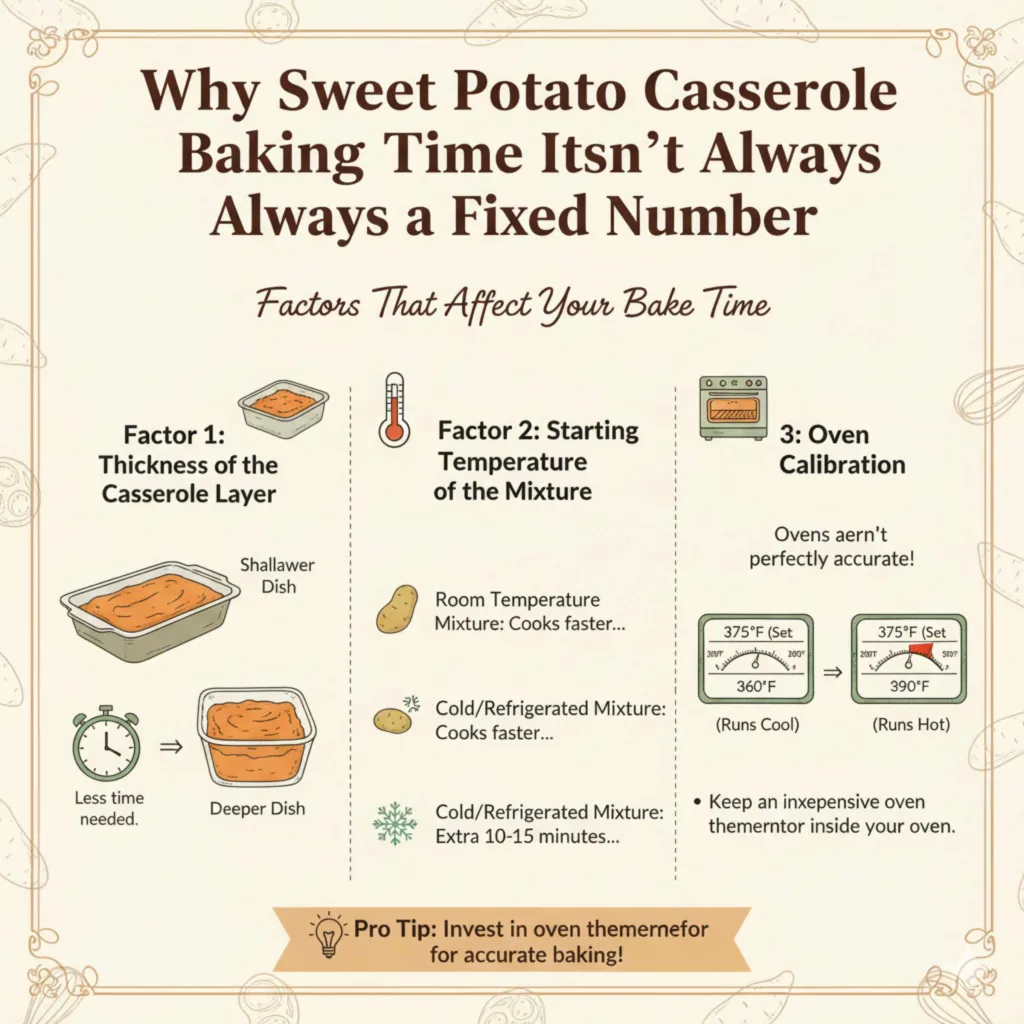
Why Sweet Potato Casserole Baking Time Isn’t Always a Fixed Number
When you’re looking up recipes, you might see times ranging from 20 minutes all the way up to an hour. Why the big difference? Baking isn’t like draining your car’s oil—it involves variables! Getting the timing right means understanding what affects the heat transfer in your oven and dish.
Factor 1: Thickness of the Casserole Layer
If you spread your sweet potato mixture thinly in a large rectangular pan, it cooks faster. If you use a small, deep square dish, the heat has a longer journey to the center.
Shallower Dish: Less time needed.
Deeper Dish: More time needed for the center to heat up evenly.
Factor 2: Starting Temperature of the Mixture
Did you just let the cooked potatoes cool on the counter for an hour, or did you mix them and put the dish straight into a preheated oven?
Room Temperature Mixture: Cooks faster, closer to the recipe’s suggested time.
Cold/Refrigerated Mixture: Will require an extra 10 to 15 minutes of bake time to reach serving warmth internally.
Factor 3: Oven Calibration (The Hidden Variable)
Just like car engines run slightly differently, ovens aren’t perfectly accurate. A recipe might call for 375°F, but your oven might be running at 360°F or 390°F. If your oven runs cool, you need more time. This is a great reason why keeping an inexpensive oven thermometer inside your actual oven is a smart move, similar to checking your tire pressure regularly. For reliable resources on home appliance accuracy, organizations like the National Institute of Standards and Technology (NIST) provide great background on measurement consistency.
The Golden Rule: Standard Baking Times for Sweet Potato Casserole
For most standard 9×13 inch baking dishes filled to a depth of about 1.5 to 2 inches, here is the baseline you should aim for.
Standard Temperature Setting
Most sweet potato casseroles bake best at a moderate temperature. This allows the dairy and eggs (if used) to set gently without scorching the bottom or the topping.
Recommended Temperature: 375°F (190°C)
Baking Time Breakdown
We divide the bake time based on what kind of topping you are using, as the topping often dictates when you finish the bake.
Table 1: General Sweet Potato Casserole Baking Guidelines (375°F / 190°C)
| Casserole Style | Estimated Bake Time | Primary Indicator of Doneness |
| :— | :— | :— |
| Basic Marshmallow Topping | 25 – 30 minutes | Marshmallows are puffed and golden |
| Pecan/Streusel Topping | 30 – 35 minutes | Topping is deeply browned/crisp |
| Uncovered/Plain Sweet Potato Bake | 35 – 45 minutes | Center registers 165°F (74°C) |
Step-by-Step Guide: How to Bake Sweet Potato Casserole Perfectly
Follow these simple steps. We are aiming for thorough heating and a beautiful finish. Don’t rush the preheating—that’s the engine warming up!
Step 1: Prepare and Preheat (The Crucial Start)
Safety and success start here. Make sure your equipment is ready.
1. Check Your Dish: Ensure your baking dish is oven-safe. If you are using a glass dish, know that glass heats slower than metal, requiring a few extra minutes or slightly lower temperature later on.
2. Preheat Thoroughly: Set your oven to 375°F (190°C). Allow the oven 15 to 20 minutes to fully preheat. A properly preheated oven ensures even heating from the moment the dish goes in.
3. Prepare the Casserole: Mix your sweet potato base completely. Pour it into your prepared baking dish (greased or lined). Smooth the top gently.
Step 2: Initial Bake (Heating Through)
This phase focuses on heating that dense potato mixture all the way to the middle.
1. Place the Dish: Carefully place the sweet potato mixture into the preheated oven. Keep it on the center rack for the most balanced heat exposure, just like aligning your wheels for even tire wear.
2. Set Initial Timer: Set your timer for 15 minutes less than the recipe suggests (e.g., if the recipe says 35 minutes, set it for 20). This prevents you from missing the critical moment when the topping needs attention.
Step 3: Adding the Topping (The Finishing Touch)
This is where we separate the good from the great—the topping application timing is key.
1. Check for Warmth: After the initial bake time, check the casserole. It should be starting to warm around the edges.
2. Apply Topping (If applicable): If your recipe calls for marshmallows or a streusel topping to be added afterthe initial bake, now is the time.
3. Return to Oven: Place the casserole back in the oven. Reduce the temperature slightly to 350°F (175°C) if you are using marshmallows, as they burn quickly.
Step 4: Final Check and Doneness Testing
This is the moment you confirm everything is cooked safely and tastes perfect. Remember, for food safety, items containing eggs or dairy should reach an internal temperature of at least 160°F.
Here are the best ways to test for completion:
Visual Cue (Most Common): The topping is golden brown, slightly crisp, and the edges of the casserole are gently bubbling.
The Skewer/Knife Test: Insert a thin, sharp knife or wooden skewer into the center of the casserole. If it slides in easily with very little resistance, it is likely done. If you feel firm resistance, it needs more time.
Internal Temperature Check (Most Reliable): Use an instant-read food thermometer inserted into the center. The target internal temperature is 160°F (71°C). If it reads lower, give it another 5 minutes and retest.
Understanding Topping Variations and Their Bake Times
The topping choice significantly impacts those crucial last 10 minutes of baking. You must monitor the topping closely to prevent burning.
Marshmallow Topping Time Management
Marshmallows are delicate. They go from perfectly golden to scorched in about 60 seconds flat!
1. Bake Base: Bake the sweet potato base (without marshmallows) for approximately 20-25 minutes at 375°F.
2. Add Marshmallows: Sprinkle the marshmallows evenly over the top.
3. Switch to Broil (Use Extreme Caution): For a quick, perfect toast, you can switch your oven to the broil setting for 1 to 3 minutes MAX. Watch it constantly! Keep the rack positioned in the upper-middle slot, far away from the heating element. If you don’t trust your broiler, simply keep the temperature at 350°F and bake until golden (about 5-8 minutes).
Pecan Streusel Topping Considerations
A classic streusel topping usually contains flour, butter, brown sugar, and pecans. This topping needs more time to crisp up and toast the nuts.
Coverage is Key: Ensure the streusel covers the entire surface evenly.
Baking: If the potatoes are already heated through (after about 25 minutes), the streusel needs another 10-15 minutes at 375°F to achieve that nutty crunch without drying out the potatoes underneath.
Troubleshooting Common Baking Issues for Casseroles
Even when following directions, things can go wrong. Here’s how to fix the three most common hiccups when baking this dish.
Problem 1: The Edges Are Browning Too Fast!
This usually happens because the edges of the dish are closer to the heating elements inside the oven.
The Fix (The Foil Shield): Take a piece of aluminum foil, fold it loosely into a strip, and gently lay it over the edges of the hot casserole dish. This shields the perimeter, allowing the cooler center to catch up without burning the outside.
Problem 2: The Casserole is Too Runny in the Middle
This means the internal temperature has not reached the point where the starches and liquids have fully set.
The Fix (Give It Space): If you are baking several dishes at once, the heat might be blocked. Remove other items from the oven. If the issue persists after 10 more minutes, you might need to increase the temperature slightly (to 400°F) for a final 5-7 minutes to encourage setting, but watch it every single minute to avoid over-browning.
Problem 3: The Topping Burned Before the Potatoes Were Done
This is the classic marshmallow disaster or the streusel that turned black too soon.
The Fix (Temporary Removal): Carefully remove the entire dish from the oven. Scrape off the burned topping layer gently with a spatula. Gently cover the exposed sweet potatoes loosely with foil. Return it to the oven at a lower temperature (350°F) until the center is hot. You might need to skip the topping entirely for that specific batch or add a fresh batch of marshmallows only for the last few minutes.
Key Equipment for Perfect Baking Results
Having the right tools makes the job much easier and more accurate, just like using the correct wrench size prevents stripping a bolt head.
- Instant-Read Thermometer: This is your best friend for safety and doneness confirmation. It eliminates guesswork immediately.
- 9×13 Inch Baking Dish (or similar size): Consistency in your vessel size equals consistency in your bake time. Stick to one size until you know how it performs.
- Mixing Bowls and Spatula: For thoroughly blending the ingredients until smooth.
- Measuring Cups and Spoons: Accuracy matters, even in baking.
- Oven Mitts: Always prioritize safety when moving hot items!
Using high-quality, consistent equipment helps ensure that when you measure 35 minutes, it truly equals 35 minutes of cooking time.
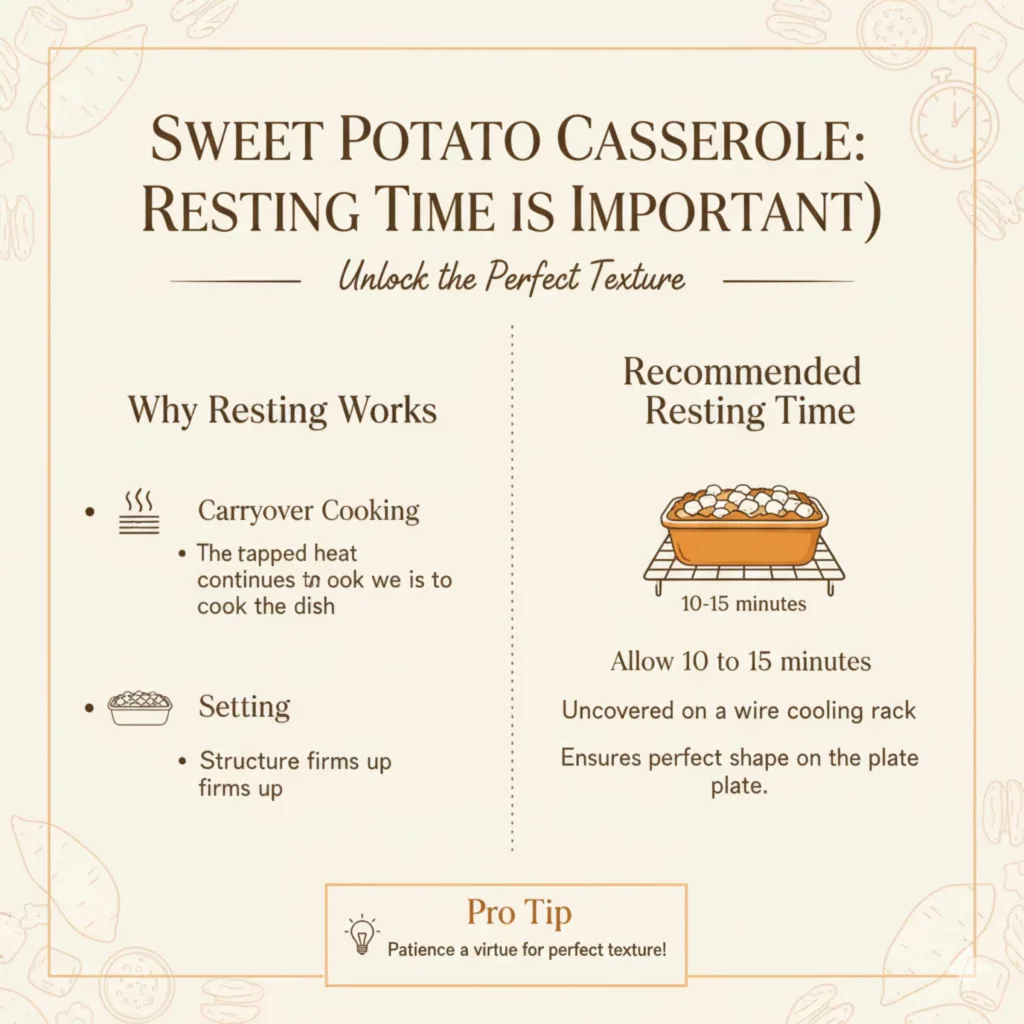
Sweet Potato Casserole: Resting Time is Important (Don’t Skip This!)
Once you pull that beautiful casserole out of the oven, resist the urge to serve immediately! This pause is vital, especially for dense, starchy dishes.
Why Resting Works
1. Carryover Cooking: The heat trapped inside the dish continues to cook the casserole for several minutes after it leaves the oven. What registers at 160°F might climb to 165°F or 170°F during the rest.
2. Setting: Resting allows the starches and structure to firm up slightly. If you serve it scalding hot, it might slump or fall apart when scooped.
Recommended Resting Time
Allow the sweet potato casserole to rest, uncovered, on a wire cooling rack for 10 to 15 minutes before scooping and serving. This ensures it holds its shape beautifully on the plate.
FAQ: Beginner Questions About Sweet Potato Casserole Baking
Here are some quick, straightforward answers for common beginner questions that pop up when baking this dish.
Q1: Can I bake sweet potato casserole completely covered with foil?
A: If you cover it completely with foil, especially during the first part of the bake, it will steam rather than bake. This prevents the topping from browning. Only cover it with foil if the topping is burning before the center is warm, or if you are completely reheating a pre-made casserole.
Q2: What if I am using frozen sweet potatoes instead of fresh cooked ones?
A: If you are using thawed, pureed frozen sweet potatoes, you will need to add extra time, often 5 to 10 minutes longer, because the mixture starts colder than room temperature potatoes. Make sure there is no lingering ice or excess liquid.
Q3: Is 350°F better than 375°F for baking?
A: 375°F is generally preferred because it heats the casserole faster, reducing the overall time the starches are exposed to heat, which helps keep the texture creamy. However, if you have a very delicate topping (like meringue or thin marshmallows), using 350°F for a slightly longer time (40–45 minutes) can prevent scorching.
Q4: How do I know if I over-baked it?
A: The main sign of an over-baked casserole is a dry, dense texture, often with visible cracks on the surface of the potato base (not just the topping). If the center temperature registered above 180°F, it is likely too dry.
Q5: Do I have* to use the center rack in the oven?
A: For most casseroles, yes, the center rack provides the most balanced exposure to heat from all sides. If you are only baking one item and your oven heats evenly, you can move it up slightly if you need the topping to brown faster, but the center rack remains the safest bet for new bakers.
Q6: If I make the casserole ahead of time, should I add the topping before chilling?
A: It is best practice to bake the sweet potato base first and chill it. Add perishable toppings like marshmallows or pecan streusel right before the final bake time. This ensures the topping is fresh, crisp, and hasn’t seeped moisture into the potatoes overnight.
Summary of Essential Timings and Temperatures
To make this information easily accessible for your next cooking project, here is a quick cheat sheet focusing on the most common scenario: a standard casserole baked at 375°F.
Table 2: Quick Reference Baking Checklist
| Action | Temperature | Time Estimate | Doneness Check |
| :— | :— | :— | :— |
| Preheat Oven | 375°F (190°C) | Done when stable | Oven Thermometer Check |
| Initial Bake (Base Only) | 375°F (190°C) | 20 – 25 minutes | Edges starting to bubble |
| Add Topping & Final Bake | 350°F (175°C) or Broil | 5 – 15 minutes | Topping golden, center 160°F |
| Resting Time | Off Heat | 10 – 15 minutes | To allow structure to set |
Conclusion: Achieving Casserole Perfection
Baking sweet potato casserole successfully is all about teamwork: the right temperature working with the right amount of time, and finally, checking for the proper internal indicators. We learned that while 25 to 35 minutes at 375°F is a fantastic starting point, you should never rely on the clock alone. Use the visual cues—the bubbling edges and the golden-brown topping—and, most importantly, confirm that internal target temperature of 160°F with a thermometer right before you pull it out. By respecting the thickness of your dish and giving it that crucial 10-minute rest, you build confidence in the kitchen. Next time you pull that beautiful, steaming dish from the oven, you’ll know exactly how you achieved perfection, and you can focus on enjoying the meal!